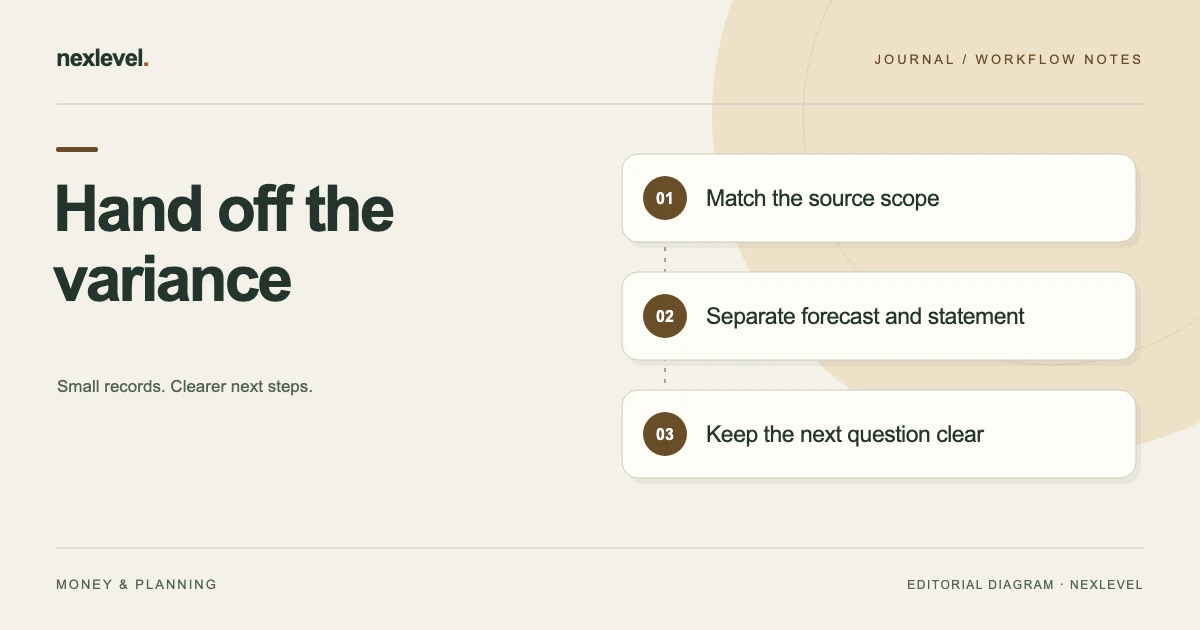
A commission variance handoff should identify the expected calculation, statement source and scope before presenting a difference. Give the next authorized reviewer a neutral source question, an explicit sign convention and the evidence needed to reconstruct the comparison.
Give the next reviewer a reproducible comparison
- Name the selected deal, plan version, period, currency and reviewer’s task.
- Establish whether the statement and forecast actually cover the same scope.
- Preserve both amounts and label the comparison convention.
- Inspect the chosen evidence pack and assign the exact unresolved question.
Working fields:
Deal/plan | Forecast source | Statement/period | Scope established? | Variance direction/result | Evidence route | Question | Next reviewer
Useful next steps: Distinguish the amount sources, Review what an issue resolution establishes, Retain the comparison with historical context.
Define the receiving reviewer’s task
Checking arithmetic is different from interpreting an employer plan or reconciling a selected statement. Name the actual question before preparing a large evidence export.
Identify the deal alias, entered plan version, expected period, statement source, and source cutoff. A broader statement total should not silently become the payment amount for one selected deal.
PayoutVerity’s current listing applies user-entered rules and values. Employer plan documents and statements control actual payment. A local comparison helps organize the question rather than decide its legal or payroll meaning.
Use a variance-handoff worksheet
Suggested fields are deal reference, selected plan version, expected calculation source, expected period, statement reference, statement scope, comparison convention, difference, evidence route, open question, and next reviewer.
| Source role | What to preserve |
|---|---|
| Forecast | Entered values and rule context |
| Statement | Actual selected amount and scope |
| Variance | The stated subtraction convention |
| Issue | Question remaining after the comparison |
These are proposed companion fields, not a claim that the app has automatic employer communication or a shared payroll workflow.
Keep private deal and statement information appropriate to the authorized recipient. A deal alias and relevant source route may be sufficient for the selected task.
Match scope before subtracting
Establish that the expected and statement amounts concern the same selected deal set and period under the actual source. Similar totals do not establish that relationship.
If the statement covers several deals while the expected value covers one, retain a scope question rather than calculating a confident deal-level variance from unmatched sources.
Likewise, an expected payout date is an entered planning source. It is not independent proof of when an employer must pay or what a statement period includes. Use the actual relevant documents and responsible process.
Work through a fictional difference
Imagine deal D22, expected amount 960 in one fictional currency, and a selected statement amount of 900. For this exercise only, assume the source scope has been established as comparable.
The independent worksheet defines variance as statement minus expected. Under that convention, 900 minus 960 equals negative 60.
The negative value describes the stated arithmetic. It does not by itself establish an employer error, underpayment entitlement, tax treatment, or an amount owed. The actual source rules and responsible review determine the meaning.
Do not assume the app uses this exact sign convention internally. Keep the independent worksheet’s convention explicit and inspect the actual display before describing it.
Preserve the expected calculation
The current product description includes credited share, rate, tiers, accelerators, caps, clawbacks, plan version, and expected totals in a readable trail. Identify which selected inputs support D22’s expected amount.
Do not replace the forecast with the statement merely to remove the difference. The comparison needs both source roles to remain understandable.
For changed forecast assumptions, use the separate plan-input review guide. A revised estimate and a statement reconciliation are related but distinct tasks.
Keep plan versions attached to the right calculation
PayoutVerity’s current listing says new plan terms create a new version without rewriting closed deals. Preserve the selected historical context rather than using whichever plan is newest.
If applicability remains unclear, retain that source question. This article does not interpret when an employer’s revised terms apply.
The packet should identify the actual plan source the reviewer needs and which calculation the record uses. A version label is useful only when its relationship to the selected deal is clear.
Inspect statement evidence rather than its filename
Open the actual source through the authorized business process. A statement filename can help locate evidence without establishing its amount, period, or selected deal scope.
The current app description includes supporting attachments and plan-dependent evidence exports. Check actual access and the selected source rather than assuming every plan or copy contains identical material.
If source content is unavailable, say so. A metadata reference may remain useful without supporting a claim that the statement was inspected in this review.
Write a neutral next question
A useful question is “Which source explains the selected negative-60 comparison under the stated scope?” That gives the receiving reviewer a bounded task without presuming an error or remedy.
Possible source questions include period alignment, credited-share basis, selected plan version, or another actually identified input. Do not invent a rule merely because it would reconcile the amount.
For the broader distinction between forecasts and payment records, use the forecast-versus-statement guide. The handoff should preserve the actual outcome or limitation from that check.
Keep issue resolution separate from a new payment
The current listing describes marking issues resolved. A recorded resolution can establish an administrative result without independently proving an additional payment occurred.
Retain the actual source of the resolution and its scope. If it explains the comparison, say what was established. If another question remains, keep it separate rather than using “resolved” as a broad assurance.
This guide does not send a message, submit a claim, or request payment. It explains how the responsible person can keep the source question clear when using their actual review process.
Prepare the actual evidence pack
PayoutVerity’s current Pro description includes focused PDF or CSV evidence exports. Check actual feature access and open the intended output.
Verify deal alias, plan context, selected periods, expected and statement values, variance convention where needed, and remaining limitation. Do not assume every independent worksheet field appears automatically.
A static evidence pack is a prepared copy. It is not a live employer statement, payroll system, or complete editable workspace. Preparing it is separate from recipient delivery.
Correct the appropriate layer
If the working sources are accurate but a cover note calls the difference a confirmed underpayment, repair the cover explanation. Do not alter accurate inputs to match an unsupported conclusion.
If an actual entry error is established, use the supported workflow and inspect the resulting record. Keep the correction’s source occasion clear.
Identify the intended replacement copy through the actual arrangement. A retained file elsewhere does not update automatically when a working note changes.
Test the receiving reviewer’s reconstruction
Ask an authorized reader to identify D22, expected 960, selected statement 900, the stated scope assumption, and the worksheet’s negative-60 result.
They should also identify what the calculation does not decide. If they infer entitlement from the sign alone, improve the source and limitation explanation.
A short handoff receipt can identify sources inspected, actual output checked, question assigned, and next reviewer. Replace generic phrases with the actual result rather than declaring the entire compensation record verified.
Prepare two different scope outcomes for D22
The first fictional outcome is that the source establishes comparability. D22’s expected 960 and selected statement 900 concern the same stated scope. Under the worksheet’s statement-minus-expected convention, the arithmetic is negative 60.
The packet should retain that comparability assumption beside the result. A recipient should not have to infer it from similar amounts or a familiar deal alias. The selected period and plan source still matter.
The second outcome is that the statement covers a broader deal set or another period. In that branch, the packet should retain a scope question rather than present negative 60 as a confirmed deal-level variance.
These are alternatives, not two labels to copy into a completed note. Use the actual source to establish which applies. The presence of a statement file alone cannot choose the outcome.
For either branch, preserve the expected calculation’s actual source. A new statement should not overwrite the entered forecast merely to make the comparison disappear. Both roles help explain what needs review.
The evidence route should be usable by the authorized recipient. A private filename may locate a source for the outgoing person while being inaccessible elsewhere. Identify the appropriate source arrangement without copying unnecessary account or customer information.
A bounded handoff row can therefore identify D22, selected plan context, expected source, statement source, actual scope result, worksheet convention, and next question. It remains useful without alleging an error or promising a remedy.
Keep clarification and resolution evidence distinct
Suppose a later source explains a period difference. That can resolve the selected administrative question while leaving the broader compensation record outside the review. State exactly what was established.
If the source instead establishes an entry mistake, use the supported workflow and inspect the result. Keep the correction distinguishable from a new payment or a new employer plan version.
A note saying “resolved” should point to its actual explanation. It should not imply additional money was received unless a separate source establishes that event and the handoff task requires it.
Open the intended evidence pack after a correction. Check that the selected scope and remaining limitations survive. A changed working note does not automatically update a PDF already retained by another person.
Ask the reader to reproduce the subtraction and explain its units and sign convention. Then ask what source establishes comparability. These are separate tests; correct arithmetic does not validate the employer-rule interpretation.
The actual provider of compensation guidance remains the relevant employer documentation and appropriate responsible process. This guide supplies no payroll rule, tax treatment, legal conclusion, or payment request.
The stopping point is an explanation another authorized person can reconstruct: actual sources, selected scope, stated calculation, established result or limitation, and next reviewer. A precise unresolved question is preferable to a confident label that exceeds the evidence.
Preserve the unit and amount role as well as the deal scope. This fictional example uses one currency and deliberately gives no tax, withholding, fee, or currency-conversion explanation for the negative-60 result. Do not infer one of those explanations merely because it would make the arithmetic reconcile.
A real source may distinguish several amount concepts. Identify the actual wording and responsible context before treating them as comparable. The article does not determine which amount a compensation plan should pay or how a statement should be interpreted under law.
If a later clarification changes the comparison basis, retain that source occasion. The receiving reviewer should be able to tell whether the result changed because of an entry correction, a newly established scope, or another actual source relationship. A generic replacement total would lose that explanation.
Also keep the handoff’s available feature scope visible. PayoutVerity’s current description places evidence exports and expanded scenarios under Pro. A prepared companion summary can explain a question, but it should not be described as a native evidence export unless that actual supported output was produced and inspected. The recipient needs to know which source and copy they are using, not just see a polished label.
Keep a recipient question attached to the selected source rather than a broad allegation. The handoff should help the responsible reviewer locate the comparison and its limitation, with no implication that a message or payment request was sent by preparing the packet.
Use PayoutVerity for a traceable comparison question
PayoutVerity connects entered plans, deal calculations, expected dates, statement comparisons, evidence, and issue notes. Its current Pro description expands plans, scenarios, and evidence output.
Check the official PayoutVerity App Store listing for current features and plan details. Keep the handoff source-aware while leaving actual compensation decisions with employer documents and the appropriate responsible process.