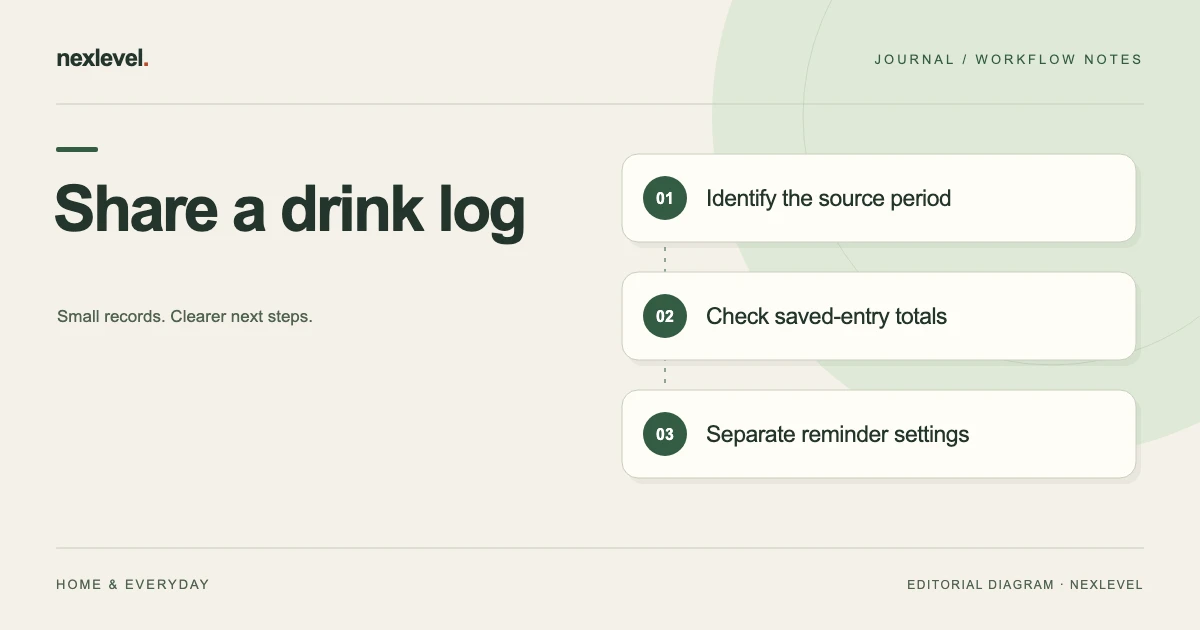
Prepare a drink-log summary by naming the selected period, included saved entries, units and preparation cutoff. Add a brief explanation of gaps or limits and inspect the actual copy before sharing it. Keep reminders and personal settings outside the entry total, and describe the file's actual preparation or sharing stage.
Show which entries and period the summary represents
- Define the recipient's purpose and choose the actual available source period.
- List the saved entries and retain units with each amount and total.
- Inspect the supported output for outside-period rows or settings counted as entries.
- Add the scope and limits to the recipient note, then use the intended sharing arrangement.
Working fields:
Purpose/recipient | Selected period | Included entries | Unit/total | Known gaps | Output/cutoff | Actual sharing stage
Useful next steps: Check the total and its denominator, Retain the entry and reminder context.
Choose the summary’s actual purpose and period
A selected day’s entry list, recent-history overview, and reminder-settings note can serve different tasks. State which one the recipient needs.
Write the selected source period, preparation cutoff, intended reader, output, and precise question. A summary of saved entries should not appear to represent every physical drink or every later correction.
Use fictional references for the exercise. There is no need to disclose real personal history or send a file merely to test the worksheet.
Separate entries, settings, and observations
A saved pour is an entered log event. A configured reminder is a local prompt. A visual trend summarizes selected information under the app’s workflow.
QuenchPop’s current description includes logging, chosen local reminders, saved schedule even when permission is off, recent history, trend/streak views, and Pro CSV output.
The app is an organization tool, not medical advice or an independent measurement of physical consumption. The summary should preserve each source role.
Set up a fictional period summary
Imagine source period D12 with saved entries E1, E2, and E3. Their invented amounts are one hundred, 150, and two hundred milliliters.
The entered sum is 450 milliliters under that stated basis. Reminder R4 and personal setting T5 are separate references and do not add entries.
Retained copy C8 represents the selected cutoff. No real person, actual drink, target, day, permission event, or health state is supplied.
Use an entry-to-summary worksheet
| Fictional reference | Role | What to retain |
|---|---|---|
| D12 | Selected source period | Actual scope and cutoff |
| E1/E2/E3 | Saved entries | Stated amount/unit and source occasions |
| Entered sum | Independent arithmetic | 450 milliliters from the selected entries only |
| R4/T5 | Reminder/personal-setting context | Separate roles, not additional drinks |
| C8 | Retained representation | Actual contents and limitation |
These are independent summary prompts, not exact native CSV headers or a promise that every settings field is included automatically.
Preserve the selected source period
A local date label, saved-entry occasion, selected history window, and export preparation time can describe different roles. Keep their actual meanings readable.
The current app describes a shorter Free history and longer Pro history with CSV export under Pro. Check actual access and records available at preparation.
This guide supplies no time-zone conversion or assumption about every historical grouping behavior. Preserve the precision the actual source establishes.
Keep units beside each amount and total
The fictional calculation is one hundred plus 150 plus two hundred, giving 450 on the stated milliliter basis. It does not independently measure what a person physically consumed.
A number copied without its unit can become ambiguous. If the source is clear while the summary loses a label, repair the summary.
If the original source is uncertain, retain the question rather than choose a convenient amount or conversion to make the total look complete.
Do not count reminders as drinks
R4 is a selected prompt reference. T5 is personal configuration. Neither should enter the E1/E2/E3 arithmetic as an additional drink.
Use the reminder-versus-entry guide for that narrower review. Preserve its actual result or precise limitation.
A completed-looking schedule, target, or streak should not become a new event merely to make the summary appear consistent.
Keep permission and delivery outside the entry total
A saved reminder schedule and notification permission have different roles. A prompt configured or observed should not silently become proof of a saved pour.
For that separate setup task, use the permission-off reminder guide. It does not determine physical consumption.
The summary exercise requires no actual device setting change or notification test. It can be completed from fictional records.
Inspect the actual CSV or retained copy
QuenchPop Pro currently advertises CSV export. Open the selected supported output and inspect source-period meaning, entry references, amounts/units, cutoff, and limitations.
A companion explanation may be needed for context not represented automatically. Do not assume a log export includes every reminder/permission setting.
The public description does not establish arbitrary CSV import or universal restoration of the app/settings. A portable table can support bounded sharing without being the complete editable workspace.
Prepare an independent recipient note
The note can identify the selected period, preparation cutoff, saved-entry scope, unit basis, and what question the summary is intended to support.
It can state the fictional E1/E2/E3 arithmetic and keep R4/T5 separate. A contents line should name only what was prepared.
The note should not claim hydration, medical suitability, physical measurement, or complete behavior history. A readable summary can preserve uncertainty honestly.
Keep preparation and actual sharing distinguishable
A prepared file, chosen destination, delivery, recipient access, and recipient understanding can have different source roles. C8 should preserve what was actually established.
This guide does not authorize sending a real personal file. Its fictional recipient test can be completed locally without contacting anyone.
A file named shared should not automatically become evidence that another person received or interpreted it correctly.
Run a second-reader source test
Give a reader the fictional C8 and recipient note. Ask which period is selected, which entries produce 450, what unit is stated, and which references remain settings rather than drinks.
Introduce another period D13 with similar entries. The reader should use actual source context rather than combine the rows by appearance.
If the working source is accurate but the copied summary is wrong, repair the summary. If the source itself is uncertain, retain the precise question rather than inventing a drink event.
Keep later corrections visibly later
A later entry clarification or source-period change should retain its own occasion and relationship to C8. It should not make the older summary appear to have known later information.
A correction to the recipient note is different from logging another pour or changing a reminder. Keep those purposes distinguishable.
A concise sharing-preparation receipt can name sources inspected, arithmetic checked, representation opened, contents prepared, and precise next question.
Connect sharing to review and retention
For current routine maintenance, use the routine-change review guide. A historical summary is not the current schedule.
For a retained packet, use the entry/reminder archive guide. For method selection, use the reminder-system comparison.
The fictional quantities remain teaching inputs. Reuse the source-period worksheet with actual authorized material while preserving saved-record, device-control, physical-consumption, and medical boundaries.
Prepare a concrete recipient worksheet
An independent recipient worksheet can summarize selected entries without claiming it is the app’s exact CSV schema. Keep the actual supported output available under the authorized arrangement.
| Companion reference | Selected fictional period | Recorded amount | Role |
|---|---|---|---|
| E1 | D12 | 100 milliliters | Saved entry |
| E2 | D12 | 150 milliliters | Saved entry |
| E3 | D12 | 200 milliliters | Saved entry |
| Selected sum | D12 only | 450 milliliters | Independent arithmetic |
| R4/T5 | Separate settings context | No amount added | Reminder/personal configuration |
The table supplies no daily target or physical-consumption measurement. It illustrates how a selected source period and entry roles can remain visible in a prepared copy.
Work through a bounded sharing-preparation case
In one fictional branch, the selected supported source establishes E1/E2/E3 in D12, and the recipient note preserves the unit/cutoff. The reader can reproduce 450 from those entries without inferring every drink a person physically consumed.
In another branch, the copied table accidentally includes a similar D13 entry. Repair the selected-period explanation or copy using the actual source. Do not change correct history merely to make the prepared total agree.
A third branch has R4 counted as another drink. Correct that role assignment. A configured reminder and saved pour are different source events.
A fourth branch has a summary prepared but no actual sharing. Record the strongest event established. A file named shared should not become evidence of recipient delivery or understanding.
Prepare a truthful source-period receipt
Give another authorized reader only the fictional C8 and recipient note. Ask which period is selected, which saved entries produce the sum, what unit is stated, what settings remain separate, and what cutoff applies.
The reader should be able to interpret the summary without a guessed medical target or private routine story. If one source relationship is missing, name it precisely.
Record the supported representation inspected, available history/access relevant to the task, selected contents, arithmetic checked, actual copy correction if any, and next question.
Keep period, unit, entry/settings distinction, prepared-versus-shared role, and cutoff inside the receipt as well as in filenames. A copied CSV can lose its original folder context.
A useful result can make the next administrative check specific while leaving delivery, physical consumption, and health interpretation outside scope. It does not need a real file recipient or observed drink event to complete the fictional exercise.
The invented quantities remain teaching inputs. Reuse the recipient worksheet with actual authorized records while preserving source-period and saved-history boundaries.
Write a concrete source-period recipient note
A fictional recipient note can identify D12 as the selected period, E1/E2/E3 as the saved entries, milliliters as the stated basis, and 450 as the independent sum. It can identify R4/T5 as separate configuration references rather than additional drinks.
That note is more useful than a bare daily total because it says what the number represents. It does not claim to measure every physical drink, describe a complete routine, or establish hydration.
In one branch, the supported source establishes the selected entries and cutoff, and the prepared copy preserves their roles. The bounded result is a readable saved-entry summary.
In another branch, C8 includes a D13 entry by mistake. Repair the selected copy using the actual source rather than change correct history to match a prepared total.
A third branch adds R4 as though it were a saved drink. Correct that role assignment. A reminder setting and a log event should remain distinct even if both appear near each other in a working view.
A fourth branch has a file prepared but no actual sharing event. Record that limited status. A selected destination, delivery, recipient access, and recipient understanding can need different actual sources.
For a final check, give the authorized reader only C8 and the recipient note. Ask them to identify the selected period, saved entries, stated units, calculation, separate settings context, actual preparation/sharing status, and cutoff.
Record any manual explanation needed and the precise remaining relationship. A useful result can identify a bounded repair without a drinking recommendation or medical conclusion. Keep the evidence limit inside the note so a later reader can continue without reconstructing the original conversation.
The fictional quantities remain teaching inputs. Reuse the worksheet with actual authorized records while preserving period, saved-history, recipient-access, physical-consumption, and health boundaries.
Before sharing the prepared summary, read its period label and included entry references together. A clear total with a missing period can still mislead the recipient. Keep the cutoff and selected saved-entry scope visible in the same copy as the arithmetic.
Use QuenchPop for clear entered summary context
QuenchPop connects saved pours, chosen local reminders, visual history, and plan-dependent CSV output without requiring a NexLevel account.
Check the official QuenchPop App Store listing for current capabilities and Pro access. Keep selected source periods, saved entries, settings, prepared copies, and health conclusions in their appropriate roles.