An inspection report structure is a place to organize later observations. A prepared item, section heading, or evidence prompt should not appear to establish that an area was inspected, a reading was taken, or a finding was resolved.
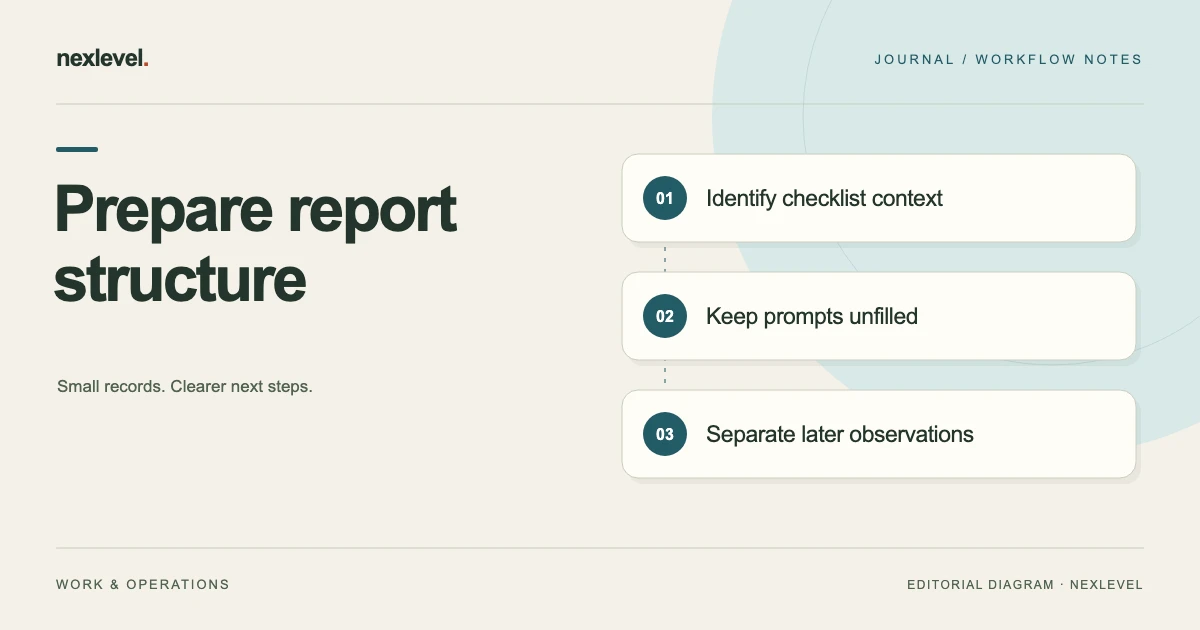
Prepare the selected report context before adding observations: identify the intended report, choose the supported starter checklist, keep prompt roles clear, and preserve the questions that require actual inspector input. A clean structure makes later records easier to interpret without supplying their facts.
This guide uses fictional administrative references. It supplies no inspection procedure, technical threshold, defect finding, repair recommendation, compliance determination, or safety conclusion. Start with the inspection evidence-log template for the underlying record roles.
Define the preparation task
Write which report context the structure will serve and which sources are available for planning it. A prepared outline differs from field observations and from a completed immutable snapshot.
The task can finish when the selected prompts and source questions are understandable. It does not need a real site visit or a fabricated finding to look complete.
Keep any broader inspection scope or professional requirement with its appropriate authorized source. A generic starter checklist should not become a claim that every necessary item for a real property has been covered.
Set up a fictional structure packet
Imagine R51 is the selected report reference, T2 the starter-checklist context, A3 an independent area reference, I4 a selected item, M5 a source question, P6 a possible photo reference, D7 a possible entered-reading reference, and S9 a later snapshot role.
At preparation time, P6 and D7 are only teaching placeholders for evidence roles. No photograph or reading is supplied. They should not appear as captured evidence.
These labels are companion worksheet references rather than native field names. The exercise does not claim an arbitrary template builder or a custom rule field for every suggested row.
Use a preparation-role worksheet
| Companion role | Question before observations | Keep separate |
|---|---|---|
| Report identity | Which selected R51 context is represented? | A similar report title |
| Starter checklist | Which supported T2 source is selected? | A universal professional standard |
| Area/item map | What does the independent A3/I4 reference identify? | An actual finding |
| Source question | What input would establish M5? | An answer invented during preparation |
| Evidence roles | What would P6 or D7 represent if actually entered? | Captured photo or measured value by assumption |
| Completion role | What still requires actual review? | A completed snapshot or approval |
This is a manual companion structure. Use actual supported controls and do not describe the worksheet as an automatic completeness or compliance checker.
Identify the selected report before reusing a structure
A familiar outline can be useful while still belonging to another report context. Establish R51’s actual identity before associating notes, source references, or an older prepared copy.
Do not copy a prior observation into a new report merely because the same prompt is relevant. Reusable structure and occasion-specific facts have different roles.
If the selected source relationship remains unclear, preserve that question. A more detailed report title cannot establish the missing association.
Choose the starter checklist within its actual scope
Inspecova currently supports starting from a curated, reusable inspection checklist and completing required and optional items. The supported starter gives structure without independently inspecting a site.
Use the actual available checklist rather than claim an unverified custom-template editor or arbitrary external checklist importer. The companion source map can retain additional administrative context separately.
Any real professional scope or requirement needs its own authorized basis. This exercise supplies no universal list of property inspection requirements.
Keep headings separate from observations
A3 and I4 can organize the companion outline. Their presence does not establish that an area was visited, an item observed, or a physical condition assessed.
For broader indexing, use the multi-room evidence index guide. Keep an index reference distinct from the actual entered observation it may later help locate.
If a prepared label sounds like a completed finding, revise the label to preserve its prompt role. Do not supply a reassuring answer just to remove an empty-looking section.
Make source questions specific without answering them
M5 should identify the administrative input still needed for the selected record. A specific question is more useful than a generic complete later label.
Do not turn the question into a technical test procedure, threshold, or diagnosis. The structure organizes what remains to be entered under the actual professional arrangement.
A clear preparation result can retain an open question. It should not claim evidence exists merely because a prompt describes what that evidence would represent.
Keep evidence placeholders visibly hypothetical
P6 can identify a possible photo-source role without becoming an actual image. D7 can identify a possible reading role without containing a measured value.
Inspecova’s current Pro capabilities include selected evidence photos, entered readings, and recommendations. The app does not independently detect or measure defects.
If a prepared companion note uses placeholder labels, identify their role explicitly. A later reader should not mistake teaching references or empty prompts for evidence captured at a real site.
Respect missing-requirement context
The current app makes missing requirements and recovery actions visible next to the affected work. A prepared structure should preserve that context rather than invent a bypass to make completion appear available.
If photo selection or the network is unavailable, the advertised field workflow can continue. That does not mean every required evidence question is automatically satisfied.
Keep availability, entered source, and actual completeness distinct. This guide supplies no undocumented skip control or method for silently clearing a warning.
Keep severity and acknowledgement separate from preparation
Inspecova advertises Monitor, Attention, and Critical finding states, with explicit critical-finding acknowledgement before completion. Those roles require actual selected record context.
A preparation worksheet should not assign a severity to fictional placeholders or treat acknowledgement as proof that a physical issue was repaired.
This exercise records no finding or acknowledgement. It keeps the future decision role identifiable without supplying the professional judgment.
Separate observations from proposed repairs
A structure can keep observation and recommendation roles clear without filling either one. A proposed next action should not silently become an observed physical fact.
The observations-versus-repairs guide covers that narrower distinction. Its source method complements preparation without supplying a repair instruction.
If an older note mixes those roles, identify the actual relationship before reusing its structure. Do not carry an earlier recommendation forward as a new observation.
Use sentence cleanup within its advertised limits
The current app describes local sentence cleanup for extra spacing, initial capitalization, and ending punctuation. It remains advisory, editable, and under inspector control.
A cleaner prompt is still a prompt. Cleanup does not supply an observation, infer a reading, diagnose a condition, or guarantee completeness.
Review any accepted wording against its actual source role. Do not describe this capability as managed AI, semantic fact checking, or automatic technical report writing.
Work through a clean preparation branch
In the first fictional branch, R51/T2 are established and A3/I4 remain independent outline references. M5 clearly identifies an unanswered source question, while P6/D7 are visibly hypothetical evidence roles.
The preparation result can state that the structure is understandable for the selected administrative task. It does not claim a completed inspection or a ready-to-publish professional report.
S9 remains a later snapshot role. The presence of that label in a worksheet does not create an immutable report.
Work through a copied-fact branch
In another branch, a prior report’s observation was copied into the new preparation note. Remove that unsupported association from the new explanation or restore its actual historical role.
Do not change accurate older evidence to make it appear to belong to R51. Repair the representation containing the copied-fact error.
The source structure can still be reusable while the occasion-specific fact is not. Keep that distinction explicit when explaining the correction.
Work through an inaccessible-source branch
In a third branch, M5 concerns a source relationship not established by available evidence. Keep the precise question rather than mark it answered by assumption.
The inaccessible-area documentation guide addresses a related record task. A source limitation should retain its own role rather than become an invented physical finding.
The preparation exercise performs no site access or inspection. It makes the next authorized source review specific while preserving uncertainty.
Keep working records separate from frozen snapshots
Inspecova currently freezes completed work into an immutable report snapshot and provides report numbering and SHA-256 traceability details. Those features identify selected representations without certifying their physical facts.
A prepared outline is not a completed snapshot. A traceability detail does not independently establish safety, compliance, legal approval, or correct professional judgment.
The revision and original-photo guide covers historical source relationships once actual report evidence exists.
Inspect the actual supported representation
The current free experience includes one template, up to two completed reports per month, basic fields, watermarked PDFs, and five local sentence cleanups per month. Pro adds the advertised expanded report and evidence tools.
Keep plan-dependent access clear when selecting an output. Do not describe the companion preparation table as a guaranteed native PDF or CSV layout.
The public description does not establish arbitrary report import or complete restoration. A readable report copy is not automatically the entire editable workspace.
Run an independent structure-reading test
Give another authorized reader the fictional preparation note and controlled source references. Ask which report and starter context are selected, what A3/I4 organize, and which inputs remain unprovided.
Then ask whether P6/D7 are actual evidence and whether S9 exists as a completed snapshot. The expected answer should preserve their hypothetical or later roles.
Record any manual explanation needed. Improve a confusing copy when its sources are accurate; retain a precise question when the underlying relationship remains unclear.
Write a bounded preparation receipt
A companion receipt can identify R51/T2, the independent area/item map, unanswered source questions, hypothetical evidence roles, actual wording correction, cutoff, and next task.
For the clean fictional branch, it states that preparation context is established without any observation, reading, critical acknowledgement, completed snapshot, or physical inspection claim.
For historical retention, use the inspection source archive guide. Keep the preparation occasion visible when the note moves away from its original folder.
Use wording that keeps an empty prompt empty
A concrete companion label can say: A3/I4 is an outline reference for the selected R51 preparation; M5 identifies input still needed; P6 and D7 are hypothetical evidence roles; S9 describes a later completion representation. This is independent worksheet wording, not a prescribed native status.
Compare that with a misleading copied label such as inspected and complete. The latter would assert an occasion and result that the fictional preparation exercise does not supply.
The supported repair is to restore the prompt role in the companion explanation. It does not require inventing a reading, assigning a severity, acknowledging a critical finding, or generating a completed report.
If actual observations are later entered, retain their own source occasion. A later evidence source can answer M5 without making the earlier preparation note appear to have contained the observation already.
For a final check, give another authorized reader only the preparation note. Ask which structure is selected, which facts remain unprovided, and what the next source question is. Their answer should distinguish a useful outline from an inspection result without relying on the original conversation.
Use Inspecova for structured entered evidence
Inspecova connects selected checklists, entered observations, evidence roles, explicit acknowledgement, and completed report representations without requiring a NexLevel account.
Check the official Inspecova App Store listing for current capabilities and access. Keep structure, observed source, human judgment, completion, and retained snapshot distinguishable.