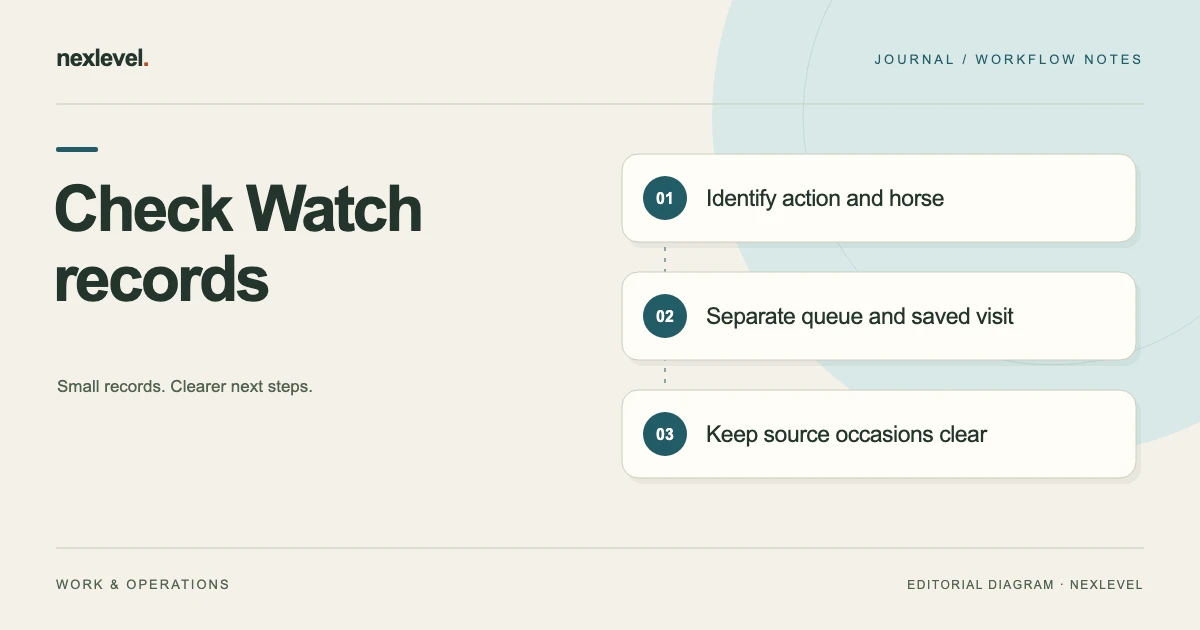
A Watch action and a saved visit are different records. FarrierForge describes actions queuing until the paired iPhone confirms they were saved. Match the actual horse and occasion to the available saved history before interpreting an old note or creating another entry.
Establish the saved record before adding another entry
- Identify the selected Watch action, horse and visit occasion.
- Check what the available queue context establishes without assuming confirmation.
- Inspect the actual saved iPhone history through supported controls and match the visit.
- Record the established relationship or precise open question, with the review cutoff.
Working fields:
Watch action | Horse/occasion | Available queue context | Saved source | Candidate visit | Established relationship | Next check
Useful next steps: Confirm horse identity and source context, Review the saved visit before a summary, Keep the review context with archived visits.
Choose the save-history question
Write what needs establishing: which horse and visit the selected action concerns, whether the available source establishes an iPhone-confirmed save, and what the retained copy actually represents.
Keep the question separate from physical work. An unclear record-save relationship does not independently establish whether a service happened.
This is a documentation review, not an instruction to perform another service or a claim that every attempted interaction created an event.
Set up a fictional Watch-origin packet
Imagine W12 is the selected Watch action reference, Q3 its queue-related source, S4 the available iPhone-side source, V5 a candidate saved visit, H6 the horse reference, L7 a selected hoof-entry reference, and C9 the retained review note.
The selected question is whether W12/Q3/S4 establish the relevant relationship to V5/H6. The exercise does not assume the answer.
These are teaching labels rather than native identifiers or visible UI strings. No actual Watch action, horse, service, save confirmation, or device recovery operation is supplied.
Use an action-to-history worksheet
| Role | Question to establish | Keep separate |
|---|---|---|
| Selected action | What does W12 actually represent? | A completed physical service |
| Queue context | What source relationship is available for Q3? | An iPhone-confirmed save by assumption |
| Saved source | What does S4 establish about V5? | An attempted interaction alone |
| Horse identity | Does the selected record concern H6? | A familiar name only |
| Hoof entry | What actual L7 relationship is recorded? | Every hoof receiving the same work |
| Retained copy | Which source set and cutoff does C9 represent? | Every later update |
The worksheet is an independent companion convention. It does not establish native queue inspectors, retry controls, debug logs, or automatic reconciliation.
Establish the horse before comparing actions
A next-due display or familiar name can be useful context without establishing every selected visit relationship. Match the actual H6 source before associating a candidate saved event.
The horse-record setup guide covers initial identity and source roles. Its result does not supply the later action’s facts.
If the identity relationship remains unclear, retain the precise question. A more confident visit title cannot establish which horse the source concerns.
Read an attempted action within its actual role
W12 can identify an attempted or entered interaction under the actual source arrangement. It should not automatically become V5’s saved-history evidence.
Likewise, an action reference does not independently establish physical work. The service and the act of recording it can require different sources.
This exercise supplies no actual device display. Do not invent a success message, error state, or native control to make the proposed review more concrete than the available documentation supports.
Keep queue context separate from confirmation
The current app description explicitly says Watch actions queue until the iPhone confirms they were saved. That does not promise every possible queue visibility, replay, or conflict-resolution feature.
For Q3, record what the available source actually establishes. If the relationship to S4 remains unavailable, keep that limitation instead of declaring the save successful or failed.
A useful review can name the confirmation boundary without claiming access to undocumented internals or performing an unsupported repair.
Inspect the actual saved history when available
If the selected S4 source establishes a saved visit, use the actual record relationship to identify V5, H6, and relevant entered content. Do not assign the nearest-looking visit solely because its title is familiar.
Keep the selected source occasion clear. A later history view and an older retained note can differ while each accurately represents its own cutoff.
The review should record what was inspected through supported controls. It should not invent a universal matching identifier or require account login for local history.
Preserve visit and hoof-specific meaning
FarrierForge’s current description supports recording performed work separately for each hoof. L7’s selected relationship should remain distinguishable from the whole visit and from other hoof entries.
This exercise supplies no shoe size, material, technique, service date, or treatment recommendation. It checks source identity and record roles.
If the saved source is accurate but C9 broadens one hoof entry to all four, repair the companion explanation. Do not change accurate history to make a copied sentence fit.
Keep reusable setups out of save evidence
A preset can describe reusable context without proving that W12 saved a visit or that any physical action occurred. Keep that source role separate.
The preset-versus-completed-visit guide covers the related distinction. It should not become a substitute for S4’s actual saved-history relationship.
A saved preset’s presence does not resolve a queue question. The next source task should target the relationship actually missing.
Work through a confirmation-established branch
In the first fictional branch, the authorized sources establish W12’s selected relationship to an iPhone-confirmed V5 save for H6. L7’s entered role is clear.
C9 can retain that bounded relationship and the actual source occasion inspected. It should not expand the result into a claim about physical service quality or animal health.
The result also does not verify every other queued action or retained copy. Keep the scope limited to the selected source set.
Work through an unavailable-confirmation branch
In another branch, W12/Q3 are the available references but the selected source does not establish S4’s relationship to V5. Keep that precise limitation.
Do not treat unknown as failed or successful merely to make the review appear finished. A missing source relationship is a useful result when the next question is specific.
This exercise does not prescribe a restart, reinstall, reset, manual duplicate entry, or deletion. Use actual supported controls and preserve accurate history while investigating a real case.
Work through a similar-visit branch
In a third branch, a candidate V5 concerns another occasion for H6. The horse match alone is not enough to establish that it is the saved result of W12.
Correct the candidate association in C9 or retain the unresolved source question. Do not rewrite the accurate visit to make the presumed action relationship fit.
A person can have several record occasions for the same horse. Keep the actual source distinction rather than infer identity from proximity in a list.
Distinguish repeated references from repeated events
Two retained notes about W12 do not independently establish two physical services or two saved visits. Identify the underlying source relationships before counting events.
Conversely, two similar-looking records are not automatically duplicates. They may concern different occasions or entered roles that the available source needs to distinguish.
The current public description does not establish an automatic merge or deduplication tool. Keep any unresolved association visible instead of deleting accurate history by assumption.
Keep scheduling context separate from save status
The current Watch companion shows the next horse due. Scheduling context can help organize work while remaining different from proof that a visit was saved.
This guide recommends no service interval or due date. Actual scheduling decisions need their appropriate authorized basis and professional judgment.
A due-looking item should not become a diagnosis, and a changed queue should not become proof of physical service completion.
Choose a review copy within current access
Free starts with five active horses, visit records, local reminders, and CSV export. Optional rewarded videos can add roster capacity when available under the current app’s conditions. Pro separately adds unlimited active horses and sharing individual owner summaries.
Inspect the actual selected representation for horse/visit identity, hoof-specific source roles, and cutoff. The independent worksheet is not a guaranteed native export schema.
The public description does not establish arbitrary CSV import or complete restoration. A readable copy should not be described as the full editable workspace or a queue-recovery mechanism.
Keep a summary check separate from save confirmation
A polished owner summary can describe entered history without independently proving how a Watch-origin action reached that history. Preserve the actual source relationship needed for the current question.
The pre-summary visit checklist covers the narrower reading task once selected saved records are available.
A successful summary review should not become a claim that every action in the Watch queue was confirmed or that every device is current.
Run an independent action-reading test
Give another authorized reader C9 and usable controlled source routes. Ask what W12, Q3, S4, and V5 each represent and which relationships are actually established.
Then introduce a similarly named horse or another visit for H6. The reader should preserve actual identity and occasion rather than assign the action by familiarity.
Record any manual explanation needed. Repair an unclear copy when its sources are accurate;retain the precise question when the underlying relationship remains unresolved.
Use a copy-ready save-history receipt
A companion receipt can identify the selected horse/action, queue-source role, available saved-history relationship, visit/hoof context, actual representation inspected, copy correction, cutoff, and next question.
For the confirmation-established fictional branch, it names the selected W12/S4/V5 relationship without a physical service or health claim. For the unavailable branch, it preserves the exact confirmation question.
Read the receipt without its filename. The next reviewer should understand the source roles without reconstructing the original conversation or assuming a successful save from an attempted interaction.
Connect the check to handoff and retention
For a professional transition, use the farrier record handoff guide. For historical copies, use the horse and hoof-context archive guide.
For choosing a working method, use the visit record-system comparison. Keep the selected save-history purpose visible when choosing a representation.
A clear packet can make the next source review specific while leaving physical work, device internals, and professional conclusions outside its administrative scope.
Record an interrupted review without inventing a failure
If the actual saved source is unavailable during a review, the companion note can preserve what was inspected and which confirmation relationship remains open. Unavailable evidence is not independently a failed save.
For the fictional case, C9 can identify W12 and the available Q3 context while stating that S4/V5 was not established from the selected source set. The next task is to inspect the appropriate authorized saved history, not to declare a device fault or perform another physical service.
Keep that note separate from the app’s actual history. A manual review receipt does not create, edit, or confirm a native visit merely by describing one.
If a later source establishes the save relationship, give that review its own occasion. The earlier C9 can remain accurate history of what was available then without appearing to contain later evidence.
For a final practical check, ask the authorized reader to identify what is known, what is not established, and which source would distinguish the question. Their answer should preserve attempted action, queue context, saved history, and physical work as separate roles. It should not require a guessed success message, undocumented retry control, or another visit entry to make the packet understandable.
Use FarrierForge for clear local saved records
FarrierForge connects local horse and hoof-specific visit records with a Watch companion and the advertised queued-action save boundary.
Check the official FarrierForge App Store listing for current capabilities and access. Keep attempted actions, queue context, confirmed saved history, retained copies, and physical service events distinguishable.