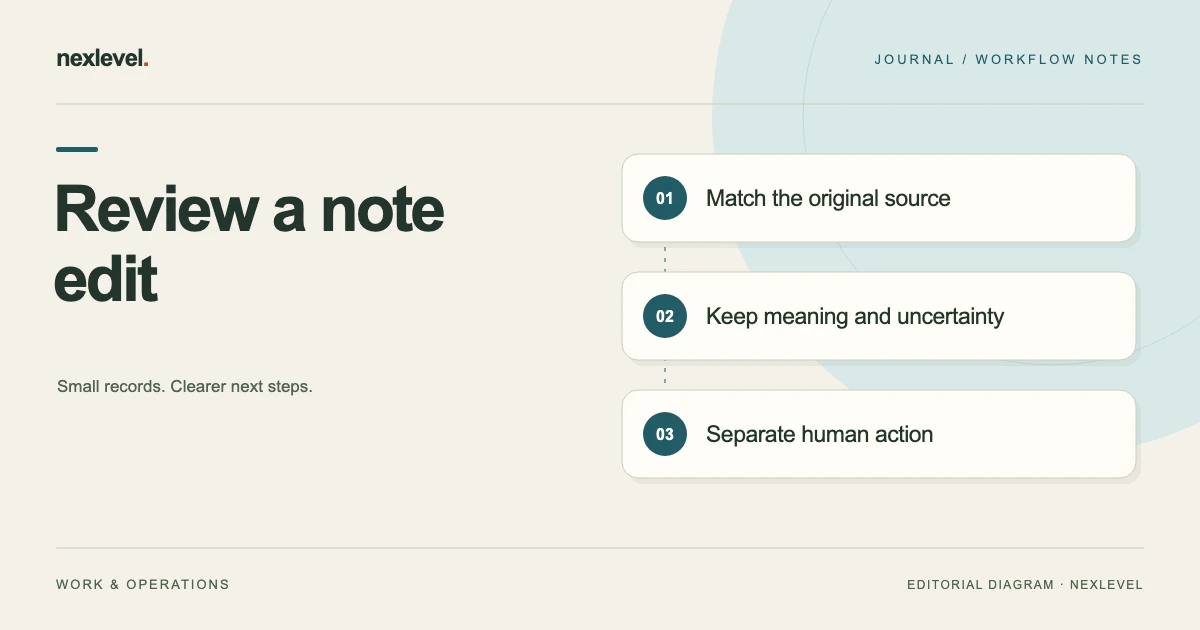
An advisory sentence cleanup should improve presentation without being mistaken for a new observation or technical conclusion. Compare the selected original note with the proposed wording, preserve its item and source context, and decide whether the actual edit is appropriate.
Inspecova’s current listing describes local cleanup for extra spacing, initial capitalization, and ending punctuation. Keep that bounded role separate from diagnosis, evidence verification, or automatic report completion.
This guide uses fictional administrative text. It supplies no inspection finding, reading, repair instruction, safety conclusion, or compliance determination. Start with the inspection evidence-log template for the underlying source roles.
Choose one note and one review question
Write which selected report, item, and original note the advisory edit concerns. A familiar sentence can recur in several reports while representing different source occasions.
The bounded question is whether the proposed presentation edit preserves the selected note’s actual meaning. It is not whether a property is safe or the report is professionally complete.
A useful result can retain a precise source question. Do not accept a more polished sentence as evidence that its facts are correct.
Set up a fictional cleanup packet
Imagine R74 is the selected report, I2 an item, O3 the original note, A4 a proposed advisory wording, C5 an accepted-working-note role, and S6 a later snapshot reference.
The independent example starts with the neutral phrase “note about item I2” with extra spacing. An illustrative presentation result is “Note about item I2.”
These are teaching references and an independent wording example, not a tested native output fixture. No actual property, observation, cleanup request, acceptance, or completed report is supplied.
Use an original-to-advisory worksheet
| Role | Question before relying on the edit | Keep separate |
|---|---|---|
| Report/item | Which R74/I2 context is selected? | A similar title or sentence |
| Original note | What does O3 actually state? | A stronger interpretation |
| Advisory wording | What presentation change does A4 propose? | A new observation or diagnosis |
| Human action | What was actually reviewed or accepted? | Automatic record mutation |
| Working result | What source establishes C5, if any? | The original or frozen snapshot by assumption |
| Retained copy | What source occasion does S6 represent? | Every later edit |
The worksheet is an independent companion convention. It does not establish native diff views, custom fields, automatic fact checking, or a complete text-revision archive.
Match the note to its selected item
A sentence can be grammatically clear while associated with the wrong item. Establish O3’s actual R74/I2 relationship before deciding what a cleanup means.
Keep controlled source references usable without duplicating unnecessary property details in a broad review note.
The report-structure preparation guide covers the earlier setup task. It does not supply the selected note’s facts.
Read the advertised cleanup scope literally
The current app description covers collapsing extra spacing, capitalizing the first character, and adding ending punctuation. It says the cleanup stays advisory, editable, and under inspector control.
Do not broaden that capability into semantic rewriting, technical report generation, or a managed AI service. The selected source still needs human review.
This exercise performs no cleanup and documents no native algorithm details beyond the advertised scope.
Use neutral examples to test the role distinction
| Independent original phrase | Illustrative presentation result | Meaning to preserve |
|---|---|---|
| note about item I2 | Note about item I2. | A note reference, not a finding |
| source context not reviewed | Source context not reviewed. | The negation remains |
| question remains open | Question remains open. | Uncertainty remains |
These examples illustrate an independent review method. They are not promises about exact native casing, spacing, punctuation, or every possible input.
Keep negation and uncertainty intact
A more polished sentence should not silently turn not reviewed into reviewed or an open question into an established fact.
If a proposed or copied wording changes that meaning, identify the actual source issue. Do not treat presentation quality as a reason to strengthen the statement.
This is a manual source comparison. The public description does not establish an automated semantic-equivalence verifier.
Keep identifiers and quantities tied to their sources
An item reference, reading, or source label should retain the actual relationship needed for the report. A familiar-looking string does not independently establish the selected identity.
This exercise supplies no technical quantity or unit. It does not test a parser or prescribe how a real measurement should be written.
If an original source is unclear, retain that question rather than invent a more precise value while cleaning the sentence.
Separate a proposal from an accepted edit
A4 is advisory wording. It should not automatically become C5’s saved-source evidence simply because it is displayed or described in a companion note.
The current listing keeps cleanup under human control and says recorded text is not altered unless the user accepts the cleanup.
This guide performs no acceptance action. It should not invent a batch-accept control, undo workflow, or hidden edit history absent from the current description.
Work through a presentation-only branch
In the first fictional branch, O3’s R74/I2 relationship is clear and the illustrative A4 changes presentation while retaining the neutral source meaning.
A companion result can identify the original phrase, the proposed wording, and the actual review stage. It should not claim a new observation or a professionally approved report.
If an actual accepted source is later established, give it its own occasion. The proposal alone does not create C5.
Work through a wrong-item branch
In another branch, O3 belongs to another item with similar wording. The sentence can be neat while the source association remains wrong.
Correct the companion association or retain the precise question rather than change accurate original evidence to make the sentence fit I2.
The useful repair concerns source identity. Capitalization and punctuation cannot establish which report item the note actually describes.
Work through an overstated-meaning branch
In a third branch, a copied explanation turns question remains open into a definitive conclusion. Restore the actual source scope in the explanation.
Do not change the original note merely to make the stronger copied wording appear true. The error can be in a companion summary rather than a native cleanup.
The result should identify what changed and which question remains. A generic fixed label would hide the source boundary.
Keep cleanup separate from evidence collection
Inspecova supports selected photos, entered readings, severity, and recommendations under its advertised access. Cleanup does not independently capture or verify any of those sources.
The multi-room evidence index covers source mapping. A readable note is not a substitute for an actual evidence relationship.
This exercise supplies no image or reading and draws no physical conclusion from text quality.
Keep observation and recommendation roles distinct
A proposed next action should not become an observed fact because it has been polished. Preserve the actual source role of the selected sentence.
The observations-versus-repairs guide covers that narrower distinction.
No actual repair advice is supplied here. The cleanup review concerns presentation and source meaning, not technical judgment.
Do not equate cleanup with readiness or acknowledgement
The current app makes missing requirements visible and requires explicit critical acknowledgement before completion. A cleaned sentence does not satisfy unrelated evidence or acknowledgement questions.
The pre-snapshot checklist covers the broader documentation-readiness task.
This exercise completes no report and records no acknowledgement. It should not make a warning appear resolved by improving a caption.
Keep working notes separate from frozen snapshots
Inspecova advertises immutable completed snapshots. A later accepted working edit should not make an older snapshot appear to contain the later wording.
The revision-and-original-source guide covers that historical relationship.
A snapshot or traceability detail also does not independently certify the facts of a sentence. Keep representation identity and professional conclusions separate.
Choose the supported capability within current access
The free experience currently includes five local sentence cleanups per month, one template, up to two completed reports per month, basic fields, and watermarked PDFs. Pro adds unlimited cleanups and the advertised expanded evidence/report tools.
Keep those access details with the current listing. Do not invent a quota bypass or require a managed online service for the advertised local cleanup.
The exercise consumes no cleanup allowance and changes no record. It is an independent source-review worksheet.
Run an independent wording-reading test
Give another authorized reader the fictional original, advisory example, and companion source note. Ask which R74/I2 context applies, what changed, and what meaning remains unestablished.
Then introduce another item or earlier note. The reader should preserve actual identity rather than choose the most familiar sentence.
Record any manual explanation needed. Repair an unclear copy when its source is accurate;retain a precise question when the underlying association remains missing.
Use a copy-ready cleanup-review receipt
A companion receipt can identify report/item, original-source role, proposed presentation edit, actual human-review stage, accepted-source relationship if established, representation inspected, correction, cutoff, and next question.
For the presentation-only fictional branch, it preserves source meaning without a physical finding or acceptance claim. For the wrong-item branch, it names the actual association question.
Read the receipt without its filename. The next reviewer should understand the result without reconstructing the original site conversation.
Connect the check to handoff and retention
For a selected report transfer, use the frozen-snapshot handoff guide. For historical copies, use the inspection source archive guide.
Keep the cleanup-review purpose visible when choosing a representation. An original note, advisory proposal, accepted working source, and frozen snapshot can all be useful without representing the same occasion.
A clear packet can make the next source question specific while keeping actual inspection, repair, and professional conclusions outside the presentation task.
Compare three representations rather than two
A practical independent example can have O3 as source context not reviewed
, A4 as Source context not reviewed.
with presentation punctuation, and a companion explanation that mistakenly says context verified
.
The proposed presentation role can preserve the original uncertainty while the companion explanation overstates it. The useful repair targets the actual mistaken representation instead of blaming a cleanup that did not supply the stronger meaning.
These are fictional wording examples, not observed native outputs. They demonstrate why the original, the proposal, and the explanatory note each need their own source role.
If the actual original itself is unclear about I2, keep that question open. Capitalization and punctuation cannot establish the correct item association or verify the factual statement.
Write the comparison result without claiming acceptance
A concise companion note can identify R74/I2, O3’s original role, A4’s illustrative presentation change, and the actual review stage. If no accepted saved source is supplied, do not describe C5 as established.
For the three-representation example, the note can state that the source uncertainty was retained in the proposal and that the companion verification claim was unsupported. It should not claim a real edit, cleanup request, quota use, or completed report.
If an actual accepted working note is later available, give it its own occasion and relationship. An earlier proposal receipt can remain accurate history without appearing to contain the later saved action.
For a final practical check, remove the original folder context and ask an authorized reader which representation changed, what meaning stayed the same, and what remains unestablished. Their answer should not require an actual property finding or an invented human action. Record any explanation still needed beside the relevant source reference.
Use Inspecova for controlled local wording review
Inspecova connects selected report evidence, human-controlled advisory cleanup, explicit acknowledgement, and completed report representations without requiring a NexLevel account.
Check the official Inspecova App Store listing for current capabilities and access. Keep original facts, proposed presentation edits, saved actions, and physical property outcomes distinguishable.