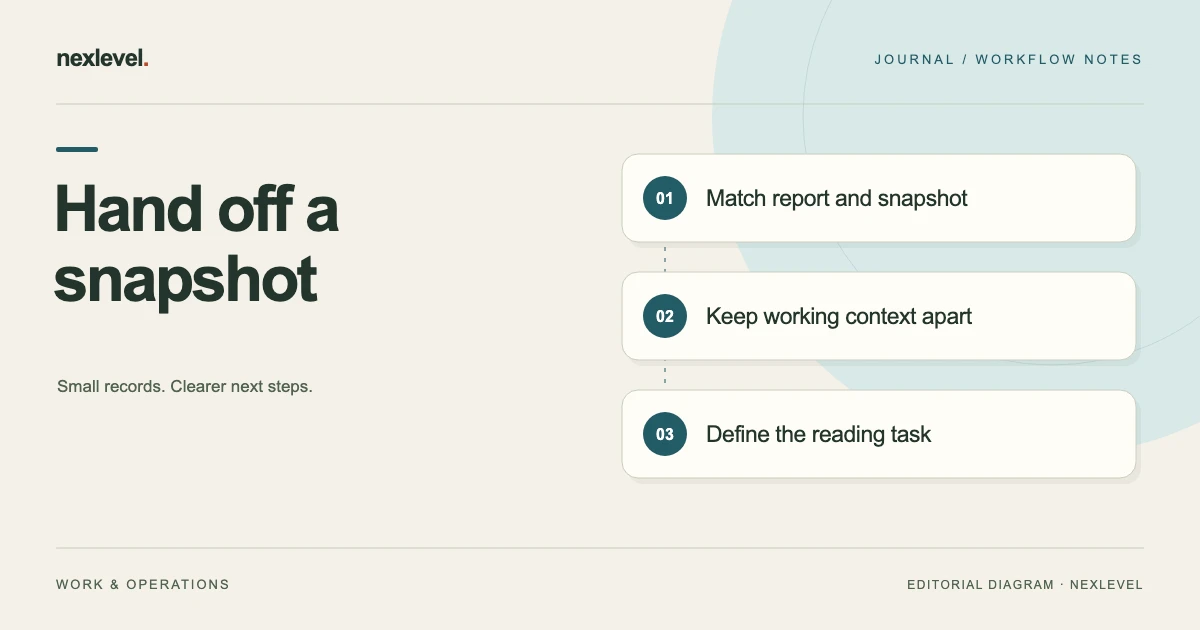
A frozen inspection snapshot should be handed off as the selected historical representation it actually is. Identify the report, snapshot occasion, chosen output, source context, and intended recipient task before treating a polished file as current or complete for every purpose.
Keep the working report, immutable snapshot, exported PDF or CSV, and companion source note in different roles. A later local edit should not make an older retained copy appear to include information it did not contain.
This guide uses fictional administrative references. It supplies no real inspection finding, technical reading, property judgement, repair instruction, compliance certification, or safety conclusion. Start with the inspection evidence-log template for the underlying source roles.
Choose the recipient’s actual task
Write why the selected representation is being prepared. Reading a completed report, reviewing a source question, and receiving current working context can need different information.
A broad request such as send the inspection does not identify which snapshot or output the reader needs. Replace it with the bounded administrative purpose and selected source occasion.
This exercise sends no message and shares no file. Prepared, inspected, shared, delivered, and understood remain separate source roles.
Set up a fictional snapshot packet
Imagine R42 is the report reference, W2 the working context, S3 the selected frozen snapshot, P4 its selected PDF representation, C5 a CSV representation, N6 the companion note, and K7 a critical-acknowledgement source.
The selected question is whether P4/N6 clearly represent S3 for the intended authorized reading task. The exercise does not assume C5 contains every field or source represented elsewhere.
These labels are teaching references rather than native identifiers or export columns. No actual property, photograph, reading, acknowledgement, report number, or sharing event is supplied.
Use a snapshot-to-handoff worksheet
| Role | Question before relying on the packet | Keep separate |
|---|---|---|
| Purpose | What does the authorized reader need? | Every possible report use |
| Report identity | Which R42 context is selected? | A familiar title alone |
| Snapshot | What S3 occasion is represented? | The later working W2 state |
| Output | What does P4 or C5 actually contain? | A complete editable workspace |
| Evidence context | Which selected source relationships are established? | Physical conclusions by assumption |
| Acknowledgement | What does K7 actually record? | A repair or safety approval |
| Handoff stage | What preparation or sharing event is established? | Recipient access and understanding |
This is an independent companion worksheet. It does not establish a native recipient-permission system, custom source fields, or automatic handoff validation.
Identify the selected report and snapshot
A familiar report title can appear in several retained copies. Establish R42/S3 through the actual authorized source arrangement rather than choose the nearest-looking file.
Inspecova currently freezes completed work into an immutable report snapshot. Keep that selected native representation identifiable without claiming every external file is uneditable or digitally signed.
If the source relationship is unclear, retain that precise question. A more formal-looking cover cannot establish which snapshot the copy represents.
Keep current working context separate
W2 may include later work not represented by S3. That difference can be legitimate when both source occasions are clear.
Do not call P4 current merely because it was reopened after W2 changed. The selected snapshot and file preparation context can answer different questions.
The revision-and-original-photo guide covers the broader historical source relationship.
Preserve completion context without expanding it
A completed documentation workflow and an actual physical property outcome have different roles. The snapshot’s existence does not independently certify safety, compliance, or repair completion.
The pre-snapshot requirements checklist covers the earlier source review. Its result should retain the actual report and source occasion.
This handoff exercise performs no completion or acknowledgement action. It identifies the source context needed to explain the selected retained representation.
Keep acknowledgement separate from remediation
The current app requires explicit critical-finding acknowledgement before report completion. K7 should preserve its actual selected finding/report relationship.
Acknowledgement does not independently establish that a physical issue was repaired or that a recipient accepted a professional conclusion.
If a companion note broadens K7 into resolved or safe without source support, correct that explanation. Do not rewrite accurate history merely to make a stronger label appear true.
Keep observations separate from proposed actions
An entered observation, reading, severity, and recommendation can support different questions. Preserve the roles actually represented in S3 rather than collapse them into a single confident summary.
The observations-versus-repairs guide addresses that narrower distinction.
The fictional handoff supplies no technical threshold, diagnosis, or recommendation. It should not add professional conclusions to make the packet sound more decisive.
Inspect photo and source relationships deliberately
Inspecova advertises inspector-selected evidence photos under Pro. A selected report photo should retain its actual item and source occasion rather than be assigned by a familiar image alone.
The existence of P4 does not prove that every original photo is included or that every source is accessible to a later reader.
Use a controlled companion reference when appropriate and record retrieval dependencies. This exercise supplies no actual photograph or visual finding.
Keep unavailable evidence context visible
A retained report can need an explicit source limitation. Do not turn an inaccessible source or unanswered relationship into a reassuring physical statement.
The inaccessible-area documentation guide covers a related record task.
If the selected source itself remains uncertain, preserve the precise question beside the affected reference. A cleaner handoff note cannot establish missing physical evidence.
Work through a clear snapshot branch
In the first fictional branch, the authorized sources establish P4 as the selected S3 representation of R42. N6 identifies the reading task and distinguishes W2’s later working role.
The result can preserve the actual evidence and acknowledgement context represented in S3 without a safety or compliance claim.
C5 remains a separate output role unless its actual relationship is also reviewed. A successful PDF reading check does not verify every other representation.
Work through a wrong-snapshot branch
In another branch, P4 concerns an earlier snapshot while N6 describes later W2 content. Correct the selected source association or the companion wording using the actual evidence.
Do not change accurate older history to make the mistaken explanation appear current. Preserve each source occasion.
The next question can identify which supported representation serves the recipient’s actual task. It does not require inventing another inspection event.
Work through an overstated-handoff branch
In a third branch, the file is prepared and inspected but N6 calls it delivered and understood. Restore the actual preparation stage in the note.
A chosen sharing destination, a completed share action, recipient access, and recipient understanding can require different actual sources.
This exercise supplies none of those external events. A useful administrative packet does not need a delivery claim to make the next source task clear.
Use traceability within its actual scope
Inspecova currently advertises unique report numbers, page numbering, and SHA-256 traceability details. Those features help identify selected representations without independently certifying their facts.
Do not turn a traceability detail into a legal signature, property certification, or guarantee of professional correctness.
The companion worksheet can identify the actual traceability role available in P4 without inventing a digest value or external verification service.
Choose supported output within current access
The free experience currently includes one template, up to two completed reports per month, basic fields, watermarked PDFs, and five local sentence cleanups per month. Pro adds the advertised expanded evidence tools and unwatermarked PDF/CSV output.
Use the actual supported representation rather than promise every companion field or original source appears in every export.
The public description does not establish arbitrary report import or complete restoration. A report copy is not automatically the entire editable workspace.
Review the complete selected packet
Read P4 and N6 together rather than stop at a familiar title or report number. Check the selected snapshot, evidence roles, acknowledgement scope, and actual source cutoff.
Keep the purpose bounded so unnecessary private property context is not copied merely to make a broad handoff packet look complete.
This is a manual review, not automatic privacy auditing. It does not change access or promise control over every externally retained copy.
Keep advisory cleanup separate from facts
The current app’s local sentence cleanup covers spacing, capitalization, and punctuation under inspector control. A cleaner note should retain its actual source meaning.
Do not treat cleanup as diagnosis, semantic verification, or proof that the snapshot is complete for every professional purpose.
If a companion summary overstates an accurate source, repair the summary. If the source relationship is unclear, retain the precise question instead.
Run an independent handoff-reading test
Give another authorized reader P4/N6 and usable controlled source references. Ask which R42/S3 context is selected, how W2 differs, what K7 establishes, and what the packet does not prove.
Then introduce another report with a similar title. The reader should preserve actual identity and occasion rather than choose by familiarity.
Record any manual explanation needed. It identifies context the packet still lacks before it can serve the selected reading task.
Use a copy-ready handoff receipt
A companion receipt can identify the intended task, report/snapshot source, selected output, evidence and acknowledgement roles, actual preparation or sharing stage, copy correction, cutoff, and next question.
For the clear fictional branch, it preserves P4/S3 without a physical safety or delivery claim. For the wrong-snapshot branch, it names the mistaken association and actual remaining source question.
Read the receipt without its filename. A future reviewer should understand the administrative result without reconstructing the original site conversation.
Connect the handoff to source indexing and retention
For broader source mapping, use the multi-room evidence index. For historical copies, use the inspection source archive guide.
For choosing a working method, use the inspection workspace comparison. Keep the selected snapshot purpose visible when choosing a representation.
A clear packet can make the next source review specific while preserving the difference between working evidence, completion, snapshot identity, external sharing, and professional conclusions.
Make the recipient-task note concrete
For the fictional clear branch, a companion note can identify P4 as the selected S3 representation of R42, with W2 retained as separate working context. It can state that the purpose is reading the selected snapshot’s documentation rather than receiving every current local record.
The note can identify K7’s actual acknowledgement role without calling it remediation. It can also identify which evidence-source references the authorized reader needs and which retrieval dependencies remain elsewhere.
If the task is only to read the selected report, do not describe C5 or the editable workspace as transferred unless that actual relationship is established. If another task needs structured downstream context, review that chosen representation separately rather than infer it from a successful PDF check.
Keep the actual stage explicit:prepared and inspected in this fictional exercise. The note should not claim a file was delivered, opened, accepted, or understood without the relevant real source.
If the selected PDF and working source differ, explain their occasions before calling either wrong. A historical snapshot can remain accurate without being the latest working state.
For a final practical check, remove the original folder context and ask an authorized reader to identify the selected report, snapshot, output, purpose, acknowledgement limit, and next source question. Their answer should not require an actual property finding or an invented delivery event. Record any explanation still needed beside the affected reference.
Use Inspecova for clear retained report context
Inspecova connects selected checklists, entered evidence, explicit critical acknowledgement, and completed snapshot/report representations without requiring a NexLevel account.
Check the official Inspecova App Store listing for current capabilities and access. Keep report history, selected snapshots, prepared copies, recipient tasks, and actual property outcomes distinguishable.