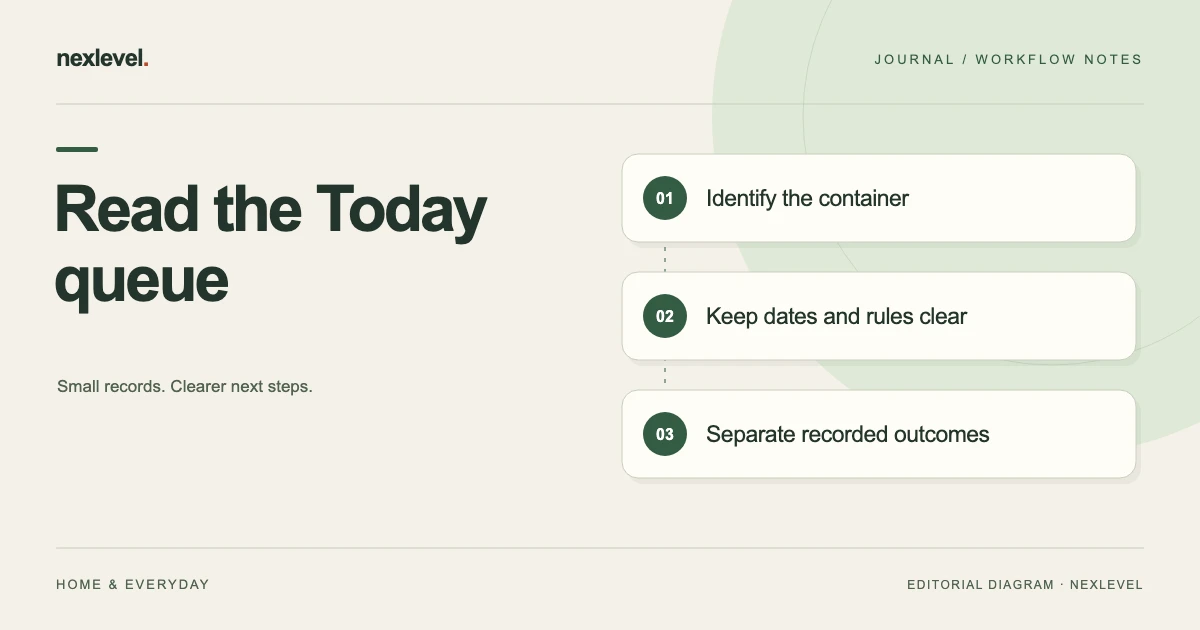
To understand a Today queue entry, identify its container, check the date sources and chosen rules, then compare the view's occasion with the current record and history. A different position or missing item needs context before it is called an error. Queue order is an organizational prompt rather than an edibility decision.
Trace the queue entry to the dates and rules entered
- Match the selected entry to its container and original label source.
- Check the meaning of entered dates and the rule or reminder actually chosen.
- Review relevant disposition history and distinguish current views from older retained copies.
- Correct a supported association error or record the precise source or behavior question still open.
Working fields:
View/occasion | Container/label | Date basis | Chosen rule/reminder | History source | Current vs retained | Correction/open question
Useful next steps: Review the label-to-record source, Separate reminder state from disposition, Reconcile a post-meal mismatch.
Choose the queue-review question
Write which selected container and view need explaining. A current Today view, an older retained note, and an outcome-history source can concern different occasions.
The task is to establish what the entered sources support. It does not decide whether food is safe or prescribe what a real household should eat next.
A precise source question is a useful result. Do not invent a date or outcome merely to make the queue look orderly.
Set up a fictional queue packet
Imagine Q51 is the selected Today-view reference, C2 the container, L3 its original label source, D4 the entered date context, R5 a chosen rule/reminder reference, U6 an outcome-history source, and N8 the retained review note.
The selected question is whether Q51’s relationship to C2/D4/R5 is understandable from actual sources. The exercise does not assume a particular queue position.
These teaching labels are not native fields or algorithm inputs. No real food, date, rule interval, physical action, or queue result is supplied.
Use a queue-to-source worksheet
| Role | Question before interpreting the view | Keep separate |
|---|---|---|
| Selected container | Which C2 context is represented? | A similar meal label |
| Original label | What does L3 actually establish? | A stronger date or safety conclusion |
| Entered dates | What source supports D4’s actual role? | A reminder or copied-file occasion |
| Chosen rules | What was actually configured in R5? | A universal food-safety rule |
| Outcome history | What does U6 record, if relevant? | Physical consumption by assumption |
| Today view | What source occasion does Q51 represent? | Every later view or copy |
| Review result | What is established or still open in N8? | A verified physical result |
The worksheet is an independent companion convention. It does not establish a native queue debugger, custom fields, or an exact ranking formula.
Establish container identity first
A familiar meal name can appear on several containers. Match the selected Q51 entry to the actual C2 source rather than assign dates from the nearest-looking label.
The container-label intake guide covers the underlying source task.
If identity remains unclear, retain that precise question. A more confident title cannot establish which container the selected source concerns.
Keep label sources separate from entered interpretation
LeftoverFirst advertises photo, text, and voice labels plus on-device label reading and editable suggestions. An extracted or entered value should retain its actual relationship to L3.
Do not treat a reviewed-looking record as independent verification of a preparation event or safety. Source content and interpretation remain different roles.
This exercise supplies no actual label and performs no capture or OCR. It preserves the source question needed before interpreting the queue.
Review the date basis without extending it
D4 should identify the actual selected entered-date context. A reminder setting or copied-file occasion should not silently become its source.
The current app’s queue explains attention from the dates and rules chosen by the user. Those inputs are organizational context, not an independently calculated safety conclusion.
This guide supplies no real date or interval and performs no shelf-life calculation. Preserve uncertainty rather than inventing a convenient date.
Keep chosen rules in their actual role
R5 can identify a selected rule or reminder configuration under the actual source arrangement. It should not become a universal storage recommendation or another physical event.
The current listing does not document every ranking weight, boundary, or tie-break rule. Do not reconstruct an algorithm from one selected queue position.
A companion note can explain its source scope while leaving an undocumented behavior question open.
Separate reminders from delivered attention
A saved reminder is configuration. Its presence does not independently establish that a notification appeared, a person saw it, or food was handled.
This review changes no notification permission or schedule. It should not prescribe a routine or a device recovery control absent from the current description.
Keep the actual selected record and source occasion clear before interpreting any prompt-related context.
Keep outcome labels distinct
LeftoverFirst currently supports eaten, frozen, shared, discarded, and archived outcomes, with undo and disposition-history search. Preserve the actual selected U6 role.
An item missing from one view does not independently establish which physical outcome occurred. Establish the actual source relationship rather than infer consumption from absence.
The container-record reconciliation guide covers the related later-history task.
Read queue order within verified scope
The current listing describes an explainable use-first queue based on chosen dates and rules. It does not promise that every position determines what is safe or appropriate to eat.
A selected entry can be understandable as entered data while substantive food questions remain outside the app’s organizational role.
Do not call a queue difference an error solely because an independent worksheet uses another assumption or source occasion.
Work through a source-clear view
In the first fictional branch, L3/D4/R5 are established for C2 and Q51’s selected source occasion is clear. N8 can preserve those relationships without claiming a particular native ranking formula.
The result is a bounded explanation of entered context. It does not establish edibility, correct handling, or physical consumption.
The check concerns the selected container/view relationship. It does not verify every other record or later output.
Work through a wrong-date association
In another branch, N8 assigns another container’s date source to C2. Correct the companion association using the actual selected evidence.
Do not change an accurate original label or record merely to make the mistaken explanation fit Q51.
The useful correction identifies the source relationship changed. A generic fixed label would hide whether container, date, rule, or outcome context was affected.
Work through an older-view comparison
In a third branch, Q51 represents an earlier occasion while the current entered record includes a later change. The retained view can remain valid history without being current.
Identify the actual source occasions before calling either representation wrong. Do not claim an older note updates automatically with local edits.
The next task can identify which supported current source is needed without inventing another physical food event.
Keep undo within its advertised scope
The current app advertises undo changes. That does not establish every retention window, history-editing control, or recovery behavior.
Do not invent an unlimited undo guarantee or recommend deleting accurate records merely to make a queue look simpler.
This exercise performs no undo, deletion, or record update. It identifies what actual source relationship needs review.
Keep optional iCloud work separate
The local core requires no account, and core records and photos stay on device. Optional private iCloud sync is among the advertised Pro tools.
The queue-review exercise does not require cloud work. A private copy’s existence does not independently establish that every device or retained note is current.
Do not borrow another app’s manual-sync or conflict-resolution rules absent from the current description.
Keep Watch actions separate from physical outcomes
LeftoverFirst advertises a Watch glance and short acknowledged actions among Pro tools. Those device roles should retain their actual source relationship.
The public description does not document every queue, save-confirmation, or recovery rule. Do not infer a physical food outcome from an attempted interaction.
This exercise performs no Watch action. It supplies no actual disposition event or device troubleshooting procedure.
Choose supported output within current access
The free plan currently supports seven active leftovers and the complete reminder, privacy, export, and deletion loop. Pro adds the advertised expanded history, templates, rules, optional iCloud, device, and insight tools.
Inspect the actual selected representation rather than promise a PDF/CSV layout absent from the current listing.
The public description does not establish arbitrary file import or complete restoration. A readable note is not automatically the whole editable workspace.
Run an independent queue-reading test
Give another authorized reader N8 and usable controlled references. Ask which container Q51 concerns, what D4/R5 establish, and how U6 differs from the current-view role.
Then introduce another similar container or an older retained view. The reader should preserve actual identity and occasion rather than assign the most familiar source.
Record any manual explanation needed. Repair an unclear copy when its source is accurate;retain a precise question when the underlying relationship remains missing.
Use a copy-ready queue-review receipt
A companion receipt can identify C2/L3/D4/R5, U6’s actual role if relevant, Q51’s source occasion, representation inspected, copy correction, cutoff, and next question.
For the source-clear fictional branch, it preserves the entered context without a safety or ranking-algorithm claim. For the wrong-date branch, it names the actual mistaken association.
Read the receipt without its filename. A future reviewer should understand the administrative result without reconstructing the original kitchen conversation.
Connect queue review to handoff and retention
For an administrative transition, use the household record handoff guide. For historical copies, use the source-occasion archive guide.
For choosing a working method, use the prepared-food inventory comparison. Keep the selected queue-review purpose visible when choosing a representation.
The fictional references remain teaching inputs. Reuse the structure with authorized actual sources while preserving uncertainty and substantive food decisions outside the administrative exercise.
Make the selected-view explanation concrete
A practical companion note can identify Q51 as the selected view, C2 as its container, L3 as the original label source, D4 as the entered-date context, and R5 as the chosen rule/reminder reference. It should preserve only the relationships actually established.
If U6 is relevant, identify its actual outcome role separately. Do not describe an item as eaten, discarded, or shared merely because the selected view differs from an older note.
Suppose N8 originally borrowed another container’s D4 reference. The useful correction is to restore C2’s actual source association in the explanation. It does not require changing a valid label or recording a physical outcome.
Suppose instead that Q51 is an older retained view and the current record has a later rule change. Preserve both occasions before interpreting the difference. A historical view can remain accurate without being current.
Write a result that stops at the evidence boundary
A source-clear result can say that the selected container, date basis, and rule context are established for the inspected view. It should not claim a native ranking formula, food-safety result, or complete disposition history absent from the actual source.
An unresolved result can identify exactly which association remains missing and which controlled source would distinguish it. A more confident summary would not supply that evidence.
For a final practical check, remove the original folder context and ask an authorized reader what each selected source represents, which occasion applies, and what remains open. They should not need an actual food date or a safety conclusion to understand the administrative result. Record any explanation still needed beside the affected reference.
Use LeftoverFirst for clear entered queue context
LeftoverFirst connects local container labels, reviewed suggestions, entered dates, chosen rules, reminders, and disposition history.
Check the official LeftoverFirst App Store listing for current capabilities and access. Keep original sources, entered configuration, selected views, recorded outcomes, and physical food conclusions distinguishable.