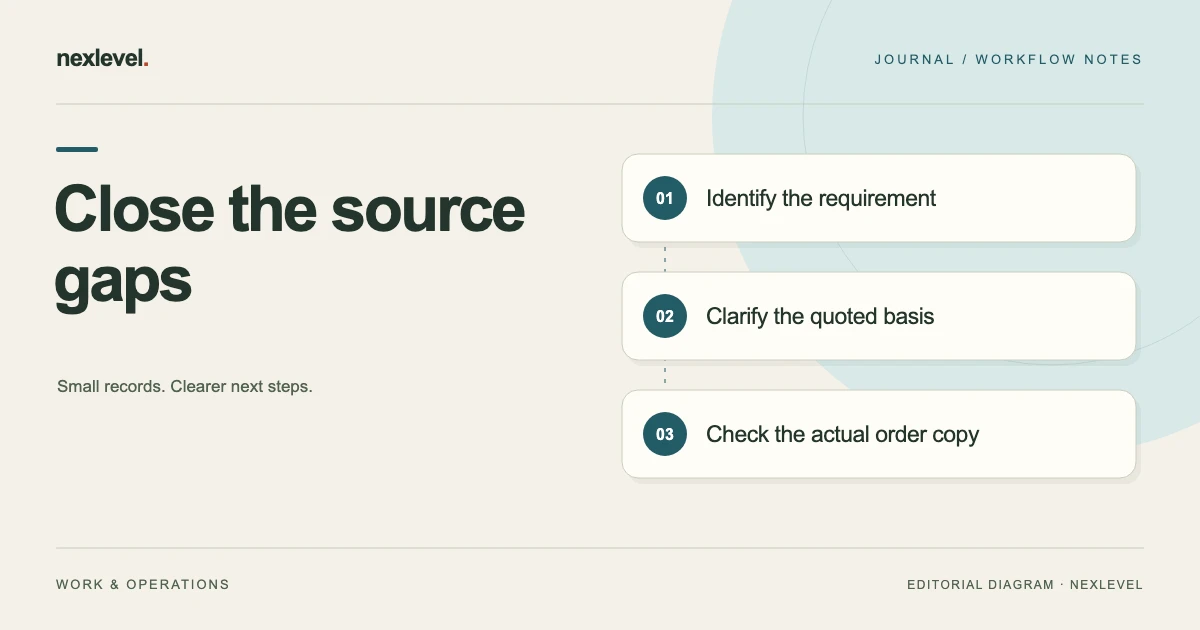
Before creating a purchase order from a quote, check whether the source establishes the item, unit, price basis, currency, charges and delivery context. Record each missing detail as a specific question; an unknown delivery charge should stay unknown until its source is clarified.
Resolve the gaps that change the order
- Match the current request to the selected supplier quote and revision.
- Check item variant, commercial unit, pack contents, price basis and currency.
- List missing charges or timing details with the person responsible for clarification.
- Carry each sourced answer into the intended PO and inspect its actual output for older copied values.
Working fields:
Request | Quote/revision/line | Missing detail | Exact source wording | Question/owner | Clarification source | PO version
Useful next steps: Compare different pack sizes, Turn a clarified quote into a PO.
Start with the requirement reference
Record the requested item, relevant specification, quantity, project context, and intended use. A quote for a similar item should not silently define the requirement.
Keep unanswered requester questions distinguishable from supplier omissions. The buyer may need clarification on both sides before a meaningful order can be prepared.
Use the responsible technical and business process to establish suitability and authority. The worksheet organizes information rather than making those determinations.
Check quote identity and edition
Record supplier, quote reference, issue date, relevant line, and any stated validity or revision information. Several files can describe different offers for the same request.
Keep the actual source available. A price copied into a message may omit the conditions that make it applicable.
If a revised source arrives, identify what changed and which edition is intended for the order. Preserve the earlier reference according to the actual process.
Check the commercial unit
Identify whether the quantity and price concern pieces, boxes, cartons, sets, or another unit. Keep the pack contents and conversion explicit where needed.
A quote saying “five” without a unit can lead to a different order from the one intended. Do not assume the supplier uses the same shorthand as the internal requester.
Use the supplier pack-size comparison guide when the unit relationship needs a worked calculation.
Check price and currency together
Record the quoted amount, currency, quantity basis, and any conditions attached to the rate. A bare numeric amount does not establish all of those facts.
Keep a planning estimate or assumed conversion separate from the source quote. Do not present it as a supplier-provided figure.
Use the actual business process for currency and pricing questions. This checklist does not recommend a market rate or a particular purchase.
Check separate charges and inclusions
Identify what the source states about delivery, handling, discounts, tax, and other relevant lines. Keep an unknown charge distinguishable from an established zero.
Review included components where they affect the item. A set description can prevent a missing component or a duplicated line.
The actual business requirements and source determine the relevant treatment. Do not copy a previous supplier’s arrangement as though it governs the new offer.
Check timing and delivery context
Record the requested date, quoted lead-time information, relevant delivery destination, and current confirmation state. Those can describe different events.
An internal desired date is not a supplier promise. Keep a proposal distinguishable from an accepted arrangement under the actual process.
If timing is unresolved, identify the precise source question and responsible person before relying on the order to coordinate later work.
Use an omission-resolution worksheet
Useful fields are request reference, quote edition, affected line, missing detail, source wording, question, responsible contact, clarification reference, current result, and intended PO version.
Keep the original observation and the later answer in separate fields. A clean current order can still have an understandable source trail.
Add any remaining condition. Preparing a document does not mean every business approval or supplier action has occurred.
Work through a missing-unit example
Imagine fictional quote Q14 lists “brackets, quantity 5, rate 30” but does not establish whether the quantity means boxes or individual items. The internal request concerns a larger item count.
The buyer preserves the wording and asks for the commercial unit and pack contents. They do not infer the answer from a product photograph or a previous order.
Once clarified, the relevant order line can state the actual quantity basis and source reference. The example illustrates a question, not an available offer or a recommended supplier.
Walk the unit clarification into the order
Suppose the fictional source clarification establishes five boxes with 12 relevant items in each. The resulting provided quantity is 60 pieces. Keep both the commercial quantity and the interpreted contents visible according to the actual document workflow.
The buyer records Q14’s source and the clarification reference before preparing the PO. A readable line should not turn five boxes into five individual items or multiply an already total 60 again. The exact fields depend on the chosen tool and business process.
Inspect the actual preview. The item description, quantity, rate basis, and relevant notes should explain the intended purchase to someone who did not attend the clarification conversation. A correct worksheet alone does not prove the issued document says the same thing.
If the underlying request was 50 pieces, the example provides ten beyond that requirement. Record any relevant decision about the quantity rather than silently changing the request to 60 and making the extra units disappear from the planning discussion.
Keep supplier acceptance separate from document preparation or the buyer’s recorded sent state. The source clarification resolves the unit question; it does not establish that a real order was sent, accepted, or fulfilled.
Work through an unknown delivery charge
A second fictional offer has a clear item subtotal of 120 currency units but no delivery statement. The worksheet records 120 plus an unresolved delivery question, not a confirmed 120 total.
If the buyer enters a planning allowance while awaiting the source, label that value as an internal estimate. Do not turn it into a supplier commitment through the order’s appearance. The appropriate business process decides whether and how a provisional view can be used.
When a source clarification arrives, retain its reference and identify the charge boundary it establishes. A fixed whole-order amount, per-package amount, and included delivery condition can produce different calculations.
Check the PO preview and related totals after the actual update. Keep a revised document distinguishable where the source or decision changed. An older export can remain a different copy even if the current editor is correct.
The omission review can close the specific delivery question while other issues remain open. Avoid summarizing one useful answer as blanket approval of the entire offer, requirement, timing, or technical suitability.
Work through a variant mismatch
A third fictional quote names variant B, while the request reference names variant A. The buyer records both source descriptions and identifies the responsible suitability question.
A lower quoted amount does not establish equivalence. Use the actual technical and procurement process to decide whether the alternative meets the requirement. This article supplies no engineering or compatibility conclusion.
If the requester confirms a revised requirement, record its source and relationship to the earlier version. Do not rewrite the old request as though it always described B. The source trail should explain why the eventual order uses its selected item.
If the variant remains unresolved, keep that limitation visible in the working record. A prepared PO should not conceal the uncertainty through a shortened generic description.
Inspect linked catalog information where the tool uses reusable entries. A familiar saved item can reduce repeated entry while still needing review against the current supplier source. Keep current and historical values distinguishable through the actual workflow.
Prepare a clear current-source summary
A fictional entry can say: “Request R8; quote Q14 edition 2; commercial unit clarified as boxes of 12; requested count 50; proposed purchase five boxes providing 60. Delivery question remains open. No issued-order or supplier-acceptance event recorded by this worksheet.”
Add real source locations, cutoff, and responsible owners to your own record. The summary should help another buyer locate the relevant evidence without treating every field as independently confirmed.
Ask a colleague to reconstruct one consequential line. They should be able to identify the item, quantity basis, price source, open condition, and intended next action.
Use the ambiguity found to improve the source note or order description. The purpose is a usable preparation record, not a guarantee of supplier performance or a legal determination about the eventual transaction.
Resolve a price-basis ambiguity
A fourth fictional offer contains a numeric rate but leaves its currency or unit basis unclear in the working copy. The buyer opens the actual source and records what it establishes. A familiar supplier does not make every abbreviated amount self-explanatory.
If the source itself is incomplete, the next action names the specific question and responsible contact. A planning worksheet may preserve an assumed view if the business process allows it, but that assumption should not be presented as a supplier-provided commitment.
Keep price, currency, and quantity together when the clarification arrives. Changing only the headline total can leave a contradictory unit field or catalog reference elsewhere in the order. Inspect the actual preview and related source note before relying on the document.
The result record should say what was established and which version uses it. A source check can close the rate question without deciding technical suitability, purchase authority, delivery feasibility, or any tax treatment outside the review’s scope.
Check the current document after a late clarification
A fifth fictional case starts with a PO draft prepared before the supplier answered a delivery question. The answer arrives while a PDF copy is already in the working folder. The buyer identifies the actual current draft and the earlier portable copy before making changes.
Use the tool’s supported workflow to apply the source information. Inspect the line descriptions, charge fields, totals, and relevant notes in the intended output. Do not assume an older downloaded copy has changed because the app’s current editor is correct.
If the draft has not been issued, keep its role clear. If a sent record exists, follow the actual business and document process for a correction or successor. This article does not prescribe a universal amendment rule or determine the legal effect of an order.
A concise note can identify the quote edition, clarification source, affected field, updated document reference, and actual communication state. It should not say a supplier accepted the new arrangement merely because the buyer prepared another file.
Test one line from source to output
Ask another person to start with the requirement, locate the relevant quote and clarification, and identify the quantity and charge basis shown on the intended PO. They should not need a verbal reconstruction from the person who prepared it.
For Q14, the answer should distinguish the requested 50 pieces from the proposed five boxes providing 60, and should identify the still-open delivery question if it remains unresolved. A balanced total does not erase those scope facts.
Record the ambiguity found and correct the appropriate source label or document field. The omission checklist is complete for its selected scope when the current result and remaining questions are clear, not when every row has been filled with a confident guess.
Before closing the selected review, read the actual current source and intended document together. Confirm which gaps were resolved, which amounts remain assumptions, and who owns each open question. Keep the cutoff and source references available. A complete preparation check can leave a purchase decision pending without filling missing commercial information with a confident default.
Use Vendraft after the source gaps are clear
Vendraft records purchase-order items, vendor details, notes, tax, shipping, and receipt states. Its current listing describes preserved document details when an order is marked sent.
Review source details and actual business requirements before sharing the order. Check current capabilities and plan details in the official Vendraft App Store listing. Keep preparation, sent state, acceptance, and receipt events distinguishable.