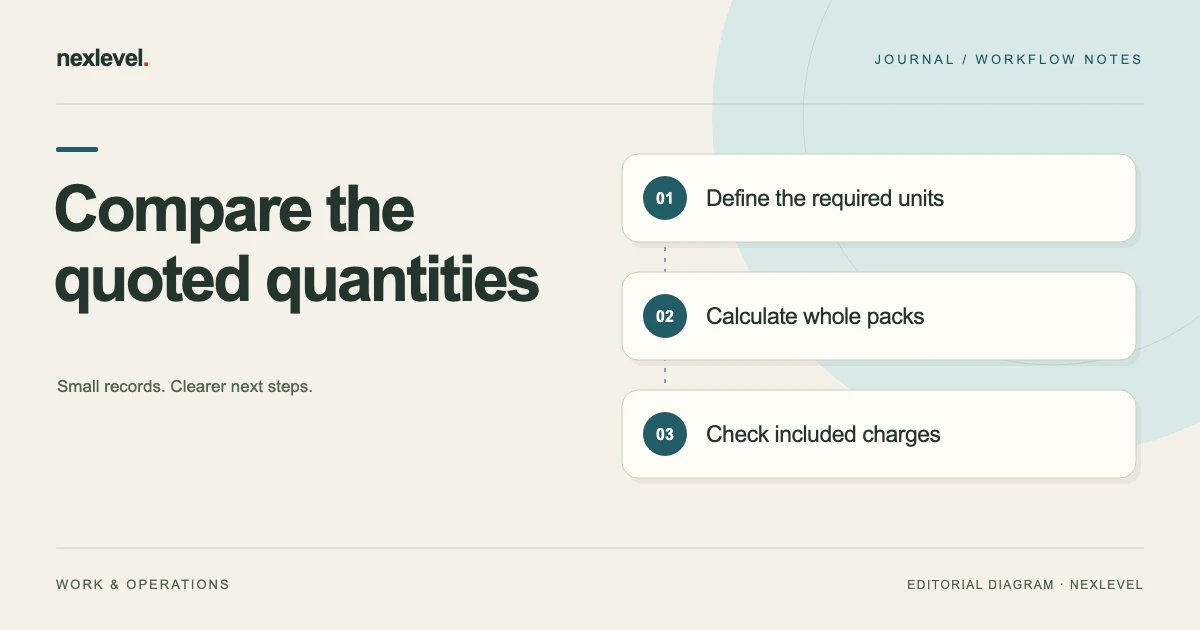
To compare quotes with different pack sizes, convert each offer to a common unit, calculate the whole packs needed for your requirement and add the quoted charges. Keep the source pack price visible: the lowest unit rate may still require a larger total purchase.
Put both offers on the same basis
- Confirm the required item and number of usable units needed.
- Record each quote’s revision, pack contents, currency and price conditions.
- Round the required pack count up where only whole packs are available, showing purchased units and excess.
- Add sourced delivery and other charges, then compare timing and unresolved conditions before selecting an offer.
Working fields:
Quote/revision | Required units | Units/pack | Pack price | Packs needed | Provided/excess units | Separate charges | Conditions
Useful next steps: Resolve omissions in the quote, Map the selected quote into a PO.
Define the required item before comparing prices
Record the item specification, quantity needed, intended use, and any relevant variant. A lower price for a different size, grade, or included component is not a like-for-like comparison merely because the item names resemble each other.
Identify which details come from the actual request and which are still assumptions. If the requester has not confirmed a variant, keep that question open. Do not let the first quote’s description become the requirement by default.
Use a stable internal reference for the requested item. Keep each supplier’s own product or catalog reference alongside it so the comparison can be traced back to the exact quoted line.
Capture each quote’s commercial unit
Record whether the price applies to one piece, one pack, a carton, a set, a measured quantity, or another unit. Include how many required units the commercial package actually contains.
Check nested packaging. A carton might contain several boxes, each with several items. Preserve the source description and show the conversion explicitly rather than assuming a carton is equivalent to the box in another offer.
Where the quoted unit is unclear, ask for clarification through the normal procurement process. A unit conversion cannot establish information missing from the offer. Keep the unresolved field visible before relying on the calculated total.
Keep the quote identity and date
Record the supplier, quote reference, issue date, stated validity period, and relevant line identifier. Similar files can represent revised offers with different pack sizes or delivery terms.
Keep the actual source available and distinguish a supplier-provided amount from an internal estimate. If you add a planning assumption, label it clearly. A completed worksheet should not make every input look like a quoted commitment.
When a revised offer arrives, preserve its relationship to the earlier version. Compare the changed lines deliberately instead of replacing the old file under an indistinguishable name and losing the explanation for a changed total.
Normalize the price to a common quantity
Choose a common comparison unit appropriate to the requirement, such as one item. Divide the quoted pack price by the number of relevant units in the pack. Keep both the original price and normalized rate visible.
If a fictional box contains 12 items and costs 30 currency units, its unit rate is 2.50. A carton containing 20 items for 46 has a unit rate of 2.30. Those figures describe the entered examples, not current supplier prices.
Do not stop at the unit rate. It is useful for understanding the offer, but the required purchase may involve whole-pack rounding, minimum quantities, and separate charges that change the actual order comparison.
Calculate whole packs for the real requirement
Subtract any confirmed usable stock or already committed supply according to the actual request. Then calculate the remaining quantity needed on the same unit basis. Keep the source and timing of the stock check clear.
When only whole packs can be ordered, divide remaining units by units per pack and round up. Record the number of packs, purchased units, and excess quantity. A fractional pack calculation may not represent an available purchase.
Do not round down merely because the displayed decimal is close to a whole number. Check what the actual packs provide against the requirement and document any deliberate change to the requested quantity.
Work through a fictional 50-item comparison
Suppose 50 items are required with no stock allocated. Offer A contains 12 per box at 30, so five boxes provide 60 items for 150. Offer B contains 20 per carton at 46, so three cartons provide 60 items for 138.
Both examples leave ten items beyond the requirement. The lower normalized unit rate and lower pack subtotal point in the same direction here, but the comparison is not yet complete because delivery and other conditions have not been checked.
The worksheet records the source unit, pack conversion, whole-pack count, provided units, and subtotal for each offer. Another person can now reconstruct the quantities without guessing what “five” or “three” means on the draft order.
Add quoted charges without hiding their basis
Record delivery, handling, and other quoted charges separately from the item subtotal. Identify which charges are fixed, quantity-dependent, included, or still unknown according to the actual source.
In the fictional example, delivery is 8 for A and 25 for B. Their illustrated totals become 158 and 163. The offer with the lower item subtotal now has the higher combined total under those stated inputs.
Keep any taxes or other treatment tied to the actual business and quote requirements. This worksheet does not determine tax rules or invent missing charges. A blank or unclear source field should remain a verification question.
Check minimum orders and conditional prices
Read the conditions attached to the quoted line. A displayed rate might depend on a minimum quantity or another part of the order. Record the condition beside the amount so it does not disappear during normalization.
If the fictional B price applied only to four cartons, the three-carton calculation would not establish an available purchase. Obtain the relevant offer for the intended quantity or compare the actual minimum arrangement explicitly.
Do not represent a hypothetical discount as confirmed. Keep proposed alternatives separate from the supplier’s actual quote. The comparison should make it clear which numbers can be acted on and which still require a response.
Keep lead time and quantity fit visible
Record quoted availability, lead time, and delivery assumptions with their source. A lower calculated total may be irrelevant to a requirement that the offered timing cannot satisfy.
Distinguish a requested delivery date from a supplier-confirmed date. A date entered on an internal worksheet does not establish that the supplier can deliver then. Preserve the current confirmation or open question.
Include the operational effect of excess units if it matters to the decision. Storage space or later demand may influence the chosen arrangement, but label those as internal planning considerations rather than pretending they are part of the supplier’s quoted price.
Use a comparison worksheet that retains original units
Useful fields are: requirement reference; item specification; units needed; supplier and quote edition; quoted commercial unit; units per pack; quoted pack price; normalized unit rate; packs required; provided units; excess; separate charges; and unresolved conditions.
Add a decision record with the selected offer, reason, person responsible, and date. Keep selection distinguishable from an issued purchase order or supplier acceptance. They are different events in the procurement sequence.
Retain the source references behind the worksheet. A total copied into a new document should not become detached from the pack size and conditions that made it meaningful.
Check substitutions as a new comparison
If a supplier offers a replacement item or different pack, identify the changed specification and quantity basis. Do not preserve the earlier pack count automatically when the supplied units per pack differ.
For 50 required units, a substitution of ten per pack would need five packs, while a 20-unit pack needs three under whole-pack ordering. The same pack count can represent substantially different provided quantities.
Have the responsible requester confirm suitability through the actual procurement process. A cost comparison cannot establish that a different item meets a technical or operational requirement.
Translate the selected offer carefully
When preparing the order, state whether the ordered quantity is packs or individual units and preserve the supplier reference. An order for five boxes should not become an unexplained quantity of five items.
Carry the relevant pack description, price basis, delivery information, and agreed notes into the order according to the actual tool and business process. Check the resulting document rather than assuming the comparison worksheet transfers perfectly.
Keep the selected quote attached or referenced in your procurement record. It explains why the order uses its particular quantities and terms, especially if a later receipt is expressed in different units.
Plan the receipt check on the same basis
Decide how received packs and individual quantities will be recorded. A delivery of three cartons should be compared with the order’s actual commercial unit and expected contents, not only with the original requirement of 50 items.
Record partial receipts and discrepancies without rewriting the original order to make the delivery appear complete. The receipt history should explain what arrived and what remains outstanding under the actual process.
For a broader worked example, use the partial-delivery tracking guide. Keep the order, receipt, and initial requirement connected while preserving their different quantities.
Ask a colleague to reconstruct the choice
Give someone the worksheet and ask them to reproduce each pack count, item subtotal, and illustrated combined total. They should also identify the source conditions and any unanswered question.
For the fictional example, they should explain why A totals 158 and B totals 163 after the stated delivery charges, even though B has the lower item rate. If that conclusion depends on your verbal explanation, improve the labels.
Record corrections to the worksheet and keep its decision history clear. The test checks the entered comparison; it does not establish current market value or guarantee a supplier’s later performance.
Check whether the decision changes with quantity
Use a separate row when the requirement changes substantially. The same pack prices can produce a different comparison because whole-pack rounding and fixed delivery charges have different effects at different quantities.
For ten required units under the original fictional offers, A needs one 12-unit box: 30 plus 8 delivery totals 38. B needs one 20-unit carton: 46 plus 25 totals 71. For 1,000 units, A needs 84 boxes providing 1,008 units for 2,528 including delivery, while B needs 50 cartons providing 1,000 for 2,325.
These are alternative requirements, not a reason to buy 1,000 items for a ten-item task. Keep each scenario’s quantity, pack count, and purpose visible. A supplier comparison is meaningful for its stated requirement and conditions, not for an unspecified quantity.
Evaluate a quantity discount against the actual purchase
A cheaper pack rate can require buying more packs. Record the actual offered tier rather than comparing its unit rate with the subtotal from a smaller order that does not qualify.
In another fictional variation, B offers four cartons at 44 each. That provides 80 units for 176, or 201 with the stated 25 delivery charge. It has a lower per-item rate than three cartons at 46, yet a higher total purchase than the earlier 163 arrangement.
State any reason for considering the extra quantity, such as separately confirmed later demand. Do not subtract an assumed value for surplus stock simply to make the discounted option appear cheaper for the current requirement. Keep the purchase total and any internal planning assessment distinct.
Use Vendraft after the quantity basis is clear
Vendraft supports purchase orders with catalog items, vendor details, notes, tax, shipping, and receipt tracking. Its current listing describes stored exact units and preserved document snapshots when an order is marked sent. The comparison worksheet above is an independent preparation aid.
Review the actual order before sharing and distinguish your recorded sent state from supplier acceptance. Check current features and plan details in the official Vendraft App Store listing.