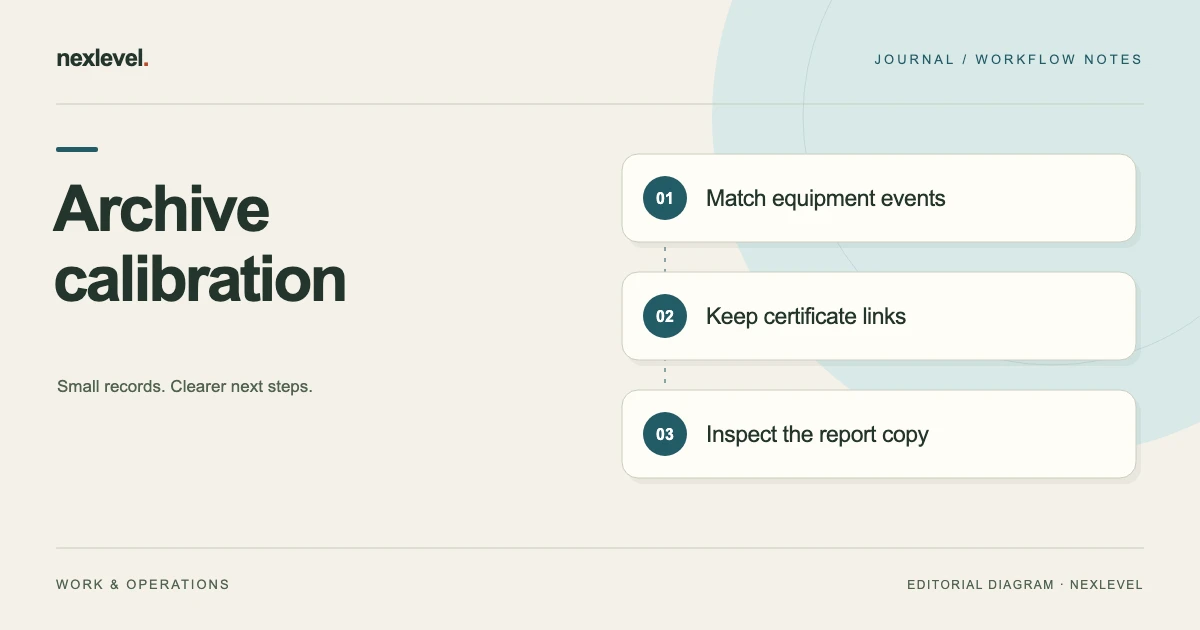
Archive calibration records around the instrument and selected event, with a usable route to the certificate source and a clear report cutoff. Label register exports, reports and original evidence for their different roles. The archive should explain both an established relationship and any question still open.
Build an archive that answers a retrieval question
- Define the equipment, event range, intended reader and archive purpose.
- Index each event against its actual certificate reference and source route.
- Keep service, issue, review and preparation dates distinct.
- Open the selected export and identify what is included versus only referenced.
- Test retrieval from equipment to certificate and back again.
Working fields:
Equipment/event | Certificate reference/source | Date roles | Report/cutoff | Included or referenced | Open question | Retrieval result
Useful next steps: Prepare a calibration handoff, Check a disputed certificate relationship.
Define the archive question
Choose the later retrieval task before preparing a large packet. A reader may need to find the certificate reference for one entered event or understand why a selected item appeared in a due queue. Those tasks differ from deciding whether equipment is fit for a particular use.
Write the equipment scope, selected event range, source cutoff, intended reader, and archive purpose. A packet concerning one instrument should not appear to represent a whole facility or every later service event.
Use the actual responsible quality and privacy arrangement for access. A useful index can retain source routes without copying unrelated customer information or credentials. The practical goal is understandable evidence relationships, not maximum file volume.
Preserve equipment identity before certificate context
Equipment names can be reused across locations or changed over time. Retain the actual identifier, serial context, location reference where relevant, and selected working-record route. A familiar nickname alone may be insufficient for another reader.
CalibraDue currently supports equipment identity, serial numbers, locations, service intervals, events, certificate references, and notes. Those fields organize entered information. They do not independently verify the physical instrument or the certificate’s substantive meaning.
If a source relationship remains uncertain, keep it as a question before building a confident archive summary. Do not attach a certificate solely because its file name resembles the equipment label.
Use an equipment-to-evidence index
One row should explain a selected event and certificate relationship. Use another row when a later clarification or different source occasion needs separate treatment.
| Field | What to preserve |
|---|---|
| Equipment | The actual selected record and identifying context |
| Event | Which entered service occasion is represented |
| Certificate source | The reference and usable route to the actual evidence |
| Date role | Service, source issue, entered due context, or archive preparation |
| Output | The intended register or report copy and its cutoff |
| Limitation | The exact relationship still needing review |
These are independent companion prompts. They do not establish that every field is a native app control or automatically appears in every export.
Work through a fictional instrument packet
Imagine equipment Q14, entered event E2, and certificate reference C5. A retained register copy lists Q14, while a companion note gives C5 without a complete event relationship. The archive task is to preserve what the actual sources establish.
The first row identifies Q14 using its selected source context. The second identifies E2 as the event under review. The third records whether the actual evidence establishes C5’s relationship to Q14/E2, rather than assuming the reference is sufficient on its own.
A fourth row identifies report R6 and the source cutoff represented by the intended copy. It distinguishes the prepared report from later working-record changes. A fifth row retains an unresolved certificate-source question where the evidence remains unavailable.
The packet can therefore explain the selected record and its limit without inventing a calibration result. No real instrument, reading, interval, tolerance, certificate, or compliance conclusion is supplied by this example.
Keep date roles separate
A service occasion, certificate issue date, entered due context, later review, and archive preparation can describe different moments. Preserve their actual source meaning rather than flattening them into one generic calibration date.
This guide recommends no interval. An entered recurring schedule is organizational context, not independent evidence of a manufacturer’s requirement or an acceptable calibration period for every use.
If the actual source establishes only limited precision, preserve that limit. Do not invent a day or clock time to make a table uniform. A current-looking date should not obscure the question a later reader needs to resolve.
Respect append-only event history
CalibraDue’s current listing describes calibration events as append-only. Keep the selected history understandable rather than designing an archive process around an assumed ability to rewrite every earlier event.
An index correction is not automatically another calibration event. If the register is accurate while a companion summary gives the wrong certificate relationship, repair the summary. Do not record a fictional service merely to document an administrative review.
If an actual source issue is established, use the supported workflow and inspect the result through the responsible process. This guide does not invent a universal amendment, merge, or historical-rewrite feature.
Use QR lookup as a route to the record
The current app supports QR labels and scanning to open the selected equipment record, with manual lookup when camera access is unavailable. These routes can help retrieval without independently proving the physical label belongs to the intended instrument.
For the archive, preserve enough identifying context that the reader can recognize Q14 if a label is unavailable or a short code is ambiguous. A successful lookup should not replace the source check of equipment and certificate identity.
This article supplies no labeling standard or physical inspection procedure. The actual responsible organizational process determines those requirements and any verification needed outside the app’s recordkeeping role.
Keep source evidence distinct from a register reference
A certificate reference points to evidence; it is not necessarily the original certificate itself. Keep a usable source route within the actual private arrangement where the reader needs to inspect the underlying material.
The current description supports certificate references and notes. Do not invent a general binary-attachment vault, arbitrary document import, or automatic provider connection to make the archive sound complete.
For a disputed relationship, use the certificate-to-equipment matching guide. The archive should retain its established result or precise open question.
Keep queue labels and reminders within scope
A due, overdue, or certificate-pending label reflects entered information under the working app’s rules. It should not be presented as independent certification, proof of a completed service, or a conclusion about measurement suitability.
A configured reminder is a local prompt. It does not establish that another person received a notice or that the underlying requirement was fulfilled. Preserve the actual source relationship where the archive concerns a past queue state.
For a current work review, use the calibration due-work review guide. The historical packet can support that task without automatically establishing its outcome.
Inspect the actual portable output
CalibraDue currently describes CSV register export, with formatted PDF audit packets and expanded active-equipment capacity under Pro. Check actual plan access and the selected output before promising a particular history or report scope.
A PDF audit packet is a representation of entered records. Its name does not grant accreditation or certify measurement results. A CSV register is not automatically the entire editable app, a certificate repository, or an arbitrary restore mechanism.
Open the actual intended copy and inspect Q14, E2, C5, relevant date roles, source cutoff, and limitation. A companion index may need to explain a relationship not included automatically in the output.
Prepare a readable cover sheet
The fictional cover sheet can begin “Q14 / selected event E2 / certificate reference C5 / report R6.” Its value comes from the index explaining those relationships, not from the short identifiers themselves.
The next line can state which source established the certificate relationship and which question remains unresolved. Keep those outcomes separate. A generic complete flag would hide whether the original evidence was actually inspected.
Add a contents line naming the actual prepared materials and their purpose. A readable report, a structured register, and a source-reference index can serve different tasks. Do not imply that one file automatically contains every other part.
For another person continuing the review, use the calibration record handoff guide. The archive does not itself transfer responsibility or provider access.
Test retrieval in both directions
Ask an authorized reader to start with Q14/E2 and locate C5’s actual source. Then start with C5 and identify which equipment/event relationship is established. Similar filenames should not be the sole basis for either route.
Ask what R6 represents and what remains outside its cutoff. The reader should distinguish a current working record, retained report, certificate reference, and actual source evidence without the original writer’s memory.
If the source relationship remains unavailable, retain that limitation. A useful archive can make the next check clear without claiming that every missing certificate question has been resolved.
Leave an archive receipt with bounded meaning
The receipt identifies selected sources opened, relationships established, intended output inspected, and next question. It records an administrative evidence review, not a calibration service or compliance approval.
A later clarification should retain its own source occasion. Do not make an earlier report appear to have included facts that were unavailable when it was prepared. Likewise, a new service event should remain distinguishable from a correction to an explanatory index.
Do not delete working records merely because a file exists. File preparation and a usable retrieval process are separate results. Inspect the intended task through the actual supported workflow and responsible arrangement.
Compare the register, report, and source evidence
Give the fictional Q14/E2 packet three purpose labels: register representation, report R6, and actual certificate-source route C5. These materials can support the same review while answering different retrieval questions. A report’s title should not make it stand in for the original evidence.
Start from the register row and ask whether a reader can identify the selected equipment and event. Then start from R6 and ask which cutoff it represents. Finally, inspect the actual C5 source relationship through the appropriate authorized arrangement.
Introduce a separate fictional equipment record Q15 with a similar model label. A similar name should not redirect C5 automatically. Keep the actual equipment identity and event relationship visible before describing a certificate as belonging to either record.
If the companion index assigned C5 incorrectly while the working register was accurate, repair the index. The administrative correction is not another calibration event. It should not create a new service occasion merely to make the archive appear updated.
Keep any remaining source question precise: which actual evidence establishes C5’s relationship to Q14/E2? That is more useful than a broad certificate-missing label when the real issue is attribution rather than file existence.
Ask the intended reader to state what the completed review establishes. It can establish a documented source relationship and a usable output while not evaluating the certificate’s technical conclusions, measurement uncertainty, accreditation, or equipment suitability.
A later source can then clarify the relationship with its own occasion preserved. The earlier R6 copy remains interpretable as historical information rather than a document that silently acquired new facts. This keeps the archive readable without inventing a provider connection or a historical-rewrite feature.
A retrieval label can combine the independent equipment reference with the selected event and report occasion. Keep the certificate-source route in the index as well. A shortened filename should not be the sole evidence connecting Q14 to E2 or C5, and a report title should not imply that the original certificate is embedded when it is only referenced.
Use CalibraDue for clear entered evidence
CalibraDue connects equipment identity, append-only event history, certificate references, and due-work context in a local register. Use the companion index when the retained copy needs additional source relationships explained.
Check the official CalibraDue App Store listing for current features and Pro output access. Preserve the evidence relationship while leaving measurement interpretation, quality-system requirements, and professional decisions with their actual responsible sources.