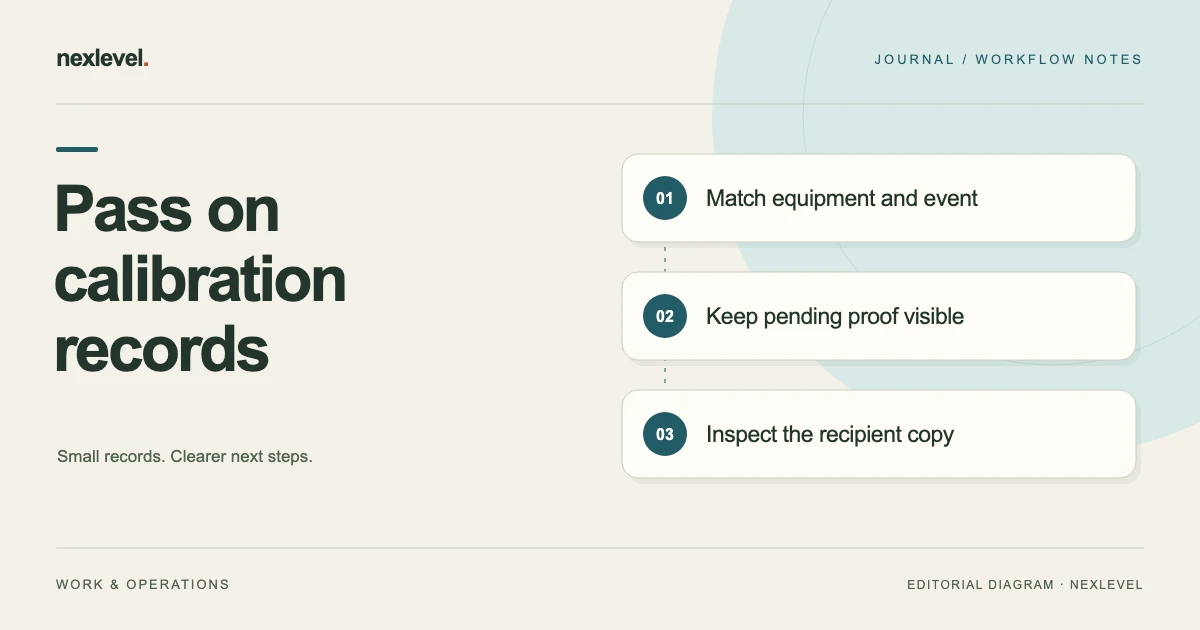
A calibration handoff should let the recipient find the equipment record, identify the selected event and continue any certificate question without reconstructing the conversation. Include the actual source route, its access limits and the next owner. State the packet's cutoff so later evidence remains recognizable.
Package one clear equipment-to-evidence question
- Define the recipient's task, selected equipment and cutoff.
- Name the event and certificate reference with their actual evidence state.
- Check the recipient's route to the underlying source.
- Assign the unresolved question and explain which register or report copy to use.
- Ask the recipient to identify the next source check from the packet alone.
Working fields:
Equipment | Event | Certificate/source route | Available to recipient | Exact question | Next owner | Packet/cutoff
Useful next steps: Match the certificate before closing the question, Prepare the due-work action queue, Retain the handoff with its source context.
Define the recipient’s actual task
A person taking over due-work tracking needs a different packet from someone reviewing one certificate question. Name the actual task before preparing a large export.
Choose the equipment scope and review cutoff. A selected register copy can be accurate without representing every asset or every later update.
CalibraDue’s current description presents a local equipment workspace. It does not advertise automatic multiuser assignment, a shared cloud quality system, or issuer verification.
Use the intended organizational process for responsibility and source access. An independent handoff can explain those relationships without claiming the app transfers them automatically.
Keep equipment identity attached to every question
Use the actual equipment reference, serial context, and recorded location where relevant. Similar equipment names should not be enough to choose a certificate or event.
An independent packet label such as E27 can help a reviewer follow the example. It is a companion reference rather than a claim about a required app field.
CalibraDue’s listing describes equipment identity, serial numbers, locations, service intervals, calibration events, certificate references, and notes. Preserve the source relationships rather than copying only a status label.
Keep sensitive information appropriate to the recipient. A general handoff summary does not need unrelated organizational access credentials.
Separate event history from certificate availability
A recorded calibration event and an available certificate reference can describe different administrative states. A certificate-pending question should remain visible rather than being hidden in a broad “done” note.
The current listing says calibration events remain append-only. Preserve the selected event’s identity while reviewing later evidence rather than rewriting earlier history to make it look complete.
This guide does not decide whether equipment may be used or whether a certificate satisfies a particular requirement. Those decisions belong to the responsible quality process and source documents.
The packet should show what the register actually establishes and what still needs clarification.
Use a handoff packet template
Suggested fields are equipment reference, selected event, entered date context, certificate reference, actual source location, evidence state, open question, next owner, and intended register copy.
Equipment: [source-backed identity]. Event: [selected history entry]. Evidence: [reference and actual availability]. Question: [specific missing relationship]. Next check: [responsible person and source needed]. Packet scope: [selected equipment and cutoff].
Do not fill an uncertain certificate reference from a similarly named file merely to complete the row. Keep the missing relationship explicit.
The template is an independent administrative aid. It does not claim a native handoff form, automatic evidence collection, or a validated approval workflow.
Work through a fictional pending-certificate transfer
Imagine equipment E27 with recorded event C4 and an unresolved certificate question. Equipment E28 has a similar short name but a different identity source.
The outgoing reviewer prepares an E27 row that identifies C4 and the missing evidence relationship. The next reviewer can see which source needs checking without assuming E28’s available certificate resolves E27.
If a later document is received, the responsible reviewer matches it to the selected equipment and event through the actual source. Until that relationship is established, the handoff should not describe the question as resolved.
The example supplies no measurement result or technical acceptance criterion. It tests whether the evidence question stays attached to the correct record.
Use QR lookup as a route to the record
CalibraDue’s current listing describes generating QR labels and scanning them to open the selected equipment record, with manual lookup available when camera access is unavailable.
A successful lookup helps locate the entered record. It does not independently validate the physical equipment, certificate contents, or measurement performance.
During the handoff, ask the recipient to identify the actual record reached by the supported lookup. Keep the manual source route available where needed.
Do not infer that a QR label establishes issuer verification or a regulatory approval. Its advertised role is record retrieval.
Keep the actual certificate source inspectable
A certificate filename or reference can help locate evidence without establishing its contents. Open the actual source through the authorized organizational process when the review task requires it.
The current description establishes certificate references and plan-dependent certificate history. Do not invent a general document-upload or external-issuer integration feature from those words.
For identity matching, use the separate certificate-to-equipment review guide. The handoff can preserve the outcome or unresolved question from that task.
If source access remains unavailable, say so. A clear source limitation is more useful than an unsupported statement that the evidence was checked.
Separate due dates and reminders from conclusions
An entered service interval and due date organize review. A local reminder prompts the configured person or device. Neither independently establishes technical fitness or a valid measurement result.
Inspect the actual reminder context used for the handoff. Do not assume a reminder on the outgoing person’s device appears automatically for the recipient.
This guide provides no recommended service interval or universal escalation timetable. Use the relevant actual requirements and responsible process for those questions.
For a selected due-queue review, see the weekly calibration-record review guide. A transfer should preserve which questions remain after that review.
Prepare the supported register output
CalibraDue’s listing includes CSV export in the free workflow and formatted PDF audit packets under Pro. Check actual plan access and choose the output the recipient’s task needs.
Open the prepared file. Verify equipment references, selected scope, event context, certificate references, and relevant limitations.
Do not assume every independent packet field appears automatically. A concise companion note may be needed to identify the next owner and unavailable source.
A portable file is a representation at a preparation point. It is not automatically the complete editable workspace or a live issuer record.
Keep administrative closure distinct from equipment decisions
The handoff question can be administratively resolved when the selected source relationship is established and the intended copy is clear. That does not necessarily decide a separate operational or quality question.
For E27, locating and matching the actual certificate source is different from interpreting its technical result. This guide performs neither task on real equipment.
CalibraDue’s current description explicitly says it does not perform calibration, certify results, grant accreditation, or replace a quality system.
Use that boundary in the recipient explanation. A formatted audit packet should not be described as a certification issued by the app.
Correct the appropriate copy
If the working event and evidence reference are accurate but the handoff summary names E28 by mistake, repair the summary. Do not alter accurate E27 history to match a copied label.
If an actual record issue is established, use the supported workflow and inspect the result while respecting the append-only event model described by the product.
This guide does not invent a particular event-edit or reversal control. The actual interface and responsible process establish the available correction path.
Identify the intended replacement copy through the actual sharing arrangement. A recipient’s retained export does not update just because another source changes.
Test one equipment-to-evidence relationship
Ask an authorized recipient to reconstruct E27/C4 from the packet. They should identify the equipment, event, certificate question, actual source route, and next responsibility.
If they choose E28’s certificate from a similar filename, improve the identity context. If they assume a pending label means a technical failure, clarify the administrative state.
A short fictional receipt can name the selected scope, source inspected, unresolved question, and prepared copy. Replace general template wording with the actual result.
The test checks continuity of the documentation. It does not validate measurements or establish compliance.
Continue from the open question after the transfer
At the next check, begin with the exact E27 source question. Record what became available and what relationship was actually established.
Do not repeat a calibration event merely to make a pending certificate label disappear. A documentation question and a physical service event have different meanings.
If the source still does not establish the answer, retain the limitation and responsible next owner. A complete-looking register made from assumptions is less useful than a bounded record.
Keep later review notes distinguishable from the original event so a future reader can reconstruct what was known at each occasion.
Write the fictional open-question packet in full
A useful E27 row can state: “Selected event C4 identified in the working register. Certificate relationship remains pending in this packet. Source holder to provide or identify the actual evidence for E27/C4. Similar E28 evidence is not being used as a substitute.” The references explain the question without introducing a measurement result.
A second row can identify the source route and its actual availability. If the recipient can reach only metadata during the transfer, say so. If the actual document was opened, record the bounded identity check performed. Neither result should be inflated into a technical review that did not occur.
Now imagine a document arrives after the packet cutoff. The receiving reviewer should first establish whether it concerns E27 and C4. A matching short equipment name is insufficient when E28 has a similar label. Use the actual identity source and the responsible process rather than attaching the file to whichever record was open.
If the relationship is established, retain the later evidence context beside the selected historical event through the supported workflow. Do not create another calibration event merely to represent receipt of a document. The physical service event and the administrative evidence event answer different questions.
If the relationship is not established, preserve the exact reason: wrong or unclear equipment identity, uncertain event occasion, unavailable source content, or another actual limitation. A generic “certificate issue” label leaves the next person to redo the initial reasoning.
Finally, compare the recipient copy with the working register. Check that E27/C4 remains the subject and that E28 appears only where needed to explain the distinction. Remove unrelated private information from the handoff scope rather than copying a larger register for convenience. Ask the recipient to name the next source check in one sentence. They should not infer equipment acceptance, technical failure, or a new service requirement from the documentation gap. The packet’s role is continuity of the evidence question, with accountable responsibility and a source route that can actually be used.
Distinguish “source not included in this packet” from “source not available anywhere.” The first describes the handoff copy’s scope; the second is a much broader claim that the selected review may not establish. Use the narrower accurate wording and identify where the next reviewer can check.
Similarly, a certificate-pending label and a due-date label can answer different administrative questions. Retain their actual source context instead of turning both into a generic equipment judgment. The recipient should be able to say whether the next task is to locate evidence, clarify an entered date, or consult the responsible quality process. That specificity makes the handoff actionable without claiming technical authority from the app or the worksheet.
Use CalibraDue for the working calibration register
CalibraDue organizes equipment identities, due work, append-only events, certificate references, QR lookup, and portable registers. Its current Pro description expands active equipment, certificate history, reminders, and formatted PDF packets.
Check the official CalibraDue App Store listing for current features and plan details. Use a concise independent handoff to preserve open evidence questions while keeping technical and quality decisions with their actual responsible sources.