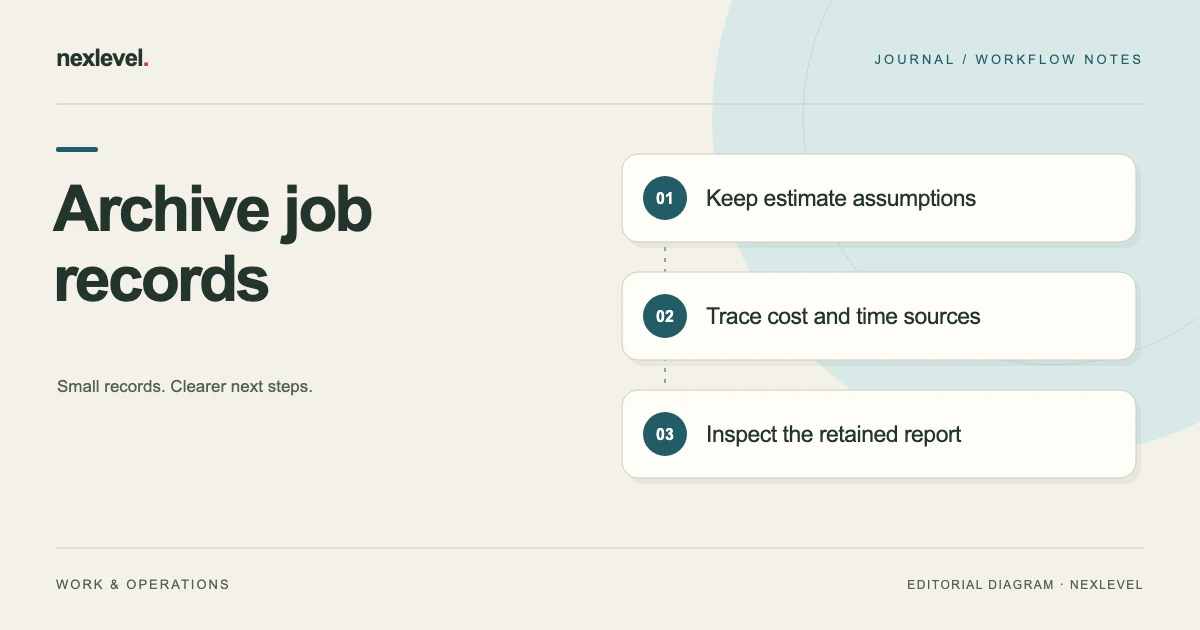
A useful service-job archive preserves the job identity, selected estimate, actual cost sources, receipt relationships, owner-time basis and report cutoff. Keep a short index beside the retained output so a later reader can reconstruct the comparison. A margin screenshot or PDF alone may leave essential context outside the file.
Archive the explanation behind the result
- Choose the historical question, selected job, cutoff and authorized reader.
- Index the estimate, direct-cost sources, owner-time record and receipt allocation with their distinct roles.
- Keep calculation definitions and exclusions beside the retained result; label later information as later.
- Open the actual report and note which source relationships need a companion explanation.
- Test retrieval from both the result and the receipt before deciding the packet is usable.
Working fields:
Job/estimate | Archive purpose/cutoff | Cost sources | Owner-time basis | Receipt allocation/source route | Metric scope | Retained output | Missing relationship | Retrieval check
Useful next steps: Preserve quote and actual-cost history, Document a shared receipt’s allocation, Prepare a report another reader can interpret.
Choose the historical question
A later reader may need to reconstruct an estimate-versus-actual difference, locate the source behind one cost, or understand the time valuation used in a report. Those questions can need different evidence.
Write the selected job/estimate scope, source cutoff, preparation occasion, intended reader, and output. A packet about one job should not appear to represent every later quote or account change.
Keep access proportional. A companion index can preserve authorized source routes without collecting unrelated customer, supplier, or account material into a broad shared folder.
Separate estimate and later entered records
A frozen estimate and a later cost/time record have related but different roles. An actual entry should not silently make the original estimate appear to have predicted the result.
JobMargin Pocket’s current description includes entered revenue, direct costs, labor value, frozen-estimate comparison, receipt images/PDFs, management summaries, and plan-dependent reports.
The archive should identify the actual selected source relationships rather than let a current dashboard stand in for every historical assumption.
Use an estimate-and-cost archive index
One row can identify each selected source role. Keep estimate, job, cost/time sources, receipt allocation, model scope, output, and limitation separate where their sources differ.
| Field | What to preserve |
|---|---|
| Job and estimate | The selected identity and historical assumptions |
| Direct costs | The actual entered source occasions |
| Owner time | The selected duration/value basis |
| Receipt relationship | The actual job allocation or source question |
| Management comparison | The explicit model scope and cutoff |
| Output | The retained representation and limitation |
These are independent companion prompts, not a dedicated archive module or a guarantee that every explanatory line appears automatically in a report.
Work through a fictional management packet
Imagine job J68, frozen estimate E2, direct-cost source C4, owner-time note T3, and receipt reference R5. Retained output P8 represents the selected cutoff.
Under a deliberately independent model, entered revenue is three hundred units in one invented currency. Estimated direct costs are ninety, and three hours are valued at twenty per hour, giving sixty of owner-time value.
With no other cost or fee assumed, estimated remainder is 150 and margin fifty percent. A later entered direct total of 105 at unchanged revenue/time gives remainder 135 and margin forty-five percent. The remainder is fifteen lower.
No real job, labor rate, cost, revenue, transaction, profit, or payment outcome is supplied. The figures demonstrate management-record relationships rather than actual accounting results.
Keep quote revisions and actual costs distinct
A revised proposed price and an actual cost entry can concern different source roles. The archive should preserve which one changed and at what occasion.
Use the quote-revision versus actual-cost guide for that narrower review. Retain its actual result or precise limitation.
A later working figure should not silently rewrite E2’s selected assumptions. If an explanatory copy is wrong while the source is accurate, repair the explanation.
Preserve owner-time meaning
Elapsed time, entered labor value, billed labor, and actual payment can have different meanings. T3 should retain its actual source role rather than become proof of payroll or an invoiced amount.
The current app describes owner-time valuation and a labor timer, with timer access under Pro. Check actual access instead of promising every time tool in the Free workflow.
The fictional twenty-unit input is not a recommended rate. This guide supplies no labor-market value, employment rule, or accounting treatment.
Keep receipt allocation tied to the selected job
A supplier receipt can support one selected cost relationship without independently establishing every job allocation or physical use of materials.
Use the split-receipt guide for that narrower task. Preserve the actual source basis instead of assigning an entire receipt by a matching name or amount.
For R5/C4/J68, identify the established relationship or precise limitation. More attachments do not automatically make the packet accurate if they concern another job.
Preserve model scope beside the result
The fictional model uses three hundred minus ninety minus sixty to give 150, and 150 divided by three hundred to give fifty percent.
The later scenario uses three hundred minus 105 minus sixty to give 135, and 135 divided by three hundred to give forty-five percent. Those calculations deliberately omit every cost not stated.
The fifteen-unit difference compares entered scenarios. It establishes no actual net profit, tax result, completed transaction, saving, or recommended pricing strategy.
Keep trends and alerts in their entered role
JobMargin Pocket currently describes dated trends, target-margin context, and plan-dependent alerts. A visual signal summarizes selected entered records rather than independently verifying business performance.
A chart should retain the actual source basis and selected period. It cannot repair an unclear receipt relationship or create a missing cost occasion.
Do not infer a physical event or payment merely from a completed-looking job view. Keep the strongest event established by the actual source.
Inspect the actual PDF or CSV
The current listing describes job PDF and portfolio CSV reports with Pro access. Check actual access and open the selected representation.
Inspect job/estimate identity, source assumptions, direct-cost occasions, time/value context, receipt relationships, model scope, and cutoff. A companion explanation may be needed where the output does not represent every relationship automatically.
The public description does not establish arbitrary spreadsheet import or universal full-workspace restoration. A portable job packet can support bounded retrieval without being the entire editable app.
Prepare a cover note for P8
The first line can identify J68/E2, the selected cutoff, and the archive purpose. Separate source lines name C4/T3/R5 and their actual roles.
A model section preserves the three-hundred-unit revenue basis, two selected direct-cost scenarios, owner-time assumption, and no-other-cost scope.
A contents line should name only what was retained. A frozen-estimate representation, job report, receipt source, time note, and companion index can serve different purposes. A filename called profitable does not establish an accounting result.
Test retrieval from the margin and receipt
Ask a reader to begin with the fictional forty-five-percent scenario and reconstruct its selected inputs. Then begin with R5 and locate the actual job/cost relationship.
Introduce another fictional job J69 with a similar client label. The reader should use actual references rather than assign C4 or R5 to the closest-looking record.
If the retained copy loses a relationship preserved in the working source, repair that copy. If the original source remains uncertain, retain the question rather than inventing a cost, physical action, or payment.
Keep later clarification visibly later
A later source may clarify a receipt allocation or estimate relationship. Retain its own occasion and connection to P8 rather than making the historical packet appear to have known it earlier.
A correction to a companion explanation is different from changing an estimate, entering another cost, or recording a payment. Keeping those purposes distinguishable prevents archive repair from creating job history.
A concise receipt can name sources inspected, arithmetic checked, representation opened, relationships established, and next question. It documents an administrative review without a profit or productivity claim.
Keep the packet proportional and usable
A small selected packet can be easier to retrieve than a broad folder of unrelated job material. Include what the intended question needs and identify where relevant sources remain elsewhere.
Keep identity, source roles, cost scope, time units, currency, and cutoff inside the packet as well as in filenames. A copied report should retain the basis needed to reproduce the model.
Do not delete the working job history merely because a file exists. Output preparation and reliable retrieval are separate results, and this guide does not prescribe a retention period.
Separate retention from pricing and tool selection
For a different model question, use the fixed-versus-hourly worksheet. Its source scope differs from preserving one historical job.
For method selection, use the job-cost system comparison. Choosing a tool and preparing one archive have different requirements.
The fictional figures remain teaching inputs. Reuse the source-index structure with actual authorized records while preserving management-model, physical-work, accounting, and payment boundaries.
Complete the management-source cover sheet
The P8 cover note can keep revenue basis, selected direct costs, owner-time model, estimate context, and later actual sources on separate lines. This is an independent worksheet rather than a claim about every internal app formula.
| Component | Fictional estimate | Later fictional scenario |
|---|---|---|
| Entered revenue | Three hundred | Three hundred |
| Direct costs | Ninety | 105 |
| Owner-time model | Three hours × twenty = sixty | The same stated sixty |
| Simple remainder | 150 | 135 |
| Remainder divided by revenue | Fifty percent | Forty-five percent |
No actual net profit, tax, payroll, transaction, or recommended rate is established. The figures preserve the selected source roles under the deliberately limited no-other-cost model.
Compare two possible retained job packets
Imagine packet A contains only a margin summary. Packet B contains the selected supported report and a companion estimate/cost-source index. Neither is automatically sufficient; compare each with the intended historical question.
If the task is to locate one selected management result, packet A may provide a useful route once identity and cutoff are established. If the task is to reconstruct E2/C4/T3/R5, the additional relationships in packet B matter.
Now suppose packet B assigns R5 to another job with a similar label. Its extra detail does not make it accurate. Repair the source relationship rather than changing an accurate cost record to match the summary.
A bounded continuation question can ask which authorized source establishes the selected receipt allocation. It should not require reconstructing a whole portfolio when one relationship remains uncertain.
Keep job identity, cost scope, time/value meaning, currency, and cutoff inside the packet as well as in filenames. A copied report can lose its original folder context.
If later source information clarifies an actual cost, preserve its own occasion and relationship to P8. It should not make the original estimate appear to have predicted the later value.
The completion receipt can name sources inspected, arithmetic checked, representation opened, relationships established, and next question. It records an administrative review without a claim about actual business profit, pricing success, or completed payment.
The fictional figures remain teaching inputs. Reuse the source-role structure with actual authorized records while preserving management-estimate, physical-work, accounting, and payment boundaries.
For a final practical check, give the reader only P8 and the companion index. Ask them to reconstruct the 150 and 135-unit scenarios and identify the job, estimate, direct costs, owner-time basis, receipt relationship, and cutoff. They should keep the independent no-other-cost model visible rather than call it actual accounting profit. Then ask which authorized source establishes R5’s most specific allocation question. Record any manual explanation needed and whether the source route is usable. A readable report can make the next administrative task clear while preserving uncertainty about physical work, actual costs, and payment. Keep that limit beside the affected reference.
Use JobMargin Pocket for traceable entered cost history
JobMargin Pocket connects entered job assumptions, cost/time records, frozen estimates, management comparisons, and plan-dependent outputs with local core work available offline.
Check the official JobMargin Pocket App Store listing for current capabilities. Preserve the management trail without treating a report as verified business profit or payment evidence.