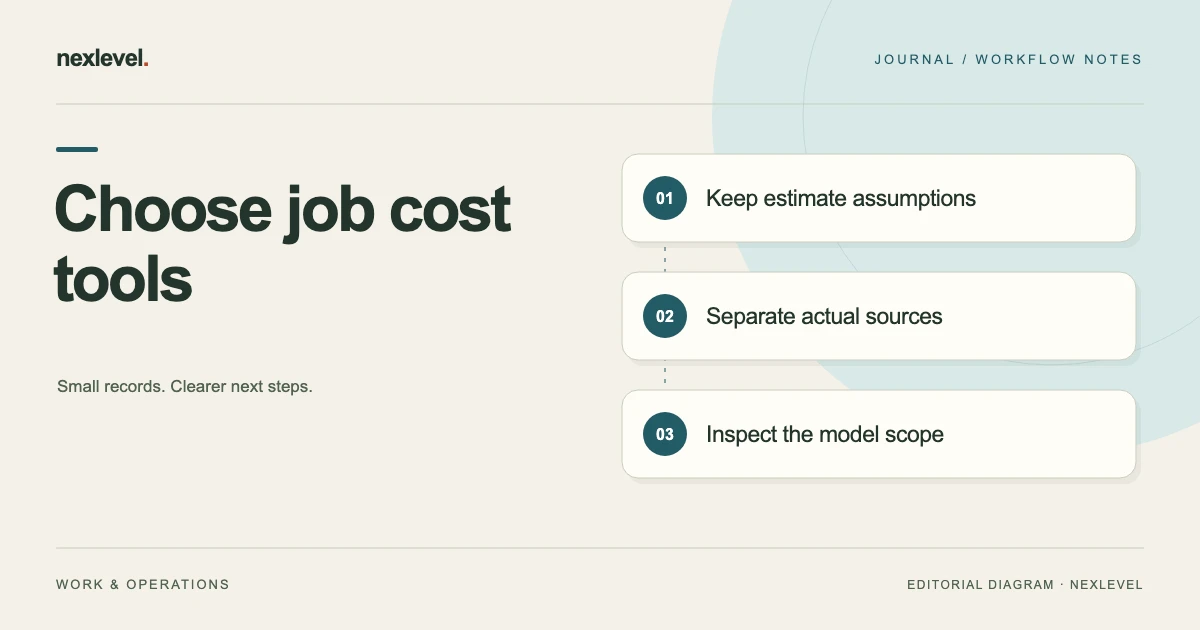
Choose a service-job cost system by running the same small job through paper, a spreadsheet and the app you are considering. Check whether each method preserves the estimate, later costs, owner-time basis and useful output. Clear source relationships matter more than an unexplained margin chart.
Test whether someone can reconstruct one job
- Define the job-record tasks and intended reader before comparing features.
- Use one fictional estimate, later cost source and time valuation so each candidate receives the same test.
- Check paper headings, spreadsheet row roles and formulas, or the app’s actual supported controls and access.
- Open the retained output and ask another reader to reconstruct the estimate-versus-actual difference.
- Record demonstrated strengths, manual maintenance and unresolved source links, then make a conditional choice.
Working fields:
Candidate | Job/estimate roles | Cost and receipt route | Time/value basis | Formula or metric definition | Output inspected | Reader result | Manual dependency | Decision/next check
Useful next steps: Use the common service-job tracker structure, Prepare labor and expense source records, Check what a usable historical packet needs.
Define the actual record task
A quick quote model, a job cost history, and a portfolio comparison serve different purposes. State which tasks matter before comparing charts or margin indicators.
Write the selected job scope, source arrangement, cost/time units, estimate version, intended reader, and output. A method that suits one calculation may need additional structure for later actual comparison.
Use fictional inputs during evaluation. There is no need to perform real work, send a quote, or copy private client records into several tools merely to compare source relationships.
Use a common comparison worksheet
Record demonstrated behavior, manual convention, actual output, and next question for every candidate. Apply the same prompts without assuming identical controls.
| Task | What to demonstrate |
|---|---|
| Identify | Find the selected job and estimate context |
| Model | Preserve entered revenue, cost, and time assumptions |
| Record | Keep actual-source occasions separate |
| Compare | Distinguish estimate from later management result |
| Support | Locate selected receipt-source relationships |
| Retrieve | Interpret the selected portable copy |
These are independent evaluation prompts, not a named comparison module inside JobMargin Pocket.
Set up a simplified fictional job model
Imagine job J53, estimate E2, later direct-cost source C4, and owner-time note T3. Under a deliberately independent one-currency model, entered revenue is two hundred units, direct costs are sixty, and owner time is two hours valued at twenty per hour.
The entered time value is forty. With no other costs or fees assumed, the simple modeled remainder is one hundred, and one hundred divided by two hundred gives a margin of one half.
An earlier estimate uses direct costs of fifty with the same stated revenue/time assumptions, giving remainder 110 and margin 55 percent. The later modeled remainder is ten lower.
Retained copy R8 represents a selected cutoff. No real job, rate, revenue, transaction, profit, tax, or payment outcome is supplied.
Test a paper job book
Paper can use job/estimate headings, separate cost-source rows, time/value labels, and an explicit actual-comparison section. Demonstrate J53/E2/C4/T3 without relying on memory.
Keep the estimate distinct from later entered records. A revised quote or newer note should not silently rewrite what the earlier estimate assumed.
Inspect the retained scan. If it loses cost scope, time basis, or source occasion, repair that copy. Its limitation belongs to the actual representation rather than every paper method.
Test the spreadsheet’s formulas and rows
Decide whether a row represents a job, estimate version, cost observation, time record, receipt allocation, or summary. Repeated J53 references may describe different roles rather than duplicate jobs to remove.
Inspect the actual formulas and intermediate values. Two multiplied by twenty equals forty; two hundred minus sixty minus forty equals one hundred. A final percentage cannot explain an omitted assumption.
Sort and filter the fictional data, then open R8. Job identity, selected estimate, cost sources, time/value meaning, and comparison context should remain connected. Formulas and maintained labels are dependencies.
Evaluate JobMargin Pocket against its current listing
The verified current JobMargin Pocket description includes entered revenue, direct costs, labor value, management profit/margin views, effective hourly return, and dated job/cost/labor trends.
It describes receipt images/PDFs, owner-time tracking, frozen estimates versus actuals, and plan-dependent PDF/CSV output. Pro expands active jobs and includes timers, estimate snapshots, alerts, and reports.
Check actual access. The app provides management estimates rather than accounting, tax, invoicing, payroll, banking, inventory, legal, or financial-advice services.
Keep model scope explicit
The fictional calculation deliberately excludes every cost not stated. It is not a universal formula for actual net business profit or a recommendation about what to omit.
The selected method should preserve revenue basis, cost roles, owner-time valuation, currency, and source occasions so another reader can reconstruct the bounded model.
A chart or alert should not create certainty about a source amount that remains unclear. Retain the exact question rather than choosing a convenient value.
Separate quote revisions and actual costs
A revised proposed price and a later cost entry can have related but different roles. The candidate should not treat them as interchangeable evidence.
Use the quote-revision versus actual-cost guide for that narrower review. Preserve its actual result or precise limitation.
For E2/C4, identify which source belongs to the estimate and which concerns the later record. A current working figure should not silently rewrite the historical assumptions.
Preserve owner-time basis
Elapsed time, entered labor value, and an invoiced amount can describe different roles. T3 should preserve what was entered rather than become proof of payroll or payment.
The current app describes a labor timer and owner-time valuation, with timer access under Pro. Check actual access instead of attributing every time-tracking tool to the Free workflow.
The fictional twenty-unit hourly input is a teaching assumption, not a recommended rate. No actual labor-market value or employment conclusion is supplied.
Keep receipt allocation in its actual scope
A supplier receipt may support one selected cost relationship without independently establishing every job allocation or physical use of materials.
Use the split-receipt guide for that narrower task. Preserve the actual source basis rather than assigning the whole document to the nearest job.
A filename or matching amount should not be the only explanation. If the selected relationship remains uncertain, retain the precise question.
Interpret margin and trend outputs narrowly
Under the explicit fictional model, the estimate gives 110 divided by two hundred, or 55 percent; the later scenario gives one hundred divided by two hundred, or 50 percent.
Those figures compare entered management scenarios. They establish no actual net profit, tax result, transaction, or recommended pricing strategy.
The current app describes dated trends and target-margin indicators. A visual signal should retain its selected source basis rather than become independent verification of business performance.
Inspect the selected PDF or CSV
JobMargin Pocket currently describes job PDF and portfolio CSV reports with Pro access. Open the actual selected output and inspect job identity, estimate version, cost/time scope, receipt relationships, and cutoff.
A companion explanation may be needed for assumptions not represented automatically. A clear working dashboard does not prove every exported source relationship survives.
The public description does not establish arbitrary spreadsheet import or universal full-workspace restoration. Keep the comparison within actual supported capabilities.
Run a second-reader exception test
Give a reader R8 and ask them to reconstruct the simplified 110 and one-hundred-unit scenarios. They should identify the changed direct cost and unchanged revenue/time assumptions.
Introduce another fictional job with a similar name. The reader should use actual references rather than assign C4 or a receipt by the closest-looking label.
Then introduce later source clarification. It should retain its own occasion without making R8 appear to have known it earlier. A current job view and older retained estimate can differ legitimately.
Choose from demonstrated maintenance
Paper may fit a bounded job book with clear estimate and source references. A spreadsheet may fit flexible arithmetic where someone maintains scope, units, versions, and allocations. JobMargin Pocket may fit repeated local job, cost, time, and comparison tasks.
These are conditional workflow comparisons, not measured profit or productivity claims. Choose from the actual task, authorized source arrangement, intended output, and maintenance observed in the trial.
For a different pricing-model question, use the fixed-versus-hourly worksheet. Its source scope differs from selecting a record system.
Complete the management-model trial table
The R8 comparison can keep estimate assumptions, later cost context, owner-time value, and modeled remainder on separate lines. This is an independent worksheet rather than a claim about every internal app formula.
| Component | Fictional estimate | Later fictional scenario |
|---|---|---|
| Entered revenue | Two hundred | Two hundred |
| Direct costs | Fifty | Sixty |
| Owner-time model | Two hours × twenty = forty | The same stated forty |
| Simple remainder | 110 | One hundred |
| Remainder divided by revenue | 55 percent | 50 percent |
The figures use one invented currency and no other cost/fee assumption. They establish no actual net profit, payroll, tax result, transaction, or recommended rate.
Write a decision with its cost-scope dependency
A practical choice may prioritize reconstructing E2/C4/T3 and preserving estimate-versus-actual roles over adding another margin indicator. State the actual task, selected candidate, demonstrated relationships, manual dependencies, output inspected, and next question.
Suppose one candidate displays both percentages but the selected output loses the owner-time assumption. Repair that representation. Suppose another keeps model scope clear but cannot establish which receipt source supports C4. Retain that separate allocation question.
Then remove the original comparison conversation. Ask the reader to reconstruct 110 and one hundred from R8 and identify which entered direct cost changed. They should distinguish the bounded management model from verified business profit.
Introduce another job with a similar name. The reader should use actual source references rather than assign a receipt or time entry by the nearest display label.
If a timer is evaluated, record the actual supported arrangement and source meaning. Elapsed time, entered owner-time value, billed labor, and actual payment should not silently become one number.
A bounded continuation task can ask which authorized source establishes the selected receipt allocation or estimate version still missing. It should not require a real quote or transaction to make the fictional trial appear complete.
Keep job identity, cost scope, unit/currency meaning, time assumptions, and cutoff inside the decision note too. A renamed report should retain the basis needed to reproduce the model.
A useful choice can remain conditional on a repaired output or maintained source index. It does not need a claim about profit gained, productivity improved, or accounting sufficiency to support the bounded recordkeeping decision.
The fictional figures remain teaching inputs. Reuse the structure with actual authorized records while preserving management-estimate, physical-work, accounting, and payment boundaries.
For a final practical check, give the reader only R8 and the decision note. Ask them to identify the job, estimate, entered revenue basis, selected direct costs, owner-time model, source occasions, and cutoff. They should reconstruct 110 and one hundred while keeping the simplified no-other-cost assumption visible. Then ask which source would establish C4’s receipt or allocation relationship. The answer should remain a bounded record question rather than a conclusion about actual accounting profit. Record any manual explanation needed and whether the intended reader can use the actual source route.
If a timer or margin alert is relevant to the trial, identify the supported feature and actual source role demonstrated. Elapsed time, entered labor value, billed revenue, and payment are distinguishable records. A polished report should not make those roles collapse into a universal profitability claim. A useful choice can identify a specific repair while preserving uncertainty. It does not need a real quote, completed job, or transaction to make the fictional evaluation complete.
Use JobMargin Pocket for traceable entered cost context
JobMargin Pocket connects entered job assumptions, cost/time records, frozen estimates, management comparisons, and plan-dependent outputs with local core work available offline.
Check the official JobMargin Pocket App Store listing for current capabilities and Pro access. Keep management models, physical work, accounting conclusions, and actual payment evidence in their appropriate roles.