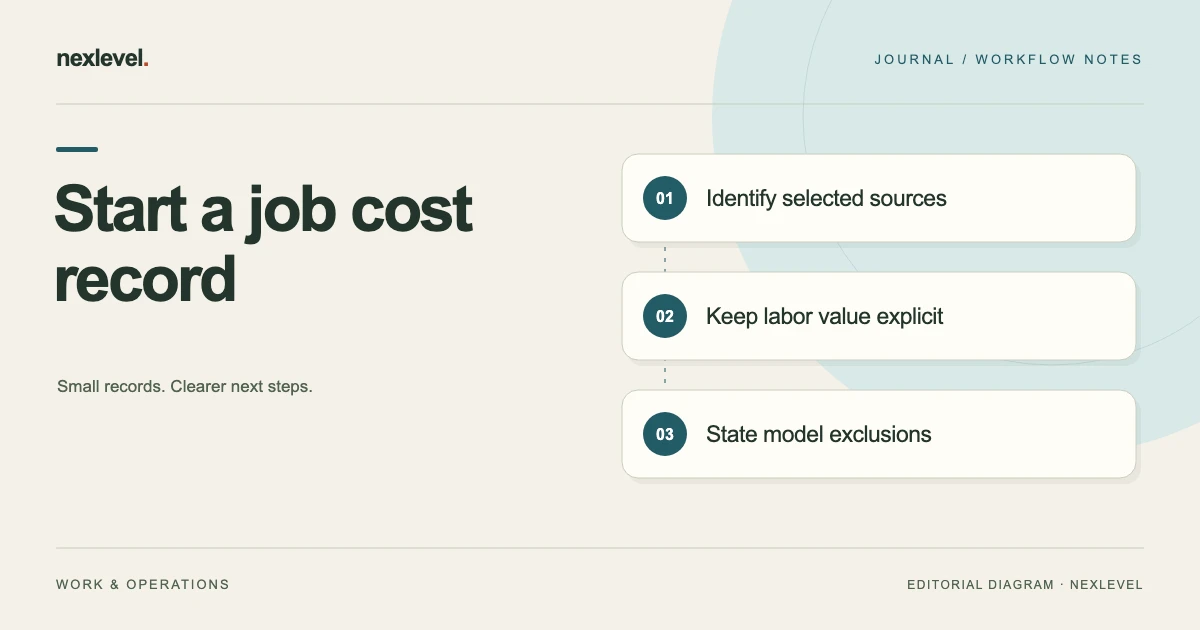
Start a service-job record by linking one job to its quote context, direct-expense sources, labor duration and separate owner-time valuation. State the currency and excluded costs before calculating. If a receipt or time note cannot be linked to that job, keep the association open instead of treating its amount as established.
Identify each input’s source before calculating
- Create a stable job reference and identify the quote or revenue basis being modeled.
- Check each expense’s source, scope, date and job allocation before adding it.
- Record duration and the selected internal hourly value as separate inputs, checking for duplicated labor.
- Calculate only the defined model and preserve units, cost exclusions and the metric denominator.
- Keep the initial estimate distinct from later actual entries and note the next missing-source question.
Working fields:
Job | Quote/revenue source | Expense/source/date/allocation | Labor duration/source | Owner-time value/source | Currency/exclusions | Estimate or actual | Calculation | Missing association
Useful next steps: Use the full service-job cost tracker, Allocate a receipt covering several jobs, Check the metric’s numerator and denominator.
Define one job and one setup task
Write a bounded purpose: “Prepare the selected job’s labor and expense source context for a management estimate.” Identify the job, relevant source occasions, intended model, cutoff, and next review task.
A familiar customer or project label does not establish which quote, receipt, or time record belongs to the selected job. Check those relationships before calculating a margin.
The preparation task can finish with an explicit source question rather than invented certainty about every amount.
Use the advertised management roles
JobMargin Pocket advertises revenue, direct costs, labor value, profit, margin, effective hourly return, frozen-estimate comparison, and a dated seven-day mini trend.
Those are management-estimate roles, not proof of recognized accounting income, tax treatment, payroll obligation, or bank activity. The official description explicitly excludes those professional-software purposes.
Do not reconstruct undocumented native formulas. This worksheet labels its own independent teaching calculations and assumptions.
Create a controlled fictional source set
For this exercise, J41 identifies the selected job. Q2 is the quote-context role, R3 a direct-expense source, L4 a labor-time source, and V5 the selected owner-time-value basis.
The teaching model uses revenue 40, materials 5, two labor hours, and an hourly management-value input of 10 in one currency. It excludes all other costs, tax, fees, discounts, overhead, and adjustments.
No actual customer, job, invoice, receipt, wage, payment, or financial result is supplied. These labels are companion references rather than native field names or an import schema.
Keep quote context separate from actual payment
Q2 can describe the selected plan or quote basis without establishing customer acceptance, work completion, earned income, or money received.
The fictional revenue input of 40 is a model role. Do not call it a bank receipt or actual profit merely because it appears in a calculation.
For broader plan/actual distinctions, use the quote revision and actual-cost guide. This setup creates no quote or transaction.
Read direct-expense sources at their actual scope
The app advertises materials, travel, subcontractors, and other direct costs, with private receipt images or PDFs. Identify which selected source establishes the amount attributed to the job.
R3’s fictional 5 is materials only in this model. It does not include the separately modeled owner labor and should not be treated as every possible real job cost.
If a source covers several jobs or an unrelated item, preserve that relationship before allocating anything. Do not assign the entire amount by a familiar label.
Keep labor time and its valuation separate
L4 supplies the hypothetical two-hour basis, while V5 supplies the hypothetical management-value rate of 10 per hour. One does not establish the other.
Recorded time is not automatically billable time, a payroll obligation, or proof of a physical work outcome. The selected source context needs to support the administrative role being used.
The example recommends no rate and makes no wage or pricing claim. It values owner time only under an explicitly declared teaching model.
Calculate the limited labor and cost model
Two hours multiplied by 10 gives an independent labor value of 20. Adding the selected materials 5 gives a limited modeled cost of 25.
These are Decimal-checkable teaching calculations, not an assertion of the app’s exact formula or a complete accounting cost structure.
Keep the exclusions visible. Omitted from the exercise does not mean zero, deductible, reimbursable, or irrelevant in a real job.
Calculate a bounded profit-and-margin illustration
Under the fictional assumptions, 40 minus 25 gives modeled profit 15. Dividing 15 by the selected revenue 40 and multiplying by 100 gives 37.5 percent.
The denominator is explicitly revenue for this independent illustration. Do not call the result a native effective-hourly-return calculation, actual take-home pay, or guaranteed margin.
The example supplies no financial recommendation. It shows why the source basis and metric definition need to remain beside a management estimate.
Use a copy-ready source-setup worksheet
A practical companion worksheet asks for selected job, quote/model context, direct-expense sources and scope, labor-time basis, owner-time-value source, currency, and explicit model exclusions.
Add source occasions, estimate/actual roles, independent arithmetic, representation inspected, cutoff, missing associations, and next review task.
These prompts form an administrative structure. They are not native required fields, an automated accounting validator, or an import-ready format.
Fill the source-clear branch
In the first fictional branch, Q2/R3/L4/V5 clearly concern J41’s selected context. The worksheet can preserve their separate roles and the limited calculation without inventing a real result.
A management estimate can be understandable while customer acceptance, actual payment, and physical completion remain unprovided.
The exercise enters no native cost, starts no timer, issues no invoice, and creates no saved estimate.
Fill a mixed-source branch separately
In another branch, one supplied receipt or time note has an unprovided job association. Do not include it in J41 merely because the customer name looks familiar.
Retain the missing relationship as the next source question. That differs from a proven mismatch or native application error.
If only a companion explanation used the wrong label, correct that explanation while preserving accurate source material. Do not invent an expense or work event to support the copy.
Keep frozen estimates distinct from actual entries
The listing advertises comparing frozen estimates with actual results and identifying changed margin inputs. Keep the selected estimate occasion separate from later cost or labor sources.
A later entry should not make an older plan appear to contain information that arrived afterward. Do not invent a native versioned-audit rule for every record change.
For retention, use the estimate and cost-context archive guide. This initial setup supplies no actual-result comparison.
Read timers, trends, and targets within their roles
The app advertises a labor timer, a seven-day mini trend built from dated jobs/costs/labor, and margin targets with alerts. Those capabilities need actual selected entries to be meaningful.
A target is a preference, not a guarantee of profitability. A chart is a representation of its dated source set, not proof of accounting completeness or business health.
Do not reconstruct an undocumented date-window or alert algorithm. This exercise starts no timer and creates no target.
Inspect the actual report representation
JobMargin Pocket advertises job PDF reports and portfolio CSV with Pro reporting capabilities. Inspect the actual supported output before stating which source and metric context a reader receives.
A clean report can represent a selected estimate without becoming an invoice, tax document, payroll record, or bank statement.
The public description does not establish every export field or arbitrary import. Keep output scope questions explicit rather than promise complete workspace reconstruction.
Preserve local work and receipt privacy
The app requires no account, keeps jobs and receipts on device, and supports core job tracking offline. Locally supported setup should not acquire a mandatory server or customer-login requirement.
Receipt images/PDFs remain private on device under the advertised workflow. Supply only authorized material needed for an actual selected sharing task.
This exercise sends no receipt, contacts no customer, makes no payment request, and changes no local record.
Keep portable copies distinct from restoration
A readable PDF or CSV can support selected management review without containing every editable relationship or attachment. The public description does not establish arbitrary import or guaranteed complete restoration.
This worksheet exports nothing, imports nothing, restores nothing, and deletes no job data. Keep actual deletion controls separate from a source-review task.
A source-limited packet can remain useful while the next reviewer identifies the missing job, cost, or labor association.
State current access accurately
Free includes three active jobs. When creating or reopening a job at full Free capacity, an optional completed video can earn one permanent extra active-job slot on this device. Videos require connection, consent and availability; closing early earns no slot. Earned slots do not unlock Pro tools and are removed by deleting all local data. Closing a completed job also frees capacity offline. Pro provides unlimited jobs, labor tools and timers, additional estimate tools, and PDF/CSV exports.
Do not invent a purchase duration, introductory trial, localized price, or unlimited capability absent from the selected official source.
A purchase cannot establish a missing receipt association, rate basis, customer acceptance, or actual financial outcome. Keep entitlement separate from the evidence behind the estimate.
Run an initial-job reading test
Give an authorized reviewer the fictional references and worksheet without the original folder context. Ask what Q2/R3/L4/V5 establish, why labor value is 20, and which assumptions produce modeled cost 25 and profit 15.
Then introduce an unassociated receipt and a later actual-cost source separately. The reader should preserve job identity and source occasions rather than reuse the most familiar total.
Record any explanation still needed. A useful result identifies the next source task without giving professional advice or claiming a real margin.
Write a bounded setup receipt
A compact fictional note can state: “J41 uses selected Q2/R3/L4/V5 roles. Under the limited same-currency model, 2 hours at 10 gives 20 labor value; plus 5 materials gives 25 cost; 40 minus 25 gives 15 modeled profit and 37.5 percent of revenue. Actual payment and professional-accounting conclusions remain unprovided.”
Keep exclusions beside the result. Add actual later sources only when they exist, with their own occasions.
The result is an understandable management-record basis, not accounting, tax, invoicing, payroll, banking, inventory, legal, or financial-advice software output.
Fill the initial cost-source note
The companion note can identify J41 and each actual source role before showing a management result. Keep the quote basis, selected expense, labor time, and value-of-time input separate so another reviewer can reproduce the limited model.
If one association is missing, retain that precise question. A complete-looking amount cannot establish which job a receipt or time note actually concerns.
The model explicitly keeps materials separate from owner labor. Do not silently include the same role twice or call omitted real-world costs zero merely because they are outside this teaching exercise.
Keep metric definitions beside results
The independent margin illustration uses modeled revenue as its denominator. It does not reconstruct the native effective-hourly-return formula or establish actual take-home pay.
If another real review uses a different metric, identify its source and definition rather than label every ratio margin. A familiar percentage is not enough to establish comparable business results.
This is management-record interpretation, not professional advice. The worksheet recommends no hourly rate, customer price, wage, deduction, or accounting treatment.
Keep later entries at their own occasions
If an actual later cost or labor source arrives, give it its own job relationship and occasion before preparing another explanation. An older estimate can remain accurate history without appearing to include later information.
If only a companion label used the wrong job, correct that explanation while preserving accurate source material. A copy correction is different from a purchase, worked hour, customer acceptance, or payment.
A future reader should be able to identify what was selected, what was calculated independently, what remained unprovided, and what next source task follows. That makes the setup record useful without turning a management estimate into a professional financial finding.
The exercise supplies no invoice, bank transaction, payroll event, or actual commercial outcome.
Use JobMargin Pocket for clear input roles
JobMargin Pocket connects quote context, direct costs, labor value, management metrics, estimate comparisons, and supported reports in a local workspace.
Check the official JobMargin Pocket App Store listing for current capabilities and access. Keep source inputs, management models, actual entries, and commercial outcomes distinguishable.