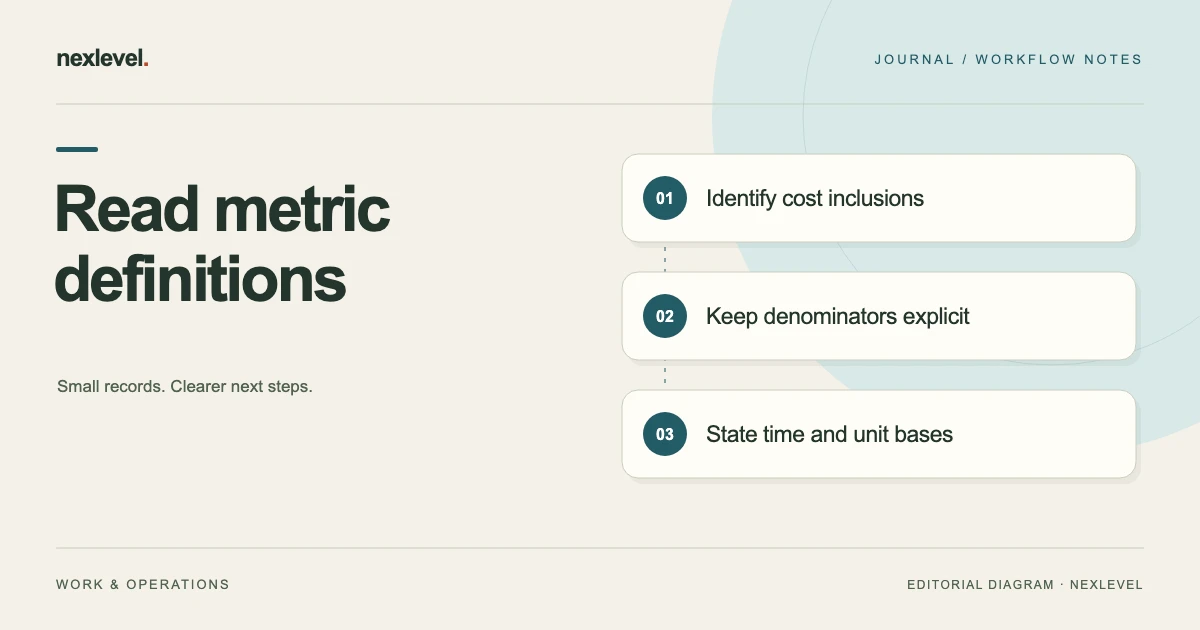
Job margin and hourly return answer different questions. Before comparing them, state which costs were deducted, whether owner time was already valued, and which revenue or duration forms the denominator. Correct arithmetic can still describe the wrong metric when the definition is missing.
Name the numerator, denominator and labor treatment
- Identify the job, source inputs, time basis and actual metric representation.
- List included costs and owner-time valuation, checking whether a bundled cost already contains labor.
- State the amount being divided, the denominator and the result’s units.
- Keep before-labor, after-labor, revenue-based and cost-based examples separately labeled.
- Confirm the actual tool’s definition before attributing a formula to it; preserve an unresolved definition as a source question.
Working fields:
Job/metric | Source inputs | Cost inclusions/exclusions | Owner labor deducted? | Numerator | Revenue/cost/time denominator | Units | Actual definition/source | Missing question
Useful next steps: Build a consistent service-job model, Explain owner labor in a report handoff, Keep trend interpretations tied to their source context.
Define the metric question before comparing results
Write a bounded purpose: “Check which source basis supports the selected margin or hourly-return explanation.” Identify job context, source occasions, actual representation, selected definition, cutoff, and next task.
A percentage and a currency-per-hour value answer different questions. They should not become interchangeable because both appear in a profitability discussion.
Keep the actual basis visible before interpreting a result as take-home pay, business health, or a professional financial finding.
Use the advertised metric roles precisely
JobMargin Pocket advertises revenue, direct costs, owner labor value, profit, margin, and effective hourly return. The selected public description does not document every native equation.
Inspect actual supported output and its source context before stating what a particular native value includes. Do not infer a formula from a familiar label alone.
The following calculations are explicitly independent teaching models, not an app test or promise of a native displayed result.
Create a controlled fictional source set
For this exercise, J63 identifies the job model. R2 is hypothetical revenue 120, C3 direct materials 40, T4 four labor hours, and V5 a management value input of 5 per hour, all in one currency.
E6 is the candidate metric representation and N7 the companion explanation. The model excludes every other cost, tax, fee, discount, overhead, and adjustment.
No actual job, customer, receipt, wage, payment, or financial result is supplied. The references are companion roles, not native field names or an import schema.
Keep direct cost and owner-time value separate
Four hours multiplied by 5 gives independent owner-labor value 20. C3’s 40 represents materials only, so the two roles are separate in this declared teaching model.
If an actual source already bundles a labor role, establish that scope before adding another value. Do not infer what an expense covers from its label.
For initial source preparation, use the labor and expense guide. The example recommends no real rate or customer price.
Separate before-labor and after-labor surplus
Under the independent assumptions, 120 minus 40 gives 80 before the selected owner-labor value. Subtracting 20 more gives 60 after that modeled value.
Those are different definitions, not competing claims about actual money paid. Keep the selected cost inclusion beside whichever amount is discussed.
Neither result establishes recognized accounting income, tax treatment, payroll obligation, customer payment, or cash available in a bank.
State the percentage denominator explicitly
The independent after-labor illustration divides 60 by revenue 120 and multiplies by 100, giving 50 percent. Its denominator is explicitly the selected revenue role.
Dividing the same 60 by modeled cost 60 instead gives 100 percent. That is a different cost-based ratio, not the same revenue-based percentage.
The worksheet does not claim the app exposes that second ratio or uses either equation in a particular native field. It shows why a label needs its actual basis.
State the time basis explicitly
Dividing the independent after-labor 60 by four hours gives 15 per hour. Dividing the before-labor 80 by the same time gives 20 per hour.
The difference follows from whether the selected owner-time value was deducted first. These are alternative controlled definitions, not statements about native effective hourly return.
Keep the time source and cost-inclusion basis beside the result. Neither is an actual wage, payment obligation, or recommendation.
Use a copy-ready metric-basis worksheet
A practical companion worksheet asks for selected job, source inputs and occasions, cost inclusions/exclusions, owner-time valuation, numerator, denominator or time basis, units, and candidate explanation.
Add actual output inspected, cutoff, missing definitions, correction source, next task, and any later source occasion.
These prompts are administrative structure, not native required fields, an automated accounting validator, or an import-ready format.
Fill the definition-clear branch
In the first fictional branch, N7 clearly labels the independent after-labor amount and revenue denominator. Its 50 percent illustration remains limited to those assumptions.
The hourly examples remain separate currency-per-time models. A reader should not have to infer which definition applies from the most favorable-looking number.
The exercise creates no actual job, cost, labor entry, timer, or native metric. It supplies a reusable reading method only.
Fill a missing-definition branch separately
In another branch, E6 shows a readable number but its relevant definition is unprovided. The review cannot choose a familiar formula merely to make the explanation complete.
Retain the exact next question: which actual source establishes the selected metric’s cost inclusions and denominator? A mathematically correct ratio may still answer the wrong question.
Do not label the gap a native app error. The packet establishes an unprovided relationship, not an observed defect.
Keep estimate and actual sources distinct
The app advertises frozen estimate comparison with actual results. A planned source and later entered cost or labor record have different roles.
A later actual source should not make an older estimate appear to contain information that arrived afterward. A quote revision is not automatically an actual expense.
For that distinction, use the quote revision and actual-cost guide. This worksheet performs neither action.
Keep targets and trends within their source context
JobMargin Pocket advertises margin targets, alerts, and a seven-day mini trend built from dated jobs, costs, and labor. Those views do not establish a universal desirable percentage or professional benchmark.
A chart shape does not settle a missing metric definition. A target being reached does not independently verify every input or prove a commercial outcome.
Do not invent date-window, alert, or ranking algorithms. This exercise creates no preference or graph.
Inspect the actual report representation
The listing advertises job PDF reports and portfolio CSV with Pro reporting capabilities. Read the actual supported output before describing which metric and source context a recipient receives.
A clean report may need N7 to explain a definition gap. The public description does not establish every column, attachment, or calculation note.
For historical copies, use the estimate and cost-context archive guide. Keep representation scope explicit.
Preserve source changes and copied corrections separately
If actual later material changes an input or supplies a definition, give it its own occasion before preparing another explanation. An older model can remain accurate history.
If only N7 called a cost-based ratio revenue margin, correct that explanation rather than invent an expense or payment to support it.
A source update, label correction, and real financial event are different administrative outcomes. Keep the actual evidence behind each conclusion.
Preserve local work and receipt privacy
The advertised workflow requires no account, keeps jobs and receipts on device, and supports core tracking offline. Locally supported review should not acquire a mandatory server or customer-login requirement.
Receipt images/PDFs remain private on device under the advertised workflow. Supply only authorized material needed for the selected review.
This fictional worksheet sends no receipt, contacts no customer, and makes no remote or payment request.
Keep portable copies separate from restoration
A PDF or CSV can help a bounded review without containing every editable relationship or attachment. The description does not establish arbitrary import or guaranteed complete restoration.
This exercise exports nothing, imports nothing, restores nothing, and deletes no job data. Keep actual deletion controls separate from metric reading.
A source-limited packet can remain useful when its next exact definition question is clear.
State current access accurately
Free includes three active jobs. When creating or reopening a job at full Free capacity, an optional completed video can earn one permanent extra active-job slot on this device. Videos require connection, consent and availability; closing early earns no slot. Earned slots do not unlock Pro tools and are removed by deleting all local data. Closing a completed job also frees capacity offline. Pro provides unlimited jobs, labor tools and timers, additional estimate tools, and PDF/CSV exports.
Do not invent a purchase duration, introductory trial, localized price, or metric-specific gate absent from the selected official source.
Expanded access cannot establish a missing definition or actual profit. Keep entitlement separate from the source evidence behind a management result.
Run a metric-basis reading test
Give an authorized reviewer N7 and the fictional source roles without the original folder context. Ask why 80 and 60 differ, why the revenue-based percentage is 50, and why the hourly examples use another unit.
Then introduce the cost-based 100 percent ratio and an unprovided native definition separately. The reader should preserve the selected denominator instead of choosing a favorable label.
Record any explanation still needed. A useful result identifies the next source task without professional advice or an actual business finding.
Write a bounded metric-review result
A compact fictional note can state: “The independent model uses revenue 120, materials 40, and owner labor 20 from four hours at 5. It distinguishes before-labor 80, after-labor 60, revenue-based 50 percent, and alternative hourly models 15/20. E6’s actual native definition requires its own source; no real profit or wage is established.”
Keep exclusions beside the result. Add actual later sources and corrections only when available, with their own occasions.
The result is an administrative explanation of metric bases, not accounting, tax, invoicing, payroll, banking, inventory, legal, or financial-advice software output.
Fill the numerator-and-denominator note
N7 can identify J63 and the selected R2/C3/T4/V5 roles before naming a metric. Keep the independent cost inclusions and denominator beside the result rather than depend on a familiar label.
The after-labor amount, revenue-based percentage, cost-based ratio, and currency-per-hour examples answer different controlled questions. A reader should not have to choose the intended definition from whichever value looks favorable.
If E6’s actual native definition is unprovided, retain that question. The worksheet does not select an undocumented app equation on the reader’s behalf.
Keep a definition gap separate from a calculation error
Arithmetic can be correct under an explicitly stated model while the model fails to describe the metric being inspected. First establish the actual source basis, then assess the corresponding calculation.
A missing denominator is not automatically a proven app defect. A copied label can also be wrong while source inputs remain accurate.
Identify which relationship the evidence establishes before choosing a correction. This avoids inventing a cost or payment to justify an unsupported interpretation.
Keep management meaning separate from a business decision
A defined ratio does not establish a desirable target, an actual wage, or advice about whether a job should be accepted. This exercise supplies no professional recommendation.
Likewise, an unprovided source here does not prove no relevant cost or transaction exists elsewhere. Record the actual coverage limit instead of a universal negative claim.
The next task can be precise while commercial outcomes remain outside the packet. A clearer label is an administrative result, not independent verification of business performance.
Preserve later input and explanation occasions
If actual later material clarifies an input or definition, give it its own source before preparing another note. The older model can remain accurate history of its selected assumptions.
If only the companion explanation confused percentage and hourly units, correct the wording at that level. Do not make the older record appear to have contained a later definition automatically.
A future reader should be able to identify numerator, denominator, time basis, cost inclusion, units, actual output, and missing source question without reconstructing an old profitability conversation.
Use JobMargin Pocket for explicit management inputs
JobMargin Pocket connects quote context, direct costs, labor value, management metrics, estimate comparisons, dated trends, and supported reports.
Check the official JobMargin Pocket App Store listing for current capabilities and access. Keep source inputs, independent definitions, native labels, and actual commercial outcomes distinguishable.