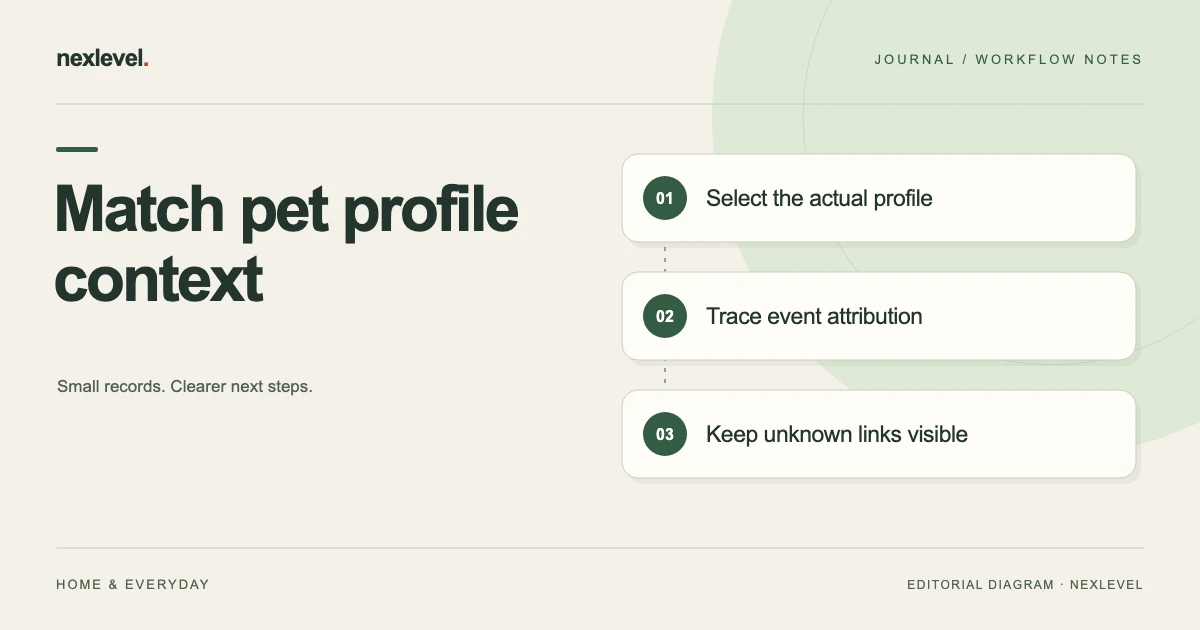
A caregiver-attributed check-in should remain tied to the pet profile and routine occasion it actually represents. A familiar task name, person label, or photograph is not enough to establish that an event belongs to the selected profile.
This guide supplies a fictional administrative matching worksheet. It gives no feeding amount, walking interval, medication dose, treatment, or veterinary advice. Keep profile identity, routine context, saved events, attribution, optional sharing, and physical outcomes distinguishable.
Define the selected association question
Write a bounded purpose: “Check what source establishes the selected check-in’s profile and routine relationship.” Identify the profile, event, caregiver context, occasion, actual representation, cutoff, and next task.
A matching task is narrower than evaluating a caregiver or certifying care. The record can be understandable while physical outcomes remain outside the packet.
Do not begin with an assumed completion and attach the most familiar event to support it. Preserve the actual source association first.
Use the advertised attribution role precisely
PawHandoff advertises actions recording who handled them and when, with a caregiver-attributed activity timeline. Keep the event, attribution, and occasion together when their actual relationship is supplied.
An entered name is a source-record role, not this article’s independent observation of a person or animal. A shared label does not establish every permission or physical fact.
The official description identifies a reminder and activity log, not veterinary advice or medication-dose calculation.
Create a controlled fictional profile set
For this exercise, P71 is the selected pet-profile role and Q2 another profile used only as a look-alike branch. E3 is a saved-check-in role, C4 caregiver attribution, T5 the event occasion, and R6 routine context.
N7 identifies the companion matching note. No actual pet, species, caregiver, date, medication, dose, or care event is supplied.
The labels are independent references, not native field names, an identity-verification system, or an import schema.
Keep profile identity ahead of task familiarity
Two profiles can use similar routine labels. A task called feeding or a custom note does not establish that the selected event belongs to P71.
Check what actual source connects E3 to the selected profile before interpreting C4/T5. A correct timestamp attached to another context would not answer the matching question.
If the association is unprovided, retain that precise source gap rather than choose the nearest-looking profile.
Keep routine occasion separate from a prompt
A routine or reminder cue represents planned context. It does not establish that E3 exists or that a physical task occurred.
Conversely, a saved event may be readable while its relationship to a particular routine occasion is unprovided in a companion packet.
For initial role separation, use the cue and saved-event worksheet. Do not invent prediction windows or confidence formulas.
Keep caregiver attribution at its actual scope
C4 identifies the selected record’s supplied attribution role. It does not independently establish decision authority, access permissions, or observed physical care.
A familiar caregiver label in another source should not silently become the same event association. Keep relevant household/profile context explicit.
This exercise identifies no real person and makes no caregiver-performance judgment. It reviews a bounded source relationship only.
Use a copy-ready profile-matching worksheet
A practical companion worksheet asks for selected profile, actual event source, routine association, caregiver attribution, event occasion, representation inspected, and evidence establishing each relationship.
Add cutoff, unprovided associations, alternative-profile sources, correction reference, sharing/access context, and next task.
These prompts form administrative structure, not native required fields, an automated care validator, or an import-ready format.
Fill the source-clear branch
In the first fictional branch, actual supplied material clearly associates E3/C4/T5/R6 with P71. N7 can preserve those selected roles without certifying physical care.
The result should say what was matched and what remains outside the packet. It does not establish that every routine or household record was reviewed.
No native profile, routine, check-in, or permission is created by the exercise.
Fill a known-other-profile branch separately
In another branch, E3’s supplied source clearly belongs to Q2 while N7 calls it P71 context. The supported correction concerns the companion explanation.
Preserve accurate source material and repair the copied association. Do not invent a physical event or claim the app assigned a check-in incorrectly.
A known other-profile relationship is different from an unknown association. Keep those conclusions and next tasks separate.
Fill an unknown-association branch
In a third branch, the packet lacks enough source context to establish either P71 or Q2. The review should retain that exact gap.
Do not attach the entry to the most familiar photo, caregiver, or routine label. A readable date or name does not supply the missing relationship.
For broader reconciliation, use the conflicting-note guide. The exercise establishes no native defect.
Keep duplicate warnings bounded
The app advertises duplicate warnings for recent check-ins. A warning can prompt context review without proving duplicate physical care or guaranteeing prevention.
The public description does not establish an exact duration, profile-matching formula, or blocking mechanism. Do not invent one.
This article triggers no warning and supplies no observed native output. Keep any actual warning source separate from the association being reviewed.
Handle supported corrections without inventing history
PawHandoff advertises Undo or removal of mistaken check-ins. If an actual supported correction is chosen, identify what source and representation the companion explanation concerns.
Do not promise a native immutable history of every previous state or a feature for moving entries between profiles absent from the selected description.
This fictional worksheet changes no record. A corrected explanation, changed native record, and physical care event remain different outcomes.
Keep optional updates separate from receipt
The listing advertises opt-in care updates when another household member checks off a task, plus local reminders chosen by the user.
A preference or local event does not establish that every intended reader saw a notification. Inspect actual supported sharing context when the task requires it.
Do not borrow another app’s acknowledgment, queue, or cloud-backend behavior. This exercise performs no update or synchronization action.
Preserve local-first use and household boundaries
The advertised starting workflow creates one pet and daily routine without an account. Check-ins save on device first even when connection is unreliable.
Household expands pets, caregivers, secure sync, medication schedules, expiring sitter access, and private care-history export. Keep those optional capabilities separate from the local starting workflow.
The term secure is an advertised capability, not an independent security certification supplied by this guide.
Keep access and medication context in their roles
An access period is not proof of care during that period. For access preparation, use the sitter-access handoff guide.
Medication reminders and Household schedules do not provide veterinary advice or calculate doses. The matching worksheet gives no medicine, dose, timing instruction, diagnosis, or treatment recommendation.
Do not infer clinical effectiveness or caregiver performance from a matched local record.
Inspect actual history output
Private care-history export is advertised with Household. Read the actual supported representation before claiming which profile, event, attribution, or access context another reader receives.
The description does not establish a universal PDF/CSV schema, arbitrary import, or complete restoration. A readable copy is not automatically a full household backup.
This exercise exports nothing, imports nothing, restores nothing, deletes no record, and shares no pet data.
State current access without invented terms
The advertised starting workflow supports one pet and daily routine without an account. Household expands pets, caregivers, sync, medication schedules, sitter access, and history export.
Restore purchases is available from the plan screen. Do not invent a plan duration, trial, localized price, backend, or export format absent from the selected source.
A purchase cannot establish a missing profile association or verify physical care. Keep entitlement separate from evidence.
Run a profile-matching reading test
Give an authorized reviewer N7 and the fictional references without the original folder context. Ask what connects E3 to P71, what C4/T5 establish, and what R6 represents.
Then introduce Q2’s known event and the unknown-association branch separately. The reader should preserve their different conclusions rather than attach every familiar routine to the selected pet.
Record any explanation still needed. A useful result identifies the next source task without prescribing care or rating a person.
Write a bounded matching receipt
A compact fictional note can state: “P71 is selected. E3/C4/T5/R6 require their actual event, attribution, occasion, and routine associations. A known Q2 source differs from an unprovided relationship. Matching a record does not independently observe care or establish receipt on every device.”
Add actual sources and corrections only when available, with their own occasions. For retention, use the source and access archive guide.
The result is an administrative profile association, not veterinary advice, a care guarantee, an identity certification, or a performance assessment.
Fill the profile-association note
N7 can name P71 as selected and retain E3/C4/T5/R6 only with their actual supplied relationships. Keep the event association visible rather than replace it with a familiar task label.
If Q2 is established as the relevant profile, preserve that different relationship and correct the companion explanation. Do not invent an event for P71 to make the note look complete.
If neither association is established, retain the precise unknown. A readable caregiver or time label does not supply the missing profile source.
Keep partial matches from becoming complete findings
A matching routine name does not establish profile identity. A matching profile does not independently observe physical care. A clear timestamp does not establish that another person received an update.
Record which relationships were inspected and which remain unprovided. The next reader should not have to infer whether a general “matched” label covers every relevant fact.
This scope discipline makes a bounded review useful without certifying a person, animal condition, access protocol, or entire household history.
Keep corrections at their actual level
If an accurate source is mislabeled in N7, correct that explanation. The correction does not itself change the native event or establish a physical task.
If a real supported Undo or removal is chosen, identify what representation the review concerns. Do not promise a native feature for moving events or retaining every previous state unless actual documentation establishes it.
The fictional exercise changes no record and makes no judgment about a caregiver. It supplies only the administrative source relationships needed for another reader’s task.
Preserve later source and sharing occasions
If actual later material clarifies the event association, give it its own source before preparing another note. An older packet can remain accurate history without appearing to include information that arrived afterward.
Preparation, chosen sharing, recipient receipt, and understanding are different stages. Neither purchase access nor a local check-in establishes all of them.
A future reviewer should be able to identify selected profile, event, attribution, occasion, routine, actual representation, coverage limits, and next source question without reconstructing an old care conversation. That is a completed administrative explanation, not veterinary advice, observed care, or a security certification.
Use PawHandoff for clear profile context
Keep the selected profile, event-reference set, actual representation, and cutoff beside the matching result. A later reader should not have to infer the inspected scope from a familiar caregiver or routine label.
If actual later material supplies a missing relationship, inspect its context before reusing the older conclusion. A newly readable source does not independently observe care or establish receipt on every device. Record the next exact association question rather than claim complete verification of a household.
PawHandoff connects local-first routines, caregiver-attributed events, recent-duplicate warnings, chosen reminders, supported corrections, optional sharing, and history output.
Check the official PawHandoff App Store listing for current capabilities and access. Keep profile associations, record attributions, shared context, and physical outcomes distinguishable.