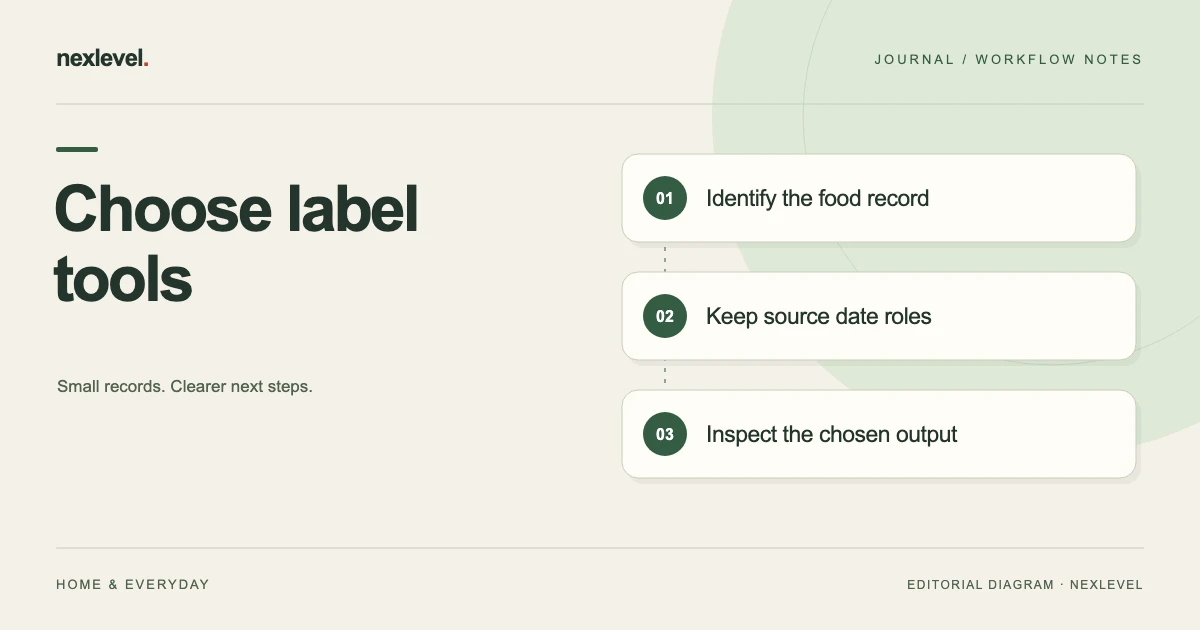
Choose a food date tracking method by following one fictional package from its label source to separate event dates, a reminder and a retained copy. Add a similarly named package to test identity. Compare what another reader can understand and what you must maintain by hand.
Try the same package record in each method
- Choose the inventory, date or history task you need the method to support.
- Use the same fictional package and source wording in every option.
- Add a separate opening note, reminder and similarly named item.
- Inspect the actual retained output for identity, date roles and cutoff.
- Record manual upkeep and unresolved source questions before deciding.
Working fields:
Method | Package identity | Label wording | Date roles | Reminder | Output/cutoff | Manual upkeep | Open question
Useful next steps: Define the food tracker fields, Test original label meaning, Check a household handoff.
Define the task before choosing the tool
A date list, a household location register, and a disposition history have different jobs. State which tasks matter before comparing colors, reminder options, or the number of available fields.
Write the selected item scope, source-label arrangement, entered date roles, intended reader, and output. A method that suits a small list may need additional source context for a later handoff.
Use fictional records during evaluation. There is no need to use real food or change actual handling decisions merely to test whether label context survives a copied representation.
Use a common comparison worksheet
Record demonstrated behavior, manual convention, actual output, and next question for each method. The same prompts make dependencies visible without assuming identical controls.
| Task | What to demonstrate |
|---|---|
| Identify | Distinguish the selected item from a similar container |
| Source | Preserve the original label wording and its route |
| Date | Keep entered date roles distinguishable |
| Remind | Explain a chosen local prompt |
| Record | Separate an entered disposition from a current item |
| Retrieve | Interpret the intended portable copy |
These are independent evaluation prompts, not a named comparison module or a promise that every candidate stores the same source material.
Set up a fictional item sequence
Imagine item alias F18, source-label reference L2, and entered record E4. Note N3 supplies a selected opened-date context. Reminder R1 and retained copy C7 concern their own source roles.
The trial asks each method to preserve the relationship among those references. A date entered in E4 should not silently change L2’s actual wording, and R1 should not become another label date.
Introduce a second fictional item F19 with a similar display name. The candidate should distinguish the records through actual identifying context rather than assigning the closest-looking source label.
No real food, date, storage rule, or outcome is supplied. The exercise evaluates administrative relationships without deciding whether anything is suitable to eat.
Test a paper label register
Paper can use an item reference, a transcription of actual label wording, a source route, separate date-role notes, and a disposition convention. Demonstrate F18/L2/E4 without relying on the original writer’s memory.
Keep an entered opened date distinct from the original label date. A blank should not ambiguously mean unknown, not applicable, or no event recorded. Use the actual convention consistently.
Inspect the retained scan. If the copy loses the wording or item identity, repair that representation. Its limitation belongs to the actual implementation rather than every possible paper method.
Test the spreadsheet’s row meaning
Decide whether a row represents an item, a date observation, a reminder, or a disposition. Repeated F18 references may identify different source roles rather than duplicate items to remove.
Sort and filter the fictional data, then open C7. Label wording, entered date roles, and source context should remain connected. A formula-generated urgency color cannot create missing source certainty.
The actual sheet’s maintained columns and linked materials are dependencies. Do not assume every spreadsheet automatically preserves label images, handles reminders, or synchronizes a household register merely because those structures could be built around it.
Evaluate SavorSoon against its current listing
The verified current SavorSoon description includes fridge, freezer, and pantry locations; an entered expiry date; optional acquired, opened, and frozen dates; local reminders; and recorded used, discarded, or archived states.
It also describes optional estimated value and waste history. Free currently includes a bounded active-food allowance, history, local reminders, and CSV export. Pro Lifetime expands active items, presets, insights, and the advertised purchase benefits.
Check actual access instead of attributing every Pro tool to the free experience. The app’s sorting and dates organize entered records; they do not independently establish physical storage conditions or food safety.
Preserve the wording behind the entered date
An app field label and wording on an original package can have different roles. Keep L2’s actual meaning available through the chosen source arrangement rather than replacing it with a more convenient generic phrase.
Use the label-wording record guide for that narrower review. Preserve its actual result or precise limitation in the trial.
This comparison supplies no interpretation of a real label or jurisdiction’s date rules. The actual manufacturer information and appropriate official guidance remain separate sources for operational decisions.
Keep date roles distinguishable
An acquired date, opened date, frozen date, entered expiry field, and export preparation occasion can describe different things. Do not flatten them into one unexplained date column.
For F18, identify what N3 establishes and which field in E4 it informs. If the source is unclear, retain that question rather than inferring the event from a file timestamp.
SavorSoon currently describes date suggestions under user control. A suggested value should not silently replace an established label source or become a general storage recommendation in the retained copy.
Separate reminder, queue, and disposition
A chosen local reminder prompts attention. A sorted queue organizes entered dates. A recorded used, discarded, or archived state concerns what the user entered about a selected item.
Those roles can support a household workflow without independently proving physical consumption, disposal, or storage suitability. Keep the actual source occasion beside the selected record.
For R1, ask each candidate to explain which prompt was configured and what the retained representation establishes. A notification setting should not become another item date or evidence that a household action occurred.
Keep food handling outside the record-system conclusion
The official FoodSafety.gov handling guidance addresses practical food-safety actions. A recordkeeping comparison does not replace that guidance or determine edibility from a queue position.
No temperatures, storage durations, reheating instructions, or physical assessment methods are supplied here. The trial can be completed with fictional references and no real food.
A method can preserve label context well while still leaving operational questions outside its scope. A successful administrative demonstration should not be presented as a safety result.
Inspect the selected CSV or retained copy
SavorSoon currently includes CSV export. Open the actual selected output and inspect item identity, entered date roles, location context, disposition, and source cutoff.
A companion explanation may be needed for original wording or source routes not represented automatically in the selected table. A clear working view does not prove every exported relationship survives.
The public description does not establish arbitrary CSV import, a universal complete restore process, or an automatically shared household database. A purchase’s Family Sharing benefit should not be rewritten as a guarantee of shared live inventory.
Run a second-reader exception test
Give a reader C7 and ask them to identify F18/L2/E4 and N3’s role. Then show F19 with the similar name. The reader should use actual reference context rather than whichever item appears first.
Next ask what R1 establishes and what source would resolve an unclear date relationship. The answer should be a bounded administrative question, not an inference that the food is safe or unsafe.
If the intended copy loses a relationship preserved in the working source, repair the copy. If the original source remains uncertain, retain that limitation instead of filling a plausible date.
Choose from demonstrated maintenance
Paper may fit a bounded list with clear item and label-source references. A spreadsheet may fit flexible rows where someone maintains date roles, source routes, and output meaning. SavorSoon may fit repeated local location, date, reminder, and disposition tasks.
These are conditional workflow comparisons, not measured waste-reduction or safety claims. Select from the actual administrative task, intended reader, authorized source arrangement, and maintenance observed in the trial.
A decision note should name the selected purpose, demonstrated relationships, actual output inspected, manual dependencies, and next question. Tool selection should not conceal a source uncertainty.
Separate selection from a handoff or archive
For another person taking over the records, use the food-label handoff guide. Choosing a method does not itself transfer source access or establish that every household copy is current.
For a historical packet, use the food-tracker archive guide. Its selected cutoff and retrieval purpose differ from evaluating a tool.
The fictional references are teaching inputs. Reuse the comparison structure with actual authorized sources while preserving original wording and leaving physical handling decisions with appropriate guidance.
Complete the same fictional trial in each method
Use a fixed sequence so the decision reflects the selected task rather than whichever feature is easiest to demonstrate first. Begin with item identity, then source wording, date roles, reminder context, and output.
| Trial reference | Expected explanation | Question if missing |
|---|---|---|
| F18 and F19 | Similar names remain distinguishable | Which identifying source belongs to the selected item? |
| L2 | The actual wording stays available | Which copy preserves the original source meaning? |
| E4 and N3 | Entered date roles remain separate | Which occasion does each date represent? |
| R1 | A chosen prompt remains a reminder | What does its selected source establish? |
| C7 | The retained output keeps its cutoff | Which relationship was lost in copying? |
For paper, record the actual source index and date-label convention. For the spreadsheet, record maintained columns and linked materials. For SavorSoon, inspect the supported selected workflow and its actual output. A feature description provides an evaluation basis rather than proof that a particular trial event happened.
Write a choice with its unresolved dependencies
A decision note can identify the actual task, selected candidate, demonstrated relationships, maintenance effort, and next question. Preserving original label meaning may matter more for this task than adding another urgency color.
If one candidate preserves date roles but its intended copy loses item identity, repair that selected output. If another keeps item references clear but needs a maintained route to the original wording, state that dependency. The findings should remain specific.
Then remove the original trial conversation and ask a reader to explain F18/L2/E4/N3/R1 from C7. They should name the source role of each reference without turning a reminder or queue order into an edibility conclusion.
Introduce a later entered date correction. If the original source was accurate and the copy was wrong, repair the copy. If later source information clarifies an earlier question, preserve its own occasion rather than rewriting the historical cutoff.
A useful decision can remain conditional on one repaired representation or a maintained source index. It does not need an unsupported claim about food waste saved, safety improved, or universal superiority. Record the bounded administrative fit that the comparison actually demonstrates.
Keep the fictional references outside genuine household history. Reuse the trial structure with actual authorized source material, preserving original wording and leaving physical food-handling decisions with appropriate instructions and official guidance.
Retain the decision note with the actual trial output. A later reader should be able to identify which source relationship was demonstrated and which still needs maintenance. Keep the label wording and date-role explanation inside the selected copy too, since a file can be renamed without preserving its original folder context.
Use SavorSoon for clear local food records
SavorSoon organizes entered location, date, reminder, and disposition context without requiring an account or sending kitchen records to an analytics service.
Check the official SavorSoon App Store listing for current capabilities and Pro access. Choose from demonstrated recordkeeping fit while keeping actual labels, storage instructions, and official food-safety guidance in their appropriate roles.