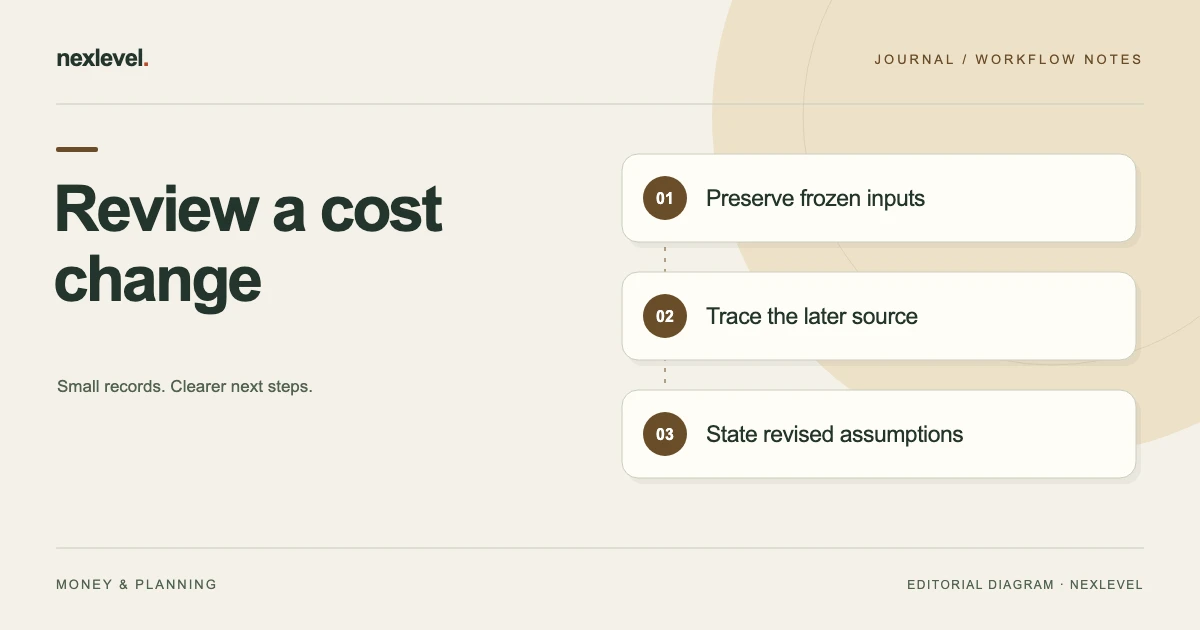
When a cost source changes after a trip decision is frozen, retain the earlier assumptions and prepare a separately identified comparison. Verify that the new amount covers the same option, group and unit basis before calculating its effect or describing a ranking change.
Compare the changed input while retaining the earlier decision
- Identify the frozen decision, source cutoff and exact cost being reviewed.
- Match the later source to the same option, group, currency and charge basis.
- Recalculate with only the established change, listing other assumptions held fixed.
- Label the revised model and unresolved inputs separately from a later decision, booking or actual charge.
Working fields:
Frozen decision/cutoff | Old input/source | Later source/basis | Fixed inputs | Revised total | Changed criterion | Open question
Useful next steps: Check the original cost-source setup, Review a changed inclusion or extra, Retain historical decision assumptions.
Define the changed-source question
Write a bounded purpose: “Review how the selected later cost source affects a comparison while preserving the earlier frozen decision.” Identify trip/group context, selected options, earlier decision occasion, later source, cutoff, and next task.
That is different from proving that the original choice was wrong or deciding which real trip somebody should book. A historical model can accurately represent its earlier inputs even when a later comparison produces another result.
Keep the question visible before comparing totals, so a changed amount does not become an unsupported story about actual prices or provider conduct.
Preserve the frozen decision’s role
TripCost Guard advertises freezing winning totals and assumptions in a decision record. Keep that selected historical representation separate from a current draft or later entered quote.
A matching trip title does not establish the same source occasion. A later reusable cost or template can be relevant without automatically describing what the saved decision represented.
Do not invent an automatic update rule. Inspect the actual selected record and its supported representation before stating what changed in the app.
Create a controlled fictional comparison
For this exercise, T53 identifies the trip context and G2 a two-traveler group. A3 and B4 are option roles, F5 the earlier frozen-decision role, and Q6 a later source concerning one extra-cost input.
All fictional amounts use one currency and cover the whole selected group. The model excludes every other charge, tax, fee, seat, bag, meal, lodging, insurance, time value, and custom adjustment.
No actual route, provider, fare, traveler, booking condition, or decision is supplied. The labels are companion references, not native field names or an import schema.
Reproduce the earlier limited model
A3’s fictional base input is 70 and its selected extra is 20, giving 90. B4’s base is 80 and its extra is 20, giving 100.
Under this deliberately limited independent model, A3 has the lower cost total. That does not establish the fastest journey, least hassle, provider availability, or appropriate real-world purchase.
F5 represents the earlier selected inputs. It is not evidence that those amounts stayed available or became actual charges.
Identify exactly what the later source changes
Q6 changes A3’s selected extra-cost input from 20 to 40 under the same fictional group and currency basis. The example changes no base fare or B4 input.
Before applying such a source in a real review, establish its relationship to the selected trip, option, group, and occasion. An unchanged label does not prove an unchanged unit basis.
The fictional source provides no explanation for why an amount changed. Do not call it a provider error, surcharge, or actual charge increase.
Calculate the revised teaching comparison
Under the stated independent assumptions, A3’s revised model is 70 plus 40, or 110. B4 remains 80 plus 20, or 100. The modeled A3 total rises by 20, and it is now 10 above B4.
These calculations are Decimal-checkable teaching arithmetic, not a native ranking algorithm or a recommendation to choose B4. The model supplies no other decision criteria.
Keep exclusions beside the result. Excluded from the exercise does not mean zero or irrelevant in a real trip.
Keep the group basis consistent
The example’s amounts cover the whole two-traveler group; they should not be multiplied by two again. The earlier A3 model of 90 corresponds to 45 per traveler, while revised A3 is 55 and B4 is 50 per traveler.
Those derived figures represent the same limited scope. They are not separate provider fares, payment shares, or reimbursement obligations.
If a later source instead uses a per-traveler basis, establish that different relationship before reusing the earlier calculation.
Use a copy-ready changed-source worksheet
A practical companion worksheet asks for trip/group context, earlier frozen decision, selected options, old source/input roles, later source occasion, exact changed amount and basis, unchanged assumptions, and independent revised result.
Add exclusions, criteria not supplied, representation inspected, cutoff, missing relationships, next source task, and actual sharing stage.
These prompts are an administrative structure, not native required fields, a live-price checker, automatic alerting, or an import-ready format.
Fill the source-change branch
In the first fictional branch, Q6 clearly concerns A3’s selected extra at a later occasion. The worksheet can explain the independent shift from 90 to 110 while preserving F5 as earlier context.
The review does not establish that the app modified a saved record, that a provider accepted anything, or that a real traveler paid more.
A useful result can therefore identify the affected assumption without rewriting history or claiming the earlier model contained later information.
Fill a changed-unit branch separately
In another branch, the later 40 amount has an unprovided group or unit basis. The review cannot safely treat it as the same whole-group extra merely because the number is readable.
Retain the missing relationship as the next source question rather than complete the arithmetic with an assumption. A mathematically correct sum with the wrong basis would not answer the selected task.
For initial source setup, use the separate-cost budget guide. Keep this review focused on the later change.
Keep included and estimated roles visible
The app advertises included costs and estimated amounts. A later source may change the relationship, not merely the displayed number.
If an item was included in the selected source, do not add it again without evidence establishing a different basis. If an amount is estimated, do not call it confirmed because it appears in a neat report.
For the narrower inclusion issue, use the included-cost review guide. This fictional model supplies no real fare condition.
Do not infer time or hassle rankings from cost alone
TripCost Guard advertises lowest-total, fastest-journey, and least-hassle views, alongside door-to-door duration and optional value of travel time.
The example supplies no duration, hassle input, or value-of-time assumption. A changed limited cost order does not establish a change in those other criteria.
Do not invent weights or tie-break rules to make the worksheet produce a preferred real option. The independent result remains limited to its stated arithmetic.
Keep currency context explicit when it applies
The listing advertises conversion using an exchange rate and source the user records. A changed rate source can be a separate input occasion from a changed provider amount.
This example uses one currency and performs no conversion. It supplies no current rate or financial advice about exchange timing.
For currency-source review, use the exchange-assumption guide. Keep entered rates distinct from live financial quotes or guaranteed charges.
Inspect the actual retained representation
The official description advertises decision records and Pro PDF decision sharing. Inspect the selected actual output rather than assume a filename proves which inputs it represents.
A historical copy can remain accurate at its cutoff while being unsuitable as a current comparison. If a companion heading wrongly labels it current, correct that explanation against its actual source occasion.
For retention, use the travel comparison archive guide. Keep source updates and copy corrections distinguishable.
Preserve local planning and deliberate sharing
The app requires no account, and trip data stays on device unless explicitly shared through PDF or CSV export. Locally supported review should not acquire a mandatory booking login or remote-content requirement.
The app does not scrape fares, sell tickets, or guarantee third-party prices. This exercise contacts no provider and makes no booking or payment request.
A readable export is not automatically arbitrary import or guaranteed complete restoration. The worksheet imports nothing, restores nothing, and deletes no record.
State current access accurately
The first trip and first two booking options advertise the complete comparison for free. Pro expands trips and options and includes reusable cost templates and PDF decision sharing.
Trip Pass is a non-renewing 30-day purchase. Monthly and annual subscriptions renew; the annual seven-day trial appears only when Apple reports eligibility.
Do not infer a monthly trial or invent a localized price. Expanded access cannot validate a source, prove availability, or determine a final charge.
Run a changed-decision reading test
Give an authorized reviewer the fictional references and worksheet without the original folder context. Ask what F5 represented, what Q6 changes, why A3 moves from 90 to 110, and which assumptions stayed fixed.
Then introduce the changed-unit branch and a later unrelated trip source separately. The reader should preserve group basis and identity rather than reuse the most familiar total.
Record any explanation still needed. A clear review can identify the next source task without recommending a purchase or claiming a booking outcome.
Write a bounded changed-source receipt
A compact fictional note can state: “F5 uses the earlier A3/B4 inputs. Q6 changes only A3’s selected whole-group extra from 20 to 40. Under the limited same-currency model, A3 becomes 110 and B4 remains 100. Historical F5, later source, and revised model remain separate.”
Keep exclusions and unprovided criteria beside the result. Add an actual later decision or charge only from its relevant source, with its own occasion.
For a reusable structure, use the complete-trip budget template. Preserve the selected changed-source purpose when adapting it.
Explain the earlier and later result without hindsight
The earlier model’s lower A3 total followed from its selected inputs. A later source producing a different limited cost order does not by itself establish that somebody made a mistake at the earlier occasion.
Keep the historical question separate from the current comparison question. F5 explains what was selected under the earlier basis; Q6 supplies a later input; the revised model shows its limited arithmetic effect.
A reader should not have to infer those occasions from two unexplained totals. Preserve which facts were available before treating a difference as a correction or new decision.
Keep one checked input from validating every cost
Establishing Q6’s group basis does not establish every other charge or inclusion. Record which assumptions were actually inspected and which remain outside the packet.
If another actual source changes currency, traveler count, transfer scope, or an included item, give it its own review relationship. Do not attribute the combined result to Q6 alone.
The independent example intentionally holds those other inputs fixed. That teaching assumption is explicit rather than a claim about any provider’s current offering.
Keep the next decision and booking stages separate
A revised comparison can identify a new planning question without establishing a saved decision, shared brief, reservation change, or payment. Each later stage needs its relevant actual source.
If a companion note labels the revised worksheet “booked,” correct that explanation rather than invent a transaction to support it. If an actual later decision exists, retain its own occasion and selected assumptions.
The result can therefore finish at a bounded source review. It does not need to recommend a purchase or claim that an earlier choice was commercially wrong to explain how one modeled input changed.
Use TripCost Guard for traceable decision inputs
TripCost Guard connects entered fares, cost scopes, included/estimated items, time context, recorded exchange assumptions, and frozen decisions.
Check the official TripCost Guard App Store listing for current capabilities and access. Keep historical assumptions, later sources, revised comparisons, and actual charges distinguishable.