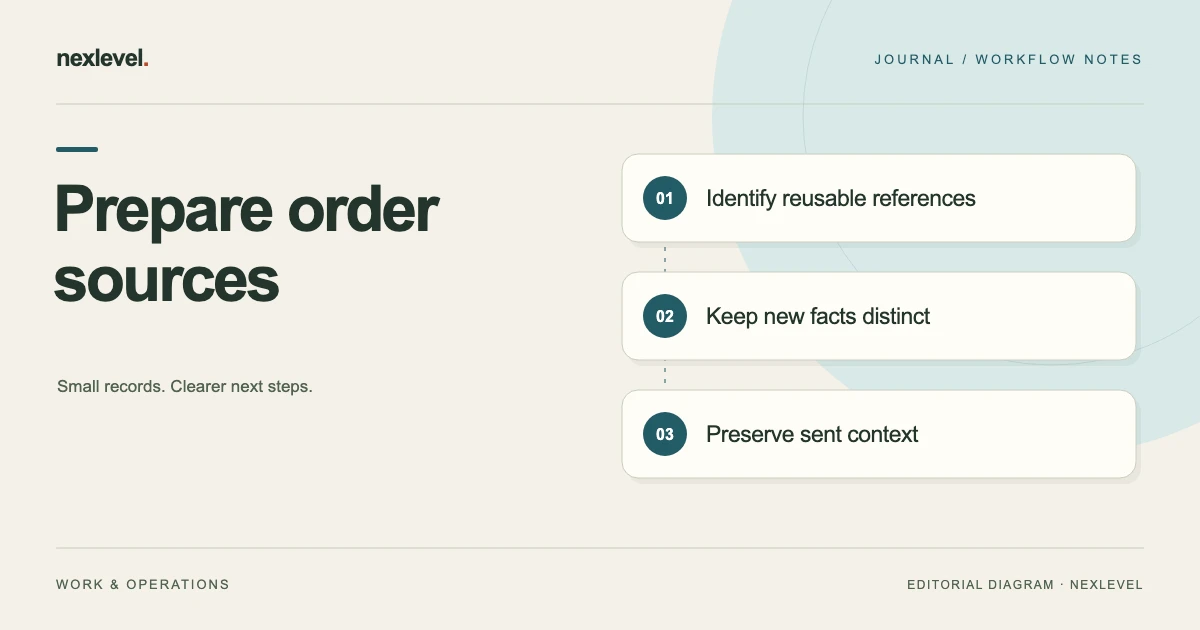
Reuse supplier and catalog entries as starting references, then verify the facts that belong to the new order. A familiar item name does not establish the current quote, quantity, price, shipping arrangement or terms. Keep old sent snapshots attached to their original occasion.
Check what belongs to this order
- Identify the new draft and the reusable supplier and item references it uses.
- Find the selected quote and record which order-specific inputs it actually supports.
- Check copied quantities, prices, terms and dates instead of treating defaults as fresh confirmation.
- Label older quotes and sent snapshots by their own occasion, then record any unresolved input question.
Working fields:
New PO | Reused vendor/item | Current quote | Input copied | Current source | Historical snapshot | Question/owner
Useful next steps: Find missing quote information, Review the completed draft.
Choose the selected reuse question
Write which new order and reusable source context need reviewing. A current library entry, older quote, and retained document can represent different occasions.
The task is to preserve source meaning before relying on a draft. It is not to certify commercial terms or establish that a supplier accepted an order.
A precise unanswered input question is a useful result. Do not borrow an older price merely to make the new order look complete.
Set up a fictional supplier packet
Imagine V74 is the supplier-reference role, L2 a catalog reference, O3 the selected new order, Q4 a quote source, D5 the order-specific date/term context, T6 an entered-total role, and S7 a sent-snapshot reference.
R9 is the companion review note. The selected question is whether V74/L2/Q4 establish the intended O3 inputs under the actual source arrangement.
These teaching labels are not native fields. No real order, quantity, amount, date, issue action, receipt, acceptance, or payment is supplied.
Use a reference-to-order worksheet
| Role | Question before relying on the draft | Keep separate |
|---|---|---|
| Supplier reference | What V74 relationship is established? | Every fact of a new order |
| Catalog context | What does L2 represent? | A current quote by assumption |
| Selected quote | Which Q4 source applies to O3? | An older offer for a similar item |
| Order-specific facts | What source supports D5 and selected inputs? | Reusable defaults as verified terms |
| Entered total | What basis does T6 retain? | A supplier invoice or payment |
| Sent snapshot | What occasion does S7 represent, if supplied? | The current editable library |
| Review result | What is established or still open in R9? | External acceptance by assumption |
The worksheet is an independent companion convention. It does not establish native custom source fields, automatic supplier verification, or a contract-import feature.
Establish supplier and item identity first
A supplier name or item description can recur across offers and orders. Match the actual selected V74/L2/Q4 relationships before assigning them to O3.
Keep controlled source routes useful without duplicating unnecessary commercial or personal details into a broad register.
If identity remains unclear, retain that precise question. A more detailed-looking order heading cannot supply missing source evidence.
Read reusable data within its actual role
Vendraft currently supports reusable vendors, catalog items, and project codes alongside order terms, notes, discounts, tax, and shipping.
A reusable reference can speed preparation while remaining different from a source confirming this order’s facts. Do not infer automatic freshness from the word reusable.
The public description does not document every prefill or historical-update behavior. Use the actual supported source arrangement.
Keep selected quotes separate from catalog context
Q4 can establish a particular offer while L2 provides reusable item context. A familiar catalog label does not independently establish the current selected price or pack basis.
The different-pack quote comparison covers a related input task.
This guide supplies no real amount or conversion and makes no supplier-selection recommendation.
Preserve order-specific terms and dates
D5 should retain the actual source role needed for O3. A prior order’s terms or issue occasion should not silently become facts of the new draft.
The quote-omissions review covers another source-preparation task.
This exercise interprets no contract, tax requirement, or legal deadline. It preserves the administrative source question.
Keep quantities and price bases explicit
An item description, pack quantity, ordered quantity, and price basis can answer different questions. Preserve the actual selected relationship before relying on an entered total.
A mathematically valid total can still answer the wrong order question if its inputs came from another source occasion.
This guide performs no arithmetic and supplies no amount. A missing input should remain a question rather than a guessed value.
Read calculated totals as entered-model results
The current app calculates totals from exact stored units. That advertised implementation does not independently verify every quantity, discount, tax, shipping, or commercial assumption entered.
T6 should retain the actual O3 input basis rather than become proof of a supplier charge or payment.
Do not infer external acceptance from a precise or professional-looking total.
Keep draft preparation separate from issue
A prepared draft and an order marked sent have different roles. The current app previews Letter or A4 output before sharing.
The selected-quote to PO guide covers the related document-preparation task.
This exercise previews nothing, sends nothing, and changes no state. It does not invent an automatic supplier-contact service.
Preserve sent-snapshot context
The current listing says marking an order sent preserves its number, totals, vendor details, and document snapshot. S7 therefore has a selected historical role.
A later current vendor or catalog entry should not make that retained snapshot appear to contain later information.
The snapshot-and-receipt archive guide covers the historical question.
Work through a reference-role-clear draft
In the first fictional branch, V74/L2 provide selected reference context, Q4 establishes the relevant offer, and D5 preserves O3-specific facts.
R9 can identify those relationships without a real issue, acceptance, delivery, or payment claim.
The check concerns the selected draft. It does not verify every vendor, item, order, or later output in the workspace.
Work through an older-price carryover
In another branch, Q4 belongs to an older offer while the supplier and item names are familiar. Correct the companion association or retain the precise input question.
Do not rewrite accurate older history to make the borrowed price fit O3. The mismatch concerns source occasion before calculation.
A generic fixed label would hide whether supplier, item, quote, quantity, term, or output context changed. Keep the actual correction explicit.
Work through a current-reference versus snapshot comparison
In a third branch, V74 changes after S7’s selected occasion. Preserve both source roles before calling the retained document wrong.
A historical snapshot can remain valid without being the current editable reference. Do not make an older file appear to update automatically.
The companion result can explain the actual occasion difference without changing the order or contacting a supplier.
Keep order states separate from physical outcomes
Vendraft currently tracks sent, accepted, partially received, received, and closed states. Their entered meanings should retain actual source support.
A label in a file does not independently establish external receipt, commercial acceptance, physical delivery, or payment.
This exercise supplies no actual state transition. It preserves the selected draft/reference distinction.
Keep receipts tied to the selected order
The current app records receipts while preventing quantities from exceeding the order. That workflow role is different from original quote preparation.
The partial-delivery record guide covers that narrower task.
This guide supplies no received quantity and performs no receipt action. Do not infer delivery from a reusable catalog entry.
Choose supported output within current access
Free currently includes up to three purchase orders per calendar month with watermarked PDF sharing. Pro adds unlimited orders, unwatermarked PDFs, custom numbering, JSON backup, and formula-safe CSV export.
Keep those output roles distinct. A PDF, CSV, and backup representation should not be described as interchangeable simply because each is portable.
The public description does not document every import, merge, or restoration behavior. This exercise performs none of those operations.
Keep local data and external sharing stages separate
The current app keeps company, vendor, catalog, order, and receipt data on device without an app account. Sharing or export happens when a destination is chosen.
A chosen destination, prepared file, delivered document, recipient understanding, and acceptance can require different actual sources.
This guide sends no message and changes no access. It does not promise control over every externally retained copy.
Run an independent reference-reading test
Give another authorized reader R9 and usable controlled sources. Ask what V74/L2 represent, which Q4 occasion applies, what facts belong specifically to O3, and how S7 differs.
Then introduce another order or later catalog source. The reader should preserve actual identity and occasion rather than borrow the most familiar input.
Record any manual explanation needed. Repair an unclear copy when its source is accurate;retain a precise question when the underlying relationship remains missing.
Use a copy-ready draft-review receipt
A companion receipt can identify supplier/catalog context, selected quote, order-specific sources, entered-total basis, actual draft/sent stage, representation inspected, copy correction, cutoff, and next question.
For the reference-role-clear fictional branch, it preserves preparation without an acceptance claim. For the older-price branch, it names the actual borrowed source relationship.
Read the receipt without its filename. A future reviewer should understand the draft basis without reconstructing the original purchasing conversation.
Connect review to retention and method choice
For historical copies, use the snapshot-and-receipt archive guide. For choosing a working method, use the purchase-order record comparison.
Keep the selected reference-versus-order purpose visible when choosing a representation. Supplier data, selected offers, new drafts, sent snapshots, receipts, and payments can all be useful without representing the same event.
The fictional references remain teaching inputs. Reuse the structure with actual authorized sources while keeping substantive purchasing, tax, terms, and approval decisions with their appropriate review.
Make the reference-versus-order note concrete
A practical companion note can identify V74/L2 as selected reusable context, Q4 as the offer source, O3 as the new draft, and D5 as the order-specific terms/date role. It should separately identify what T6 and S7 actually establish.
If only supplier identity is clear, the note should not call every price, quantity, term, or shipping input current. A familiar reference does not supply the facts of a new order.
If the actual source is accurate but the companion explanation borrows an old quote, repair the explanation rather than change correct historical data to make the stronger label true.
If a later selected offer becomes available, give it its own occasion before preparing another draft or note. An older Q4/S7 relationship can remain valid history without appearing to contain later information automatically.
Keep a clear draft result separate from issue or acceptance
A source-clear review can identify the new order’s input basis without establishing external contact. An unresolved result can identify exactly which reference or order-specific relationship still needs evidence.
The independent worksheet should not create a native duplicate-order control, automatic supplier update, or approval workflow absent from the current description.
For a final practical check, remove the original folder context and ask an authorized reader which information is reusable, which facts belong to O3, what the selected quote establishes, and what the actual document stage is.
The answer should not require a real commercial term, tax rule, order amount, or supplier acceptance. Record any explanation still needed beside the affected reference.
A useful review can make the next source task specific without issuing a purchase order, recording a receipt, changing a vendor library, or contacting a supplier.
Keep the controlled source route beside the selected order-specific input so another authorized reviewer can distinguish a current offer from an older reusable reference.
Use Vendraft for clear selected-order context
Vendraft connects reusable supplier/catalog sources, entered order facts, stored-unit totals, document snapshots, receipt history, and supported output in a local workspace.
Check the official Vendraft App Store listing for current capabilities and access. Keep references, order-specific facts, prepared documents, external decisions, and actual commercial outcomes distinguishable.