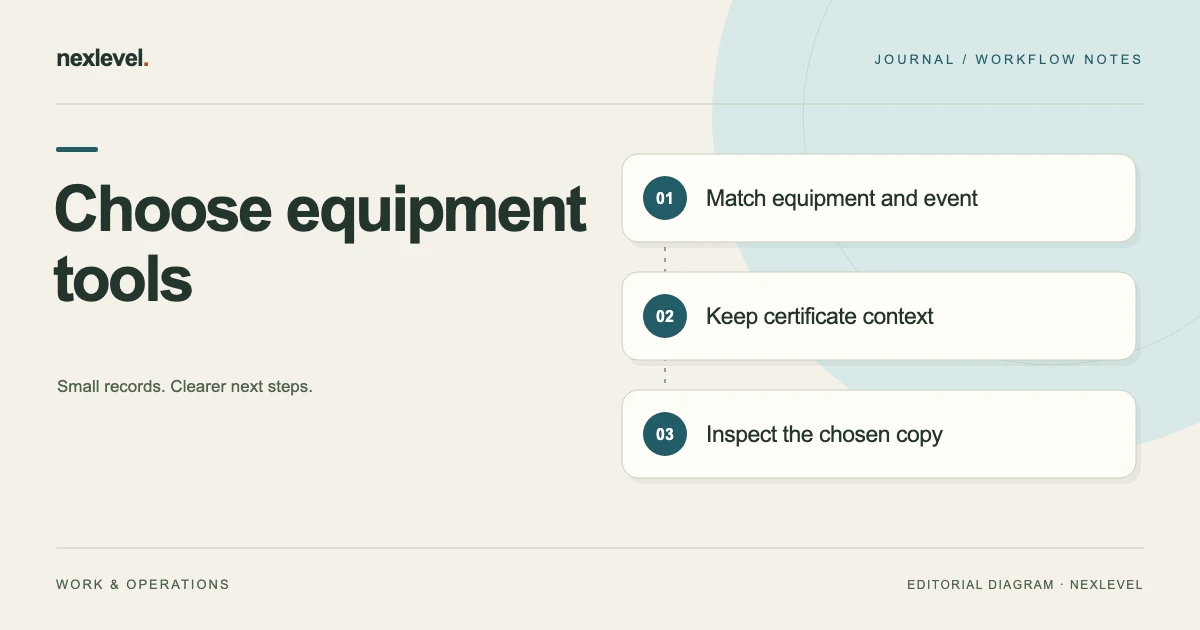
Choose a calibration record system by tracing the same equipment ID, service event and certificate question through paper, a spreadsheet and an app. Inspect what a second reader can retrieve from the retained output, then record the manual conventions and source-access dependencies each option needs.
Run the same equipment-record trial in each option
- Define the record tasks and use fictional equipment for the comparison.
- Find the equipment from its identifying source, then locate the selected event.
- Keep a pending certificate question separate from due-work status.
- Inspect an export or retained copy and introduce a later clarification.
- Choose against the demonstrated task, recording remaining manual work and access gaps.
Working fields:
Candidate | Equipment lookup | Event history | Certificate question | Due context | Output/cutoff | Manual dependency | Remaining gap
Useful next steps: Define the register fields to compare, Test certificate-to-equipment matching, Test the due-work review.
Define the actual record task
A due list, a service history, and a certificate evidence packet have different purposes. State which tasks the selected system needs to support before comparing dashboards, file types, or feature counts.
Write the equipment scope, identity convention, source arrangement, event history, selected reminder task, and intended reader. A system that handles a small due list may still need a separate evidence index for another purpose.
Use fictional records during evaluation. There is no need to copy real serial numbers or private certificates into several tools merely to compare whether an event can be retrieved and interpreted.
Use one equipment trial
Imagine instrument alias Q21 with identifying source I2 and recorded event E5. Certificate reference C8 is initially unresolved. Retained register copy R4 represents one source cutoff; a later source clarifies C8’s relationship.
The comparison asks every candidate to distinguish equipment identity, event history, certificate-reference status, and output timing. A similar equipment description should not be enough to assign another item’s certificate to Q21.
No real equipment, calibration result, service date, technical limit, or certificate is supplied. The fictional trial tests administrative relationships without implying that an instrument is suitable for use.
Set up a comparison worksheet
Record demonstrated behavior, manual convention, actual output, and next question for each candidate. The same prompts make dependencies visible without pretending every method has identical controls.
| Task | What to demonstrate |
|---|---|
| Identify | Find Q21 from its actual identifying context |
| Record | Keep E5 distinguishable from a later event |
| Reference | Explain C8’s role and unresolved relationship |
| Review | Separate due context from certificate-pending context |
| Export | Inspect R4 and its source cutoff |
| Continue | Locate the next source question without the writer |
These are independent evaluation prompts, not a description of a named comparison module inside CalibraDue.
Test a paper register
Paper can use an equipment page, separate event rows, and a certificate-reference index. Demonstrate the route from Q21 to E5 and C8. The reader should not need to remember which similar instrument was discussed.
Use an explicit convention for an unresolved certificate relationship. A blank field can otherwise look like no certificate was expected, a document is missing, or the question was never checked.
Inspect the retained scan or copy. If the crop loses the equipment reference or event heading, repair that selected representation. That limitation belongs to the actual copy rather than every possible paper register.
Test the spreadsheet’s row meaning
Decide whether a row represents equipment, an event, a certificate reference, or a source question. Repeated Q21 values across event rows do not automatically mean duplicate equipment records.
Sort and filter the fictional data, then open R4. The equipment-to-event relationship should survive, and a later source should remain distinguishable from the original cutoff. A status formula depends on maintained input meanings.
Record linked-file dependencies. A filename in a cell may help locate a source without embedding the document or giving the intended reader access. Do not assume every spreadsheet automatically preserves certificate history or an immutable event trail.
Evaluate CalibraDue against its current listing
The current CalibraDue description includes equipment identity, serial numbers, locations, entered service intervals, calibration events, certificate references, notes, and a focused due queue.
It describes append-only calibration events, QR labels with manual lookup as a fallback, CSV register export, and Pro PDF audit packets. Free currently has a bounded active-equipment allowance; Pro expands active equipment and other advertised tools.
Check actual access before attributing a Pro capability to every free workflow. The app organizes entered calibration evidence. It does not perform calibration, certify measurement results, grant accreditation, or replace a quality system.
Compare identity lookup and source matching
A QR label can open a selected equipment record without proving that every attached source belongs to that instrument. Keep lookup convenience separate from certificate identity matching.
For Q21, ask each method to show which source establishes I2 and which connects C8 to E5. A similar model name should not substitute for the actual identifying relationship.
Use the certificate-to-equipment review guide for that narrower check. Preserve its result or exact open question in the comparison.
Keep event history distinct from current planning
A recorded service event and an entered next-due context answer different questions. A countdown or colored status does not establish the appropriate interval or the physical condition of the equipment.
CalibraDue currently describes append-only events so the working history remains understandable. Evaluate that advertised relationship without assuming it independently validates the content entered by the user.
For paper and spreadsheets, demonstrate the actual history convention. Overwriting one date cell can lose a prior occasion unless another maintained structure preserves it.
Distinguish due work from a certificate question
An instrument can have a recorded event while its certificate relationship remains unresolved. The selected review should keep those roles clear instead of collapsing everything into one ready-looking label.
The current app describes overdue, due-soon, and certificate-pending equipment. These organize attention around entered information. They do not supply a technical acceptance decision.
Use the due-date and pending-certificate review guide when the next administrative task needs closer definition. This comparison recommends no review interval or operating decision.
Inspect certificate references and actual documents separately
A certificate reference, an original document, and a report representation can have different contents and access dependencies. The reader needs to know which one the selected candidate actually provides.
CalibraDue’s public description establishes certificate references and history. It should not be expanded into a promise of an arbitrary binary-document vault or universal certificate import system.
For C8, record the actual authorized source route or limitation. A portable table can be useful without automatically containing the original certificate or every explanatory relationship.
Compare the selected outputs
CalibraDue currently advertises CSV register export and Pro formatted PDF audit packets. Open the actual intended output and inspect equipment identity, event context, source cutoff, and certificate-reference meaning.
Paper scans and spreadsheet exports need the same inspection. A clear working view does not guarantee that a copied representation keeps its headings, links, or source explanations.
The current product description does not establish arbitrary CSV import or a universal full-system restore process. Record the actual supported purpose rather than making all candidates sound equivalent.
Run a second-reader exception test
Give an authorized reader R4 and ask them to identify Q21, E5, and C8’s actual role. Then introduce another fictional instrument Q22 with a similar model label.
The reader should use the established identity reference rather than choosing whichever instrument appears first in a recent list. If they assign C8 to Q22 solely from the similar label, repair the explanation.
Next introduce the later source clarification. The reader should identify its own occasion without making R4 appear to have contained it from the start. A current working record and an older retained copy can differ legitimately.
Write a decision with maintenance dependencies
Paper may fit a bounded register with clear equipment and event cross-references. A spreadsheet may fit flexible tabular work where someone maintains identities, history, formulas, and document routes. CalibraDue may fit repeated local due-queue, QR lookup, and event-record tasks.
These are conditional workflow comparisons, not measured productivity or compliance claims. Select the method whose demonstrated behavior fits the actual administrative task, reader needs, and access arrangement.
A decision note should name the trial, relationships retained, actual output inspected, manual steps, and unresolved question. Choosing a tool should not make a certificate uncertainty disappear.
Separate tool selection from a handoff or archive
Another person taking over the records needs a source arrangement and a clear next question. Use the calibration record handoff guide for that task.
A historical packet has its own source cutoff and retrieval purpose. Use the calibration archive guide when preparing that representation.
Tool choice, responsibility transfer, and archive retrieval have related but distinct requirements. A successful comparison does not itself grant source access or technical authority.
Complete the equipment comparison in a fixed order
Begin with identity, then event history, then the certificate question, and finally the output. This order helps reveal whether a candidate’s attractive due list depends on relationships that its retained copy cannot explain.
| Trial step | Expected explanation | Record if missing |
|---|---|---|
| Find Q21 | The actual identifying source is I2 | The specific identity relationship still needed |
| Open E5 | The selected event remains distinguishable | The missing source occasion |
| Inspect C8 | The certificate reference has a defined role | The actual document or matching question |
| Open R4 | The retained representation keeps its cutoff | The source context lost in copying |
| Add later context | A clarification remains later information | The explanation needed to preserve chronology |
For paper, write down the actual page and index references used. For the spreadsheet, note the maintained row and linked-document dependencies. For CalibraDue, inspect the supported view or output relevant to the selected task. A feature description establishes what to evaluate; it does not prove that an imagined trial event occurred.
Make the decision note specific
A practical decision might prioritize retrieving event history and finding open certificate questions over adding another summary column. State the actual task, selected candidate, demonstrated relationships, maintenance dependencies, and remaining question.
Suppose one candidate opens the correct equipment quickly but its selected output loses the event reference. That is an output issue to repair. Suppose another preserves event identity but the original certificate route remains unavailable to the intended reader. Keep that access dependency separate. Neither finding needs to become a claim about calibration validity.
Use an explicit continuation question: which authorized source establishes C8’s relationship to Q21/E5? That is more actionable than asking another person to review the whole register when only one link is uncertain.
After making the choice, remove the original evaluation conversation and repeat the Q21/E5/C8 retrieval from R4. The reader should identify which relationships are established and which remain unresolved. If they infer technical approval from a due status, clarify the administrative scope.
A useful choice can be conditional on a repaired output or maintained index. State the dependency rather than hiding it behind a general claim that an app, paper book, or spreadsheet is best. The comparison does not need measured time savings or a compliance promise to support a bounded recordkeeping decision.
Keep fictional references outside genuine equipment history. Reuse the trial structure with actual authorized sources, while leaving operating decisions and technical evidence assessment within the applicable quality arrangement.
Retain the selected decision note beside the actual trial output. If a later reader starts with the due list, they should still be able to locate Q21/E5 and the precise C8 question. If they start with the certificate reference, they should be able to find the same equipment context. This two-direction test can reveal a missing cross-reference without requiring a broader technical review. State which direction worked and which source relationship still needed attention rather than describing the whole register as verified.
Use CalibraDue for clear entered equipment history
CalibraDue connects entered equipment identity, event history, due context, certificate references, and supported portable outputs in a private workspace without requiring an account.
Check the official CalibraDue App Store listing for current capabilities and Pro access. Keep actual calibration, measurement, accreditation, and quality-system decisions with their appropriate sources and responsible professionals.