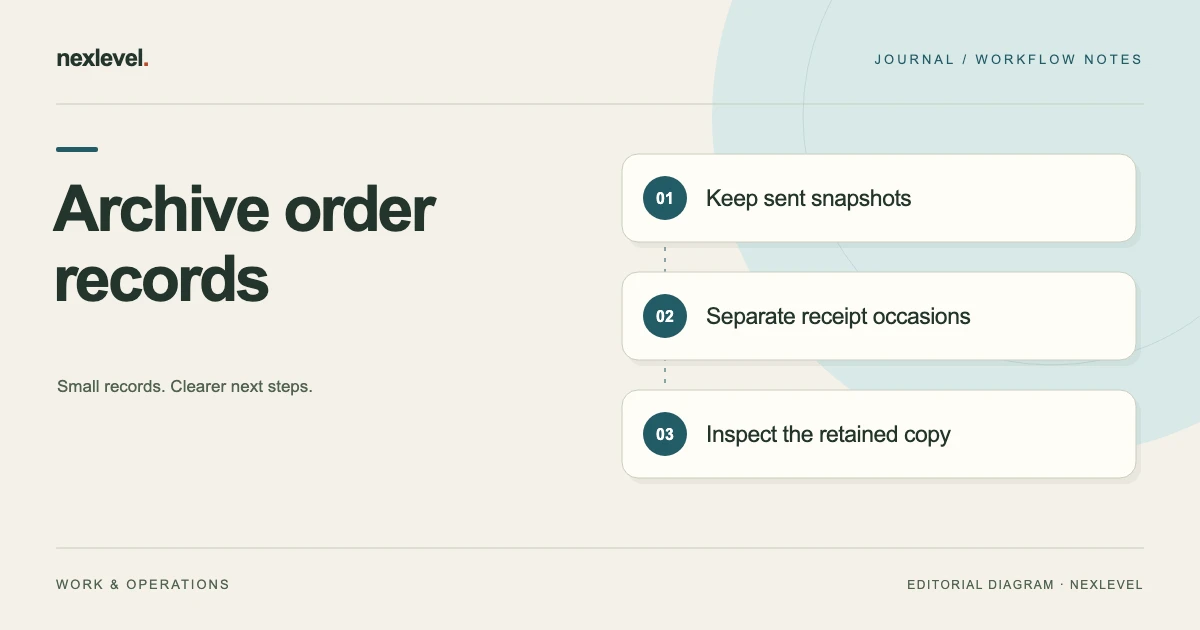
Archive a purchase order with its selected source, preserved sent version and separately identified receipt events. Add a short index showing the cutoff and unit basis so a later reader can explain the remaining quantity and distinguish historical records from newer working data.
Build a retrievable order packet
- State the order, line and historical question the archive needs to answer.
- Retain the selected quote or request and the corresponding sent snapshot.
- Index each receipt occasion with its quantity, unit and source, keeping unresolved relationships visible.
- Open the retained output and ask another reader to retrieve both the snapshot and the receipt calculation.
Working fields:
Order/line | Source quote/request | Sent snapshot | Receipt references/units | Remaining quantity basis | Cutoff | Retained files | Open question
Useful next steps: Compare a copy with the sent snapshot, Prepare the next partial-receipt handoff.
Choose the historical question
A later reader may need to reconstruct a sent snapshot, identify one receipt occasion, or understand a remaining quantity. Those questions can need different sources.
Write the order and line scope, source cutoff, preparation occasion, intended reader, and actual output. A packet about one order should not appear to represent every later vendor or account change.
Keep the archive proportional. A companion index can preserve authorized source routes without collecting unrelated supplier, customer, or account material into a broad shared folder.
Separate source, entered order, and sent snapshot
A selected quote or request, an entered purchase order, and a preserved sent-document snapshot have related but different roles. The archive should identify the actual relationship among them.
Vendraft’s current description includes reusable vendor/catalog context, exact stored units, PDF preview, and preservation of number, totals, vendor details, and document snapshot when marked sent.
A later working vendor record should not silently replace the explanation of an older snapshot. Keep the selected source occasion and actual representation readable.
Use an order-and-receipt archive index
One row can identify each source role the packet needs. Keep line identity, snapshot, receipt occasions, quantity reconciliation, and output context separate where their sources differ.
| Field | What to preserve |
|---|---|
| Order and line | The selected identity and stated unit basis |
| Source | The actual selected quote or request relationship |
| Snapshot | The preserved document and source occasion |
| Receipts | Separate entered receipt references and quantities |
| Remaining context | The calculation scope and any unresolved source question |
| Output | The retained copy, cutoff, and limitation |
These are independent companion prompts, not a named archive module or a guarantee that every explanatory field appears automatically in a PDF or CSV.
Work through a fictional partial-receipt packet
Imagine order O35, line L2, selected source Q4, and sent snapshot S6. The fictional order contains twelve stated units of a non-food supply item.
Receipt entries R1 and R2 record five and four units. Under the stated entered-record model, receipts sum to nine and the remaining quantity is three.
Retained copy C8 represents the selected cutoff. A limitation row asks which source establishes the relationship between R2 and the selected line. No real supplier, order, physical delivery, price, tax, or payment is supplied.
Keep line units beside the quantity
A pack and an individual unit can have different meanings. The fictional O35 example uses stated individual units and no pack conversion.
Five plus four equals nine, and twelve minus nine equals three under those explicit assumptions. Correct subtraction does not establish physical receipt or item condition.
For a source-unit question, use the supplier pack-size worksheet. Preserve the actual basis rather than guessing a conversion to make the packet look complete.
Preserve source-to-order context
A request, selected quote, and entered order can cover different details. Keep Q4’s actual role and source occasion instead of treating a similarly named document as interchangeable.
Use the quote-to-order mapping guide for that narrower review. Preserve its actual result or precise limitation.
If a detail remains absent, retain the source question. Do not invent a term or price to make the historical order appear more complete than its sources establish.
Give local sent status its actual role
Vendraft currently preserves a document snapshot when an order is marked sent. That local action and evidence of external sending, delivery, or vendor acceptance can have different meanings.
For S6, identify what the actual selected source establishes. A document filename or local status should not silently become an external acknowledgement.
The archive task does not authorize contacting a supplier. Its fictional retrieval exercise can be completed without sending an order or changing a real business relationship.
Keep receipt occasions separate
R1 and R2 represent distinct entered receipt contexts. A combined total can support a summary while still needing the original separate references for later review.
The current app describes receipt recording that prevents quantities from exceeding the order in the supported workflow. That organizing control does not independently verify a physical delivery.
Use the partial-receipt guide for that narrower task. Preserve the actual source relationships rather than overwriting an earlier occasion with a later combined number.
Keep acceptance, closure, and payment distinguishable
A local accepted, received, or closed state can organize entered workflow. It should not automatically stand in for external vendor acceptance, item condition, invoice matching, or a bank transaction.
Identify which actual source answers the selected historical question. If the packet lacks that relationship, retain the precise limitation rather than choosing a confident completion label.
No accounting or legal conclusion follows from O35’s fictional remaining quantity. The archive preserves entered records and source roles, not a complete supplier-account determination.
Inspect the selected output and backup purpose
Vendraft currently advertises PDF sharing, Pro formula-safe CSV, and Pro JSON backup. Check actual access and open the representation selected for the archive.
Inspect order identity, selected source, line units, snapshot context, receipt occasions, quantity scope, and cutoff. A companion explanation may be needed where the actual output does not represent every source relationship automatically.
The public description does not establish arbitrary spreadsheet import or every backup recovery arrangement. A named backup capability should not be expanded into an untested universal restoration promise.
Prepare a cover note for C8
The first line can identify O35/L2, the selected cutoff, and the archive purpose. A source line names Q4 and the actual authorized route.
A snapshot line identifies S6. Separate receipt lines name R1/R2 and their entered quantities. A calculation line preserves twelve ordered, nine entered received, and three remaining units under the stated model.
A contents line should name only what was retained. A PDF snapshot, CSV, backup representation, source document, and companion index can serve different purposes.
Test retrieval from the snapshot and remaining quantity
Ask a reader to begin with S6 and identify the selected order and line context. Then begin with the fictional three remaining units and reconstruct the separate receipt entries.
Introduce another fictional order O36 with a similar line description. The reader should use actual references rather than assign R2 to the closest-looking item.
If a retained copy loses a relationship preserved in the working source, repair that copy. If the original source remains uncertain, retain the question rather than inventing delivery or acceptance evidence.
Keep later clarification visibly later
A later source may clarify the receipt or selected quote relationship. Retain its own occasion and connection to C8 rather than making the historical packet appear to have known it earlier.
A correction to the companion explanation is different from recording another receipt or changing an order. Keeping those purposes distinguishable prevents archive repair from creating a business event.
A concise receipt can name sources inspected, arithmetic checked, representation opened, relationships established, and next question. It documents an administrative review without a procurement-success or payment claim.
Keep the archive proportional and usable
A small selected packet can be easier to retrieve than a broad folder of unrelated vendor material. Include what the intended question needs and identify where relevant sources remain elsewhere.
Keep the actual cutoff and important unit explanations inside the packet too. A copied or renamed file should not lose the distinction between the selected snapshot and later working information.
Do not delete the working history merely because an output exists. File preparation and reliable retrieval are separate results, and this guide does not prescribe a retention period.
Separate retention from a method decision
For tool selection, use the purchase-order system comparison. Choosing a system and preparing one historical packet have different requirements.
The fictional figures remain teaching inputs. Reuse the source-index structure with actual authorized records rather than importing invented receipts into genuine purchasing history.
A useful archive can identify a bounded remaining source question without claiming that every supplier relationship or payment outcome is complete.
Complete the order-and-snapshot cover sheet
The C8 cover note can keep selected source, entered order, sent snapshot, separate receipts, and output on their own lines. This is an independent explanatory worksheet rather than a guarantee that every line is a native export field.
| Reference | Role in the packet | Question to test |
|---|---|---|
| O35 and L2 | The selected order and twelve-unit line | Which stated unit basis is retained? |
| Q4 | The source quote or request | What actual relationship supports the entered line? |
| S6 | The preserved document snapshot | What local event and occasion does it represent? |
| R1 and R2 | Five and four entered receipt units | Which separate occasions remain visible? |
| Remaining quantity | Twelve minus nine equals three | What external source question remains separate? |
| C8 | The retained representation | Which cutoff and contents were inspected? |
Ask the reader to begin with the remaining quantity and reconstruct R1/R2. Then begin with S6 and locate O35/L2/Q4. The routes should converge where actual sources establish the relationships.
Compare two possible retained order packets
Imagine packet A contains only the sent-document PDF. Packet B contains the selected supported output plus a companion source/receipt index. Neither is automatically sufficient; compare each with the actual retrieval question.
If the task is to find the selected snapshot, packet A may provide a useful route once its identity and cutoff are established. If the task is to explain separate receipt occasions or remaining units, the additional relationships in packet B matter.
Now suppose packet B labels a receipt entry as independently verified delivery even though the source only establishes entered records. Its extra detail does not make it accurate. Repair the explanation rather than creating a fictional delivery acknowledgement.
A bounded continuation task can ask which authorized source establishes R2’s line relationship or the external event relevant to the reader’s question. It should not require reconstructing the whole supplier account when one relationship is uncertain.
Keep order identity, unit basis, snapshot role, and cutoff inside the packet as well as in filenames. A copied file can lose its folder path, and a later reader should not infer source chronology from modification time.
If a supported backup check is actually performed, record its bounded arrangement and observed result. Do not claim recovery success merely because a JSON file exists or a backup feature is available.
The completion receipt can name sources inspected, arithmetic checked, representation opened, relationships established, and next question. It records an administrative review without a claim about physical delivery, vendor acceptance, or payment completion.
The fictional figures remain teaching inputs. Reuse the source-role structure with actual authorized purchasing records while preserving unit meanings and external evidence boundaries.
For a final check, give the reader only C8 and its companion index. Ask them to identify the selected snapshot, separate receipt occasions, stated units, and remaining quantity. Record any manual explanation needed and the exact external source question still open. The packet can support a bounded next review without claiming supplier acceptance or verified physical delivery.
Use Vendraft for clear entered order history
Vendraft connects entered order details, selected document snapshots, receipt records, and supported outputs in a local workspace without requiring an account.
Check the official Vendraft App Store listing for current capabilities and Pro access. Preserve administrative history while keeping external communication, physical delivery, and payment evidence in their appropriate roles.