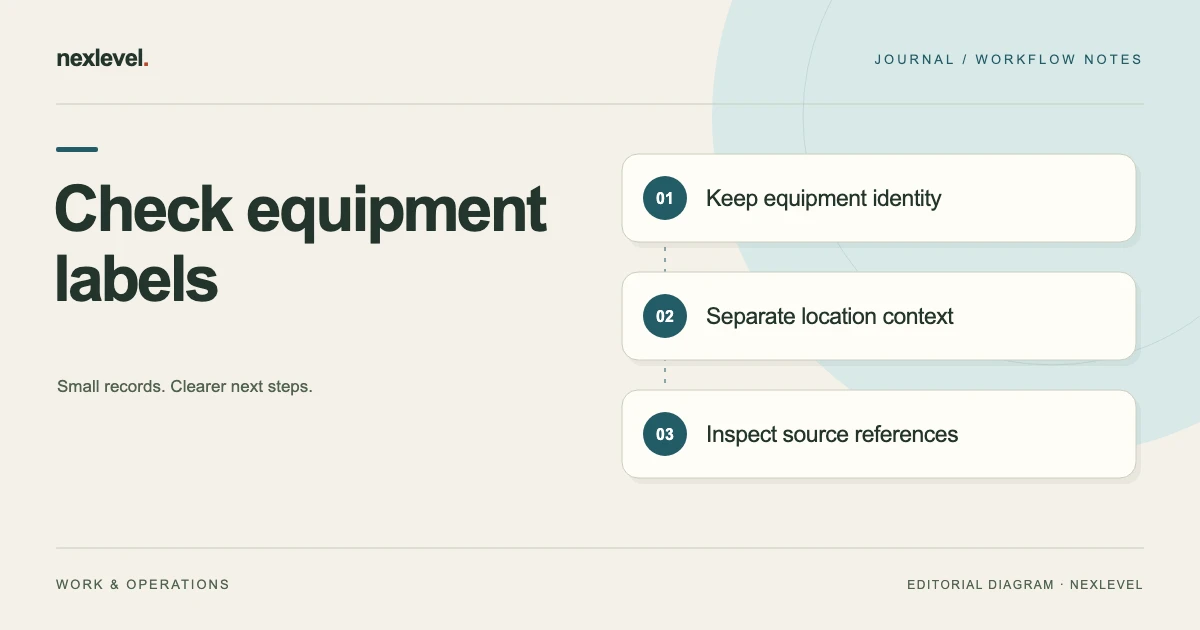
When an equipment location label changes, first establish which instrument each record represents. Compare stable identity sources before deciding whether the difference is a renamed room, an older location, a copied-label error or an unresolved item match. Location wording alone cannot settle that question.
Establish identity before interpreting the label change
- List the selected equipment records, old and current labels and source occasions.
- Compare the identifying sources that distinguish similar instruments.
- Check the event and certificate relationships separately from location text.
- Classify the finding before correcting the affected summary or record.
- Keep the established result and precise unresolved question in a short receipt.
Working fields:
Equipment/source ID | Old label/occasion | Current label/occasion | Event/certificate | Finding type | Supported correction | Remaining question
Useful next steps: Check certificate identity separately, Build equipment identity from existing source files, Preserve historical label context.
Define the bounded identity question
Write the selected equipment records, source cutoff, exact label discrepancy, intended reader, and source arrangement. A check about one location note should not appear to verify the entire register.
Useful questions include whether an older label and a current label concern the same selected item, or whether a copied certificate reference was assigned using location rather than actual identity.
Use fictional records during the exercise. There is no need to calibrate, operate, or inspect real equipment merely to test the worksheet.
Separate equipment identity from location wording
A location describes entered context. It is not automatically a permanent identity key. Several items can occupy one area, and one item can have differently worded location sources over time.
CalibraDue’s current description includes equipment identity, serial numbers, locations, entered intervals, append-only calibration events, certificate references, and QR lookup with manual fallback.
This guide’s references are independent document conventions. They do not establish a native move-history module, automatic duplicate merge, or a particular QR data format.
Set up a fictional label discrepancy
Imagine equipment reference Q31, source identity I2, older location label L3, and current label L4. Event E5 and certificate reference C6 concern selected source occasions.
Another record Q32 has a similar model name. A cover summary groups Q31 and Q32 under the same current room label, leaving the identity relationship uncertain.
No real instrument, serial number, move, calibration, certificate, or operational result is supplied. The references evaluate administrative matching without creating equipment history.
Use an identity-and-location check table
| Source | Relationship to establish | Result to retain |
|---|---|---|
| Q31/I2 | The selected equipment identity | Actual source or precise question |
| L3/L4 | Old/current location context | Occasion and role, not identity by assumption |
| E5 | The selected event relationship | Equipment reference and limitation |
| C6 | The actual certificate-reference context | Source route or unresolved match |
| Q32 | The similar alternative record | What distinguishes it from Q31? |
The table is an independent companion worksheet. It does not claim that the app automatically verifies the underlying source identity.
Collect the selected source representations
Start with the relevant working equipment record, authorized identifying source, actual older location representation, current label context, and selected event/certificate references.
An older CSV or note can preserve a historical location label without being a live register. Identify its actual source occasion rather than assuming it is current because the file opens.
If a source is unavailable, retain that limitation. Do not borrow a similar instrument’s serial context merely to make the packet look complete.
Check identity before interpreting location differences
First establish which selected item each representation concerns. Only then compare L3 and L4 and ask whether the difference reflects wording, a later source occasion, or another unresolved relationship.
A familiar model name or room label can help the writer remember an item without being sufficient evidence for another reader. Preserve actual source references.
This guide gives no physical inspection method. The administrative task is to connect records without inventing equipment facts or authorizing use.
Keep QR lookup and physical identity distinguishable
The current app describes creating a QR label for an item and scanning it to open its equipment record, with manual lookup when camera access is unavailable.
Opening a selected record is not independent proof that every physical label or source document belongs to that equipment. Preserve the actual identity relationship relevant to the check.
Do not invent a QR-repair procedure or edit a label target from a guess. If the source relationship is unclear, identify the appropriate bounded record question.
Preserve event and certificate context
E5 and C6 can answer different questions from L3/L4. An event or certificate reference should not acquire another item’s identity solely because the location wording matches.
Use the certificate-to-equipment matching guide for that narrower task. Preserve the actual result or precise limitation.
CalibraDue currently describes append-only events. A correction to an explanatory location index is different from recording another calibration event.
Distinguish wording changes from new historical events
An updated room name, a copied-label error, a later location observation, and a documented move can have different source roles. Do not automatically turn one into another.
The current public description does not establish a dedicated location audit log. An independent worksheet may need to preserve the actual older/current source relationship.
If the working source is accurate but the cover summary is wrong, repair the summary. If the original identity relationship is uncertain, retain the question rather than changing correct records to match a guess.
Keep due status outside the identity conclusion
A due, overdue, or certificate-pending state organizes attention around entered information. It does not independently establish that Q31 and Q32 are the same instrument.
Use the due-date and certificate review for that separate task. A selected identity check should retain its limited scope.
This guide recommends no service interval or operating decision. Actual technical and quality-system conclusions remain with their appropriate sources and responsible people.
Inspect the selected register/report output
CalibraDue currently advertises CSV register export and Pro formatted PDF audit packets. Open the actual representation relevant to the selected check.
Inspect equipment identity, serial/source context, location role, selected event/certificate references, and cutoff. A companion explanation may be needed where the output omits a historical location relationship.
The public description does not establish arbitrary CSV import or a universal merge/restore process. A portable output should not become permission to rewrite the register.
Run a reverse lookup test
Begin with C6 and ask a reader to identify the actual selected equipment reference. Then begin with L4 and ask which source distinguishes Q31 from Q32.
Introduce the older L3 representation. The reader should preserve its occasion and meaning rather than declare it wrong solely because the current label differs.
If a route fails, identify the missing relationship precisely. More files are useful only when they supply the source context the bounded question needs.
Classify the finding before making a correction
Distinguish an unclear identity, shortened-label problem, wrong copied reference, historical/current cutoff difference, and genuinely conflicting source context.
A documentation correction is different from a move, calibration, or certificate event. Keep those roles distinguishable so review does not create equipment history.
Do not merge or delete records merely because a model/location combination looks duplicated. The selected source relationship must be established under the actual authorized arrangement.
Write a bounded check receipt
Name the equipment records selected, sources inspected, identity/location relationships established, actual copy correction if applicable, and precise remaining question.
A later clarification should retain its own occasion and connection to the selected packet. It should not make the historical record appear to have known later information.
The receipt documents an administrative identity review without certifying measurement, calibration, accreditation, or suitability for use.
Connect the result to handoff or retention
For another person taking over the records, use the calibration-record handoff guide. A worksheet does not itself grant technical authority.
For a historical packet, use the calibration archive guide. For method selection, use the equipment-system comparison.
The fictional references remain teaching inputs. Reuse the check structure with actual authorized records while preserving source uncertainty and professional-review boundaries.
Classify four location-label cases
The worksheet can keep a copied-label problem separate from an actual identity question. Each finding should name the source relationship established and the bounded next review.
| Fictional finding | Source situation | Bounded result |
|---|---|---|
| Cover-label error | Q31/I2 is established, but the summary uses the wrong location text | Repair the summary |
| Historical/current labels | L3 and L4 have distinct established occasions | Preserve both source roles |
| Unresolved identity | The sources do not distinguish Q31 from Q32 | Retain the precise identity question |
| Certificate assigned by room | C6’s equipment match is not established | Continue source matching before describing the relationship as verified |
These are independent teaching cases. They do not claim a native move-history, merge, certificate-verification, or physical-label repair feature.
Continue the selected finding without rewriting history
For the cover-label case, correct the explanatory copy using the established source. There is no need to create a move or calibration event merely to make the summary agree.
For the historical/current case, retain each occasion. A prior location can remain useful history without being the present working label.
For the unresolved-identity case, identify the actual authorized source that would distinguish Q31/Q32. A similar model and shared room label are not enough to settle it.
For the certificate case, continue the specific equipment/source match. A current location should not make an unrelated reference look correct by association.
Then remove the original conversation. Ask a reader to begin with C6 and locate the selected equipment source, then begin with L4 and identify what distinguishes Q31/Q32.
Keep identity, location roles, event/certificate context, and cutoff inside the check receipt as well as in filenames. A copied register should not lose its historical/source distinctions.
If later clarification resolves a relationship, preserve its own occasion. It should not make an older packet appear to have known a later identity confirmation.
A bounded receipt can name the case applied, sources inspected, relationship established, copy corrected if applicable, and next question. It documents an administrative review without certifying calibration, measurement, or operating suitability.
The fictional references remain teaching inputs. Reuse the classification structure with actual authorized records while preserving quality-system and professional-review boundaries.
Prepare an identity receipt for the selected labels
In one fictional branch, the authorized identifying source establishes Q31/I2 while an explanatory cover summary uses the wrong location wording. The supported repair is to correct that summary. It should not create a move, calibration, or certificate event.
In another branch, L3 and L4 have established but different source occasions. Preserve both roles. A prior location label can remain useful history without being the current working label or evidence of a new event.
A third branch leaves Q31/Q32 identity unresolved. The supported result is to name which actual source would distinguish them. A similar model and shared room label should not silently merge the records or attach C6 to whichever appears first.
The receipt can identify the selected records, sources inspected, identity/location relationships established, actual explanatory copy corrected if any, and precise remaining question. Keep technical history and operating decisions outside that conclusion.
For a final check, give another authorized reader only the packet and receipt. Ask them to begin with C6, then L4, and locate the established equipment context or exact limitation. Record any manual explanation needed.
A useful check can make the next administrative task specific without a physical inspection method, calibration claim, or authorization to operate equipment. Keep that evidence limit beside the affected reference so another reviewer can continue without reconstructing the original conversation.
Use CalibraDue for connected entered equipment context
CalibraDue connects entered equipment identity, location, events, certificate references, due context, and supported outputs without requiring an account.
Check the official CalibraDue App Store listing for current capabilities and Pro access. Keep record lookup, actual identity, technical history, and operational conclusions in their appropriate roles.