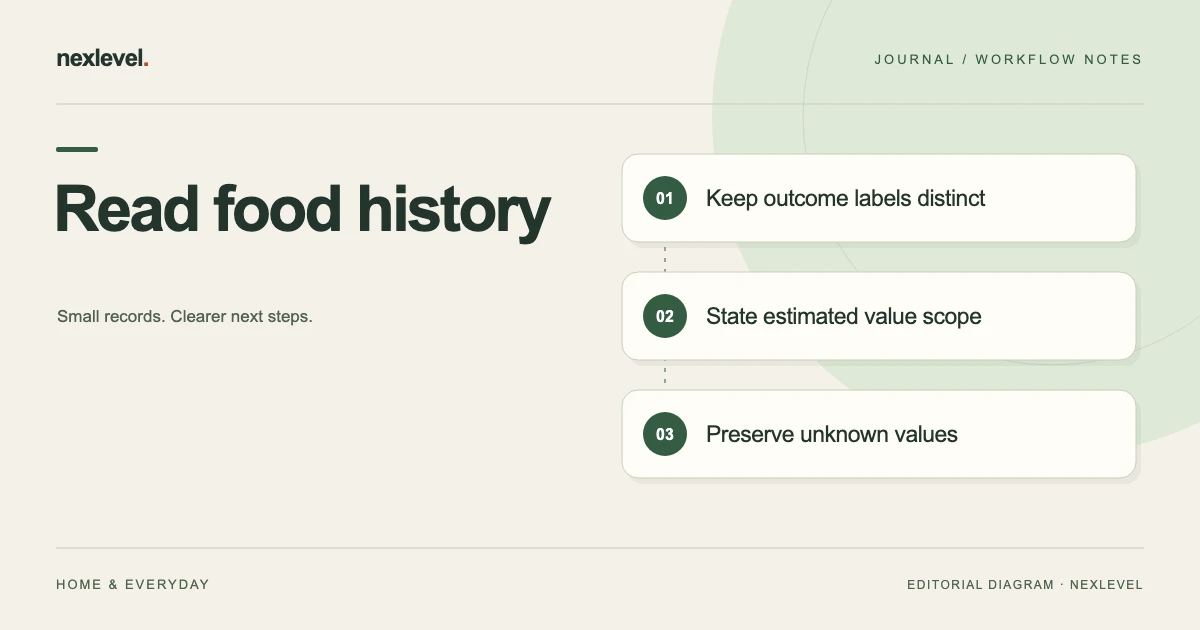
Before interpreting food waste history, check which items were recorded as used, discarded or archived and which have known estimated values. Keep the selected period and missing amounts visible. A sum of estimates describes that source set; it does not establish household spending or savings.
Check outcome and value scope before reading a total
- Select the history copy, items and review period.
- Match each outcome to the correct item and source occasion.
- Keep archived records separate from recorded discards.
- List known estimated values and leave missing values unknown.
- State the grouping and known-value scope beside any independent calculation.
Working fields:
Item | Outcome/source occasion | Estimated value/basis | Known or missing | Selected grouping | Period/cutoff | Interpretation limit
Useful next steps: Understand archive states before grouping history, Check the item and value source, Inspect the exported history copy.
Choose the history question
Write which selected history representation and source occasion are being reviewed. A current item queue, a retained CSV, and a prepared companion summary can represent different scopes.
The bounded question is what the selected entered outcomes and value fields establish. It is not whether a real item was safe, physically consumed, or disposed of correctly.
A useful result can contain a specific missing source relationship. Do not fill a blank value or outcome with a plausible guess merely to make an insight look complete.
Set up a fictional outcome packet
Imagine item I1 has an entered used label and an estimated value of four currency units. I2 has an entered discarded label and a value of six. I3 has an entered archived label and a value of five.
I4 has an entered discarded label but no value established in the exercise. C8 is the retained companion worksheet, and H9 the selected source-history reference.
These are invented teaching inputs, not actual food, purchase prices, physical outcomes, or native field names. No claim is made about SavorSoon’s internal insight grouping or calculation method.
Use an outcome-and-value review table
| Fictional item | Entered outcome role | Estimated-value role | What remains separate |
|---|---|---|---|
| I1 | Used in the selected source | 4 currency units | Verified physical consumption or savings |
| I2 | Discarded in the selected source | 6 currency units | Actual expenditure or a safety conclusion |
| I3 | Archived in the selected source | 5 currency units | Used or discarded by assumption |
| I4 | Discarded in the selected source | Not established | A zero value or complete group total |
The table is an independent worksheet. It does not promise a native insight layout, export schema, or automatic verification of any physical outcome.
Establish the selected item relationships
A familiar food or container label can recur. Match each selected outcome to its actual item and source occasion rather than assign a status by the closest-looking name.
The mixed-source intake guide covers package, receipt, opened, and frozen-date roles. Its source method can support identity without supplying the later outcome.
If the item association remains unclear, retain that precise question. A more detailed-looking summary cannot establish which record the source concerns.
Keep the three entered outcome labels distinct
SavorSoon currently advertises used, discarded, and archived outcomes. Their presence in a history record should retain the actual selected source meaning.
Do not describe I3 as used or discarded merely because it is archived. The exercise supplies only the archived label and does not infer another event.
Likewise, an entered used or discarded label should not independently become a verified physical action, safety determination, or complete account of a household routine.
Read values as estimates when that is their source
The current app supports an optional estimated value. Preserve that role rather than call every entered amount a receipt-backed purchase price.
A user estimate, a copied document amount, and a modeled allocation can answer different questions. This exercise uses invented values in one currency without claiming an actual financial result.
Do not infer savings, waste reduction, tax treatment, or verified expenditure from the existence of an estimated-value field.
State the independent grouping convention
For the selected known-value items I1, I2, and I3, the independent worksheet sum is four plus six plus five, or fifteen currency units.
Under a separate explicitly defined worksheet grouping of selected discarded items with known values, I2 contributes six. I4 has no established value and is not silently assigned zero.
Those calculations illustrate source scope. They are not claims about SavorSoon’s native waste-insight algorithm or about a complete monetary total for every discarded item.
Keep a missing value separate from zero
I4’s value is not established in this teaching source set. That limitation should remain visible rather than disappear into a zero-filled total.
A zero would be another entered value with its own meaning. The absence of a source does not independently establish it.
A useful companion note can therefore report the known-value scope while identifying the unresolved item. It need not invent a price to make the worksheet look finished.
Keep source occasion beside outcome
An outcome can be entered or clarified later while an older retained copy remains accurate for its earlier occasion. Keep those source contexts distinguishable.
A file preparation date should not replace the actual selected history relationship. Likewise, a current view should not make an older C8 appear to update automatically.
If the actual source does not establish the period needed for a selected comparison, retain that question instead of choosing a convenient interval.
Separate date fields from outcomes
An expiry, acquired, opened, or frozen date has a different role from an entered used, discarded, or archived label. A date alone should not supply an outcome by assumption.
The date-wording preservation guide covers the source meaning of entered dates. It does not turn a label into a safety or physical-consumption conclusion.
This exercise supplies no real date and performs no shelf-life calculation. It preserves administrative roles before interpreting a history copy.
Work through a clear source branch
In the first fictional branch, H9 establishes the selected I1/I2/I3 outcomes and known estimated values. C8 preserves the fifteen-unit known-value sum and the separately defined six-unit discarded-known-value scope.
I4’s missing value remains explicit. The result should not be described as a complete monetary waste total or verified spending.
The bounded check makes the entered source set reproducible without claiming actual food use, disposal, or savings.
Work through an archive-as-discard error
In another branch, C8 treats I3’s archived label as discarded even though the selected source does not establish that outcome. Restore the actual label role in the explanation.
Do not change accurate item history merely to make the mistaken summary consistent. The error may be in the companion grouping rather than the source record.
Keep the correction specific:item association, outcome role, or independent calculation convention. A generic fixed label would hide what actually changed.
Work through a missing-value error
In a third branch, C8 silently treats I4’s unavailable value as zero and calls the result complete. Correct the scope statement using the actual source limitation.
If a later authorized source establishes a value, give it its own occasion and relationship before revising the worksheet. Do not make an older retained copy appear to contain later information.
The review can remain useful while the value question is open. It does not need a guessed price or actual shopping decision.
Keep reminders separate from outcome evidence
SavorSoon supports optional local reminders that can be changed or disabled. A prompt is configuration, not another used or discarded event.
Do not count a reminder as an outcome because it appears near an item in a working view. Its source role differs from the selected history record.
This exercise changes no schedule or notification setting. A reminder state does not establish attention, physical handling, or food safety.
Read native insights within verified scope
The current listing advertises waste-history review and complete waste insights under Pro Lifetime. It does not document every grouping, rounding, period, or attribution rule.
Inspect the actual available representation without assigning the independent worksheet’s convention to the native display. Different scope can produce different numbers without establishing a data error.
If the source meaning needed for the selected interpretation is unavailable, name that precise question. A more precise-looking companion number should not become proof that an undocumented native calculation is wrong.
Choose a supported portable representation
SavorSoon Free currently includes up to thirty active foods, location tracking, local reminders, history, and CSV export. Pro Lifetime adds unlimited active foods, custom expiry presets, complete waste insights, and Family Sharing.
Inspect the actual selected representation for item identity, outcome role, estimated-value basis, and source cutoff. The companion table is not a promised native CSV layout.
The public description does not establish arbitrary CSV import or complete restoration. A readable history copy should not be described as the whole editable workspace.
Run an independent outcome-reading test
Give another authorized reader C8 and the fictional selected source set. Ask how I1, I2, I3, and I4 differ and what the fifteen-unit and six-unit calculations represent.
Then ask what I4’s missing value establishes. The answer should preserve an unknown rather than invent zero or a complete group total.
Record any manual explanation needed. Repair a confusing copy when the source is accurate;retain a precise question when the underlying association or value basis remains missing.
Use a copy-ready history receipt
A companion receipt can identify H9, the selected items, outcome occasions, known estimated-value inputs, explicit independent grouping, actual representation inspected, copy correction, cutoff, and next question.
For the clear fictional branch, it preserves the known-value scope without a physical consumption, actual spending, or savings claim. For the archive-as-discard branch, it identifies the incorrect outcome association.
Read the receipt without its filename. A future reader should understand the result without reconstructing the original household conversation or assuming every archived item was discarded.
Connect history review to handoff and retention
For an administrative transition, use the food-record handoff guide. For historical copies, use the label-context archive guide.
For choosing a working method, use the food record-system comparison. Keep the selected outcome-review purpose visible when deciding which representation serves a task.
The fictional values remain teaching inputs. Reuse the source structure with actual authorized records while preserving uncertainty and substantive food decisions outside the administrative exercise.
Keep record counts separate from value sums
The fictional source set contains four selected item records, while only three have established estimated values. Those counts describe records and known inputs, not physical portions or the monetary value of every outcome.
The fifteen-unit sum combines I1, I2, and I3 under its stated known-value convention. The separate six-unit result concerns I2 under the explicitly selected discarded-known-value grouping. Neither number supplies I4’s missing value.
A useful companion label can therefore state both scope and limitation: four selected records;three known estimated-value inputs;one unavailable value;independent known-value sum fifteen;selected discarded-known-value sum six. This is worksheet wording, not a native insight format.
If a real source uses a value for a different item basis or currency, establish that relationship before combining it. Do not assume a whole-record estimate is a unit price or perform a conversion merely because two numbers appear comparable.
For a final practical check, remove the original chart or folder context and ask an authorized reader what each number counts or sums. They should distinguish records, known inputs, and estimated currency amounts without inferring physical consumption or actual expenditure. Record any explanation still needed and keep the source question beside the affected item.
Use SavorSoon for clear entered history roles
SavorSoon connects local entered dates, storage locations, optional reminders, outcome history, estimated values, and supported CSV output without requiring an account.
Check the official SavorSoon App Store listing for current capabilities and Pro Lifetime access. Keep entered outcomes, source periods, value assumptions, independent calculations, and physical food conclusions distinguishable.