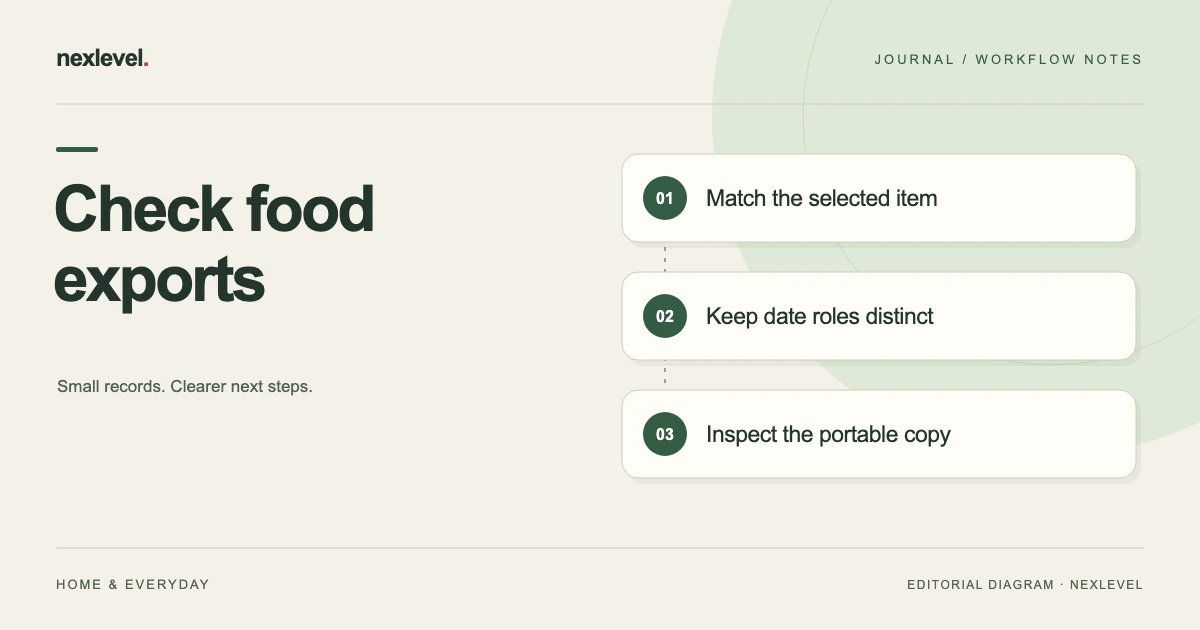
Before relying on a food tracker CSV, open the file and match its rows to the source items. Check what each date represents, which outcomes it records and the cutoff it covers. Add a companion note where original wording or unresolved questions are outside the exported columns.
Compare the selected CSV with its source records
- State the export's task and the source occasion it should represent.
- Match a selected row to the actual item and label reference.
- Compare entered, acquired, opened and frozen dates by role.
- Check outcome and estimated-value context without filling unknowns.
- Inspect the CSV with its companion note and distinguish preparation from actual sharing.
Working fields:
CSV/cutoff | Item/source | Date column/role | Label route | Outcome | Missing context | Companion note | Review result
Useful next steps: Map the source notes before export, Check the original date wording, Prepare the household handoff.
Choose the selected export question
Write what the portable copy needs to support: a source check, an administrative handoff, or historical retrieval. A current item queue and an older CSV can represent different occasions.
The task is to establish the copy’s actual scope. It does not determine whether food is safe or prove a physical consumption event.
A useful result can contain a precise unanswered source question. Do not fill a missing date or outcome merely to make the output look complete.
Set up a fictional pre-export packet
Imagine I34 is the selected item, L2 the label-source reference, D3 its entered date context, A4 an acquired-date source, O5 an opened-date source, F6 a frozen-date source, E7 the selected CSV, and R8 the companion review note.
The selected question is whether E7 preserves the actual I34 source roles needed for the task. No real food, package wording, date, amount, or physical outcome is supplied.
These labels are teaching references rather than native CSV column names. The exercise does not invent a field layout or a source-verification feature.
Use a source-to-copy checklist
| Role | Question before relying on E7 | Keep separate |
|---|---|---|
| Item identity | Which I34 source does the row represent? | A similar package or label |
| Label wording | What does L2 actually establish? | A broader interpretation |
| Entered date | What source supports D3’s role? | A suggestion as printed evidence |
| Other event dates | How do A4/O5/F6 differ? | Interchangeable date values |
| Outcome context | What entered role is actually represented? | Verified physical use or disposal |
| Copy occasion | What source cutoff does E7 represent? | Every later change |
| Review result | What is established or still open? | A complete restore or safety claim |
This is an independent companion worksheet. It does not promise native export filters, custom columns, or automatic source matching.
Establish item identity before comparing dates
A household can contain similar items with different source occasions. Match the actual selected row to I34 before comparing its entered date context.
A familiar product name or storage location does not independently establish the relationship. Keep the authorized source route usable without adding unnecessary household detail to a general note.
If the association remains unclear, retain that precise question. A more confident row label cannot provide the missing evidence.
Preserve label meaning outside a shortened value
A copied date value can lose the original wording or qualification that explains its role. Preserve the selected L2 context through the actual supported representation or an appropriate companion note.
The date-wording preservation guide covers that narrower task. It should not become a generic interpretation of every real label.
This exercise supplies no actual labeling term. Important real source or safety questions need their appropriate authoritative guidance rather than a spreadsheet assumption.
Keep entered dates tied to their actual basis
SavorSoon currently supports an expiry date plus optional acquired, opened, and frozen dates. D3 should retain the source basis actually established for its selected role.
The current listing also advertises practical entry suggestions and Pro custom expiry presets. A suggestion or preset is not automatically wording printed on L2.
Do not describe the app as independently verifying a package, reading a receipt, or calculating food safety. The source relationship remains important after export.
Separate acquired, opened, and frozen contexts
A4, O5, and F6 can represent different occasions even when values happen to resemble one another in an actual record. Preserve their distinct roles in the selected copy.
The mixed-source intake guide covers the underlying source association.
If the native output lacks some companion context needed for the task, retain it separately rather than claim an unverified export column. Do not copy one date into another role to fill a gap.
Keep storage location separate from date meaning
SavorSoon organizes fridge, freezer, and pantry records. Location can help identify an entered item while remaining different from label meaning and event dates.
A location field does not independently establish temperature, condition, correct handling, or a revised expiry conclusion.
This export exercise performs no physical move or storage calculation. It keeps administrative source roles understandable in the portable representation.
Check entered outcomes without broadening them
The current app supports used, discarded, and archived outcomes. Preserve the actual selected source role rather than infer one outcome from another.
The outcome-and-value history guide covers a related interpretation task. An archived label should not become discarded by assumption.
A readable output still does not independently prove physical consumption, disposal, or safety. Keep those conclusions outside the selected source check.
Keep estimated values in their own role
SavorSoon advertises optional estimated value and waste-history review. If a value is relevant to the selected copy, preserve its actual basis rather than call it verified spending or savings.
This case supplies no monetary amount and performs no economic calculation. Missing context should remain a source question rather than a guessed price.
Do not use a more polished spreadsheet display to strengthen what the underlying entered evidence establishes.
Work through a source-clear copy
In the first fictional branch, E7 clearly represents I34 and preserves the selected date roles needed for the task. L2 and A4/O5/F6 have their actual associations established.
R8 can identify the source set, selected representation, and cutoff without a food-safety or complete-workspace claim.
The result concerns the actual copy inspected. It does not verify every row, another export, or later history merely because the selected row is understandable.
Work through a date-role mismatch
In another branch, the companion explanation labels O5 as the package expiry source even though the available source establishes an opened-date role.
Correct the explanatory association using the actual source. Do not change accurate history to make a mistaken label appear true.
If the underlying native source itself needs review, preserve that different question and use supported controls. The exercise does not invent a universal import or correction mechanism.
Work through an older-copy mismatch
In a third branch, E7 represents an earlier source occasion while the current local record includes a later change. The older copy can remain valid history without being current.
Identify the actual cutoff before calling either representation wrong. Do not make R8 claim that an older file updates automatically with local edits.
A source-occasion distinction can resolve a confusing comparison without inventing a missing event or rewriting accurate original records.
Inspect the actual supported CSV representation
SavorSoon Free currently includes CSV export alongside up to thirty active foods, location tracking, local reminders, and history. Pro Lifetime adds the advertised expanded access and insights.
Use the actual native representation rather than a guessed schema. Inspect the selected copy for item identity, date roles, outcome context, and source occasion needed for the stated task.
The companion worksheet does not promise every field or a field-level export filter. Preserve necessary additional context separately when appropriate.
Do not confuse portability with complete restoration
The current public description does not establish arbitrary CSV import or full restoration. A readable portable copy should not be described as the entire editable workspace.
A successful E7 reading check establishes what that selected representation supports. It does not prove recovery of every record, setting, history role, or source context.
This exercise performs no import or restore. Record only the actual inspection of the copy and the source result it supports.
Keep reminders separate from exported events
The app’s optional local reminders are prompts that can be changed or disabled. A reminder should not become another acquired, opened, frozen, used, or discarded event in a companion explanation.
Preserve the actual supported output’s roles rather than infer event history from nearby configuration.
This review changes no schedule or notification permission. A prompt state does not establish attention, physical handling, or safety.
Read the complete selected packet
Inspect E7 and any companion note rather than stop at one familiar heading. A correct item title does not establish every date-role association in the selected copy.
Keep the intended purpose visible so additional private household context is not copied merely to make a broad sheet look complete.
This is a manual review, not automatic privacy auditing. It performs no sharing and makes no promise about every recipient’s retained representation.
Run an independent source-reading test
Give another authorized reader E7/R8 and usable controlled source references. Ask which item is selected, what L2 establishes, how D3/A4/O5/F6 differ, and what the copy occasion is.
Then introduce another similarly labeled item or an older export. The reader should preserve actual identity and source occasion rather than choose by familiarity.
Record any manual explanation needed. Repair a confusing copy when its source is accurate; retain the precise question when the underlying association remains missing.
Use a copy-ready export-review receipt
A companion receipt can identify the purpose, I34 source set, date-role relationships, entered outcome context if relevant, representation inspected, actual correction, cutoff, and next question.
For the source-clear fictional branch, it preserves the selected date roles without a safety claim. For the mismatch branch, it identifies the mistaken association rather than describing every record as incorrect.
Read the receipt without its filename. A future reviewer should understand the result without reconstructing the original household conversation.
Connect the check to handoff and retention
For an administrative transition, use the food-record handoff guide. For historical copies, use the label-context archive guide.
For choosing a working method, use the food record-system comparison. Keep the selected export-review purpose visible when deciding which representation serves a task.
The fictional references remain teaching inputs. Reuse the structure with authorized actual records while preserving uncertainty and real food decisions outside the administrative exercise.
Make the selected date-role note specific
A concrete companion note can identify E7 as the selected I34 review copy, L2 as the label source, D3 as the entered-date context, and A4/O5/F6 as separate event-date references. It should preserve only the source relationships actually established.
If O5’s relationship is missing, keep that limitation beside O5 rather than use a general complete label. A clear acquired-date source does not supply an opened-date occasion by assumption.
If the native CSV does not carry the original label wording needed for the task, the companion note can identify its controlled source route. That does not create a native column or prove that every recipient can access the original.
For a final practical check, remove the original folder context and ask an authorized reader to identify the item, each date role, actual source occasion, and precise next question. They should not need a real package date or a food-safety conclusion to explain the administrative result.
Record whether the copy was prepared and inspected or actually shared under the real arrangement. A selected destination and a readable file do not independently establish delivery, recipient access, or understanding.
Use SavorSoon for clear portable source context
SavorSoon connects local entered food dates, location context, optional reminders, outcome history, estimated values, and supported CSV output without requiring an account.
Check the official SavorSoon App Store listing for current capabilities and Pro Lifetime access. Keep source dates, entered roles, selected copies, later updates, and physical food conclusions distinguishable.