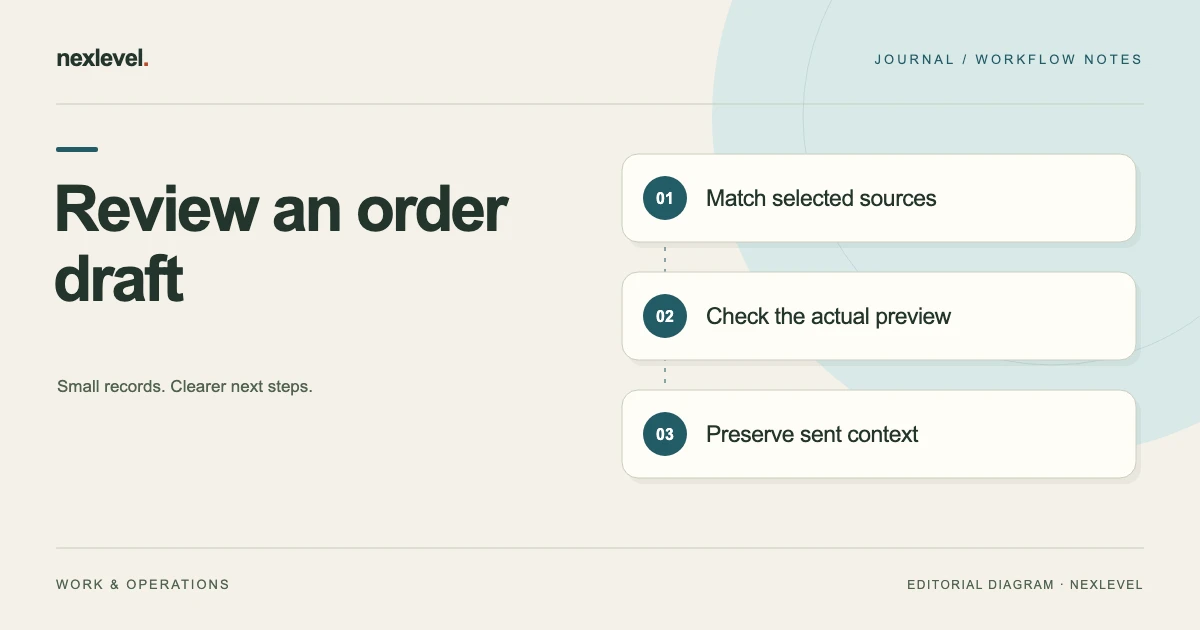
Before marking a purchase order sent, compare the draft and its actual PDF with the selected supplier and quote sources. Check units and terms as well as the total, then preserve the intended document. A prepared preview and a sent snapshot describe different stages.
Review the draft and the rendered document
- Confirm the selected PO, vendor, item and quote revision.
- Check quantity, pack and price bases, then review every adjustment and sourced term.
- Inspect the number, currency, line descriptions and total in the actual PDF preview.
- Resolve or name remaining questions before using your business’s supported sent workflow; retain external communication separately.
Working fields:
PO/draft | Vendor/quote | Line units/prices | Charges/terms | Number | PDF inspected | Open question | Sent snapshot reference
Useful next steps: Map the selected quote into the draft, Check a later copy against its snapshot.
Choose the selected pre-issue question
Write which draft and source occasion need reviewing. A current reference library, selected quote, previewed PDF, and older sent snapshot can represent different contexts.
The task is to preserve source meaning before relying on a document stage. It is not to certify business terms or prove external acceptance.
A precise unanswered input question is a useful result. Do not mark a placeholder order sent merely to make a queue look complete.
Set up a fictional draft packet
Imagine O71 is the selected draft, V2 its vendor reference, I3 the item context, Q4 a quote source, L5 the line-input role, N6 numbering context, P7 the chosen PDF, S8 a later sent-snapshot role, and R9 the companion note.
The independent teaching model uses quantity three at four currency units each, plus one unit of shipping, with no other charges, discounts, or tax inputs. The modeled total is thirteen.
These are invented values, not a real order, native output fixture, or commercial recommendation. No preview, state change, sharing, acceptance, receipt, or payment is performed.
Use a draft-to-snapshot worksheet
| Role | Question before relying on the stage | Keep separate |
|---|---|---|
| Selected order | Which O71 context is intended? | A similar saved draft |
| Vendor/item sources | What do V2/I3/Q4 establish? | Reusable references as every new fact |
| Line inputs | What basis supports L5? | A desired total as evidence |
| Numbering | What selected N6 role is established? | External acceptance |
| What does P7 actually represent? | The entire editable workspace | |
| Sent snapshot | What source establishes S8, if supplied? | A prepared preview alone |
| Review result | What is established or still open in R9? | A legal or physical outcome |
The worksheet is an independent companion convention. It does not establish native custom fields, a new approval gate, or automatic supplier verification.
Establish the selected order first
A vendor or project label can recur across drafts. Match the actual source relationships to O71 before comparing a PDF or assigning a quote.
The reference-versus-order guide covers the earlier preparation task.
If identity remains unclear, retain that precise question. A more detailed-looking order heading cannot supply missing source evidence.
Review the selected supplier and item basis
Vendraft supports reusable vendors, catalog items, and project codes. Those references should retain their actual selected relationship rather than establish every fact of O71 by assumption.
Q4 needs its own source occasion, quantity, price, and item context when relevant to the draft. A familiar supplier name does not make every quote interchangeable.
The pack-size quote comparison covers a narrower input task.
Keep line quantities and prices explicit
An item description, ordered quantity, pack basis, and unit price can answer different questions. Preserve the actual selected relationship before relying on a total.
The independent example uses three selected units multiplied by four currency units per unit, giving twelve. It is not a native calculation test or real offer.
If the actual source does not establish a line basis, retain that question rather than choose a value that makes the document agree.
State other modeled inputs beside the number
The fictional worksheet adds one unit of shipping to twelve, giving thirteen under the explicit no-other-adjustments convention.
That example does not claim real tax, discount, fee, or other cost sources are zero or irrelevant. Actual business inputs need their actual sources.
The current app calculates totals from exact stored units, but that implementation does not independently verify every assumption entered.
Keep terms and source dates deliberate
Payment terms, notes, discount, tax, and shipping context can be order-specific. A prior order’s values should not silently become facts of O71.
The quote-omissions review covers related source questions.
This guide interprets no contract, tax requirement, or legal deadline. It supplies an administrative review structure.
Review numbering within current access
Vendraft preserves the order number when the order is marked sent, and Pro advertises reliable custom numbering. Keep the actual selected N6 role clear.
Do not infer a supplier’s acceptance or a legal issue event from a number alone. The source stage still matters.
The public description does not document every numbering or editing behavior. Do not invent one for the worksheet.
Inspect the actual supported PDF preview
The current app previews Letter or A4 output before sharing. P7 should identify the actual selected draft representation rather than a familiar older file.
Read the selected vendor, item, quantity, price, terms, total, and source occasion needed for the task. Do not stop at a correct heading.
This exercise opens no native preview and supplies no screenshot or observed response fixture.
Separate a prepared file from the sent source
A readable P7 is not independently S8. The current listing says marking an order sent preserves its number, totals, vendor details, and document snapshot.
Keep that selected historical role separate from current editable reference data or later local changes.
The snapshot-and-receipt archive guide covers the related retention task.
Work through a source-clear draft
In the first fictional branch, O71/V2/I3/Q4/L5/N6 relationships are established and P7 represents the selected draft. R9 preserves the independent thirteen-unit model and its assumptions.
S8 remains a later role unless an actual sent-source relationship is established. The result claims no external acceptance or payment.
The check concerns the selected draft. It does not validate every vendor, item, order, or later output.
Work through a wrong-quote input
In another branch, Q4 belongs to another source occasion while the vendor and item names are familiar. Correct the companion association or retain the precise input question.
Do not rewrite accurate historical evidence to make the borrowed price fit O71. The mismatch concerns identity before arithmetic.
A generic fixed label would hide whether vendor, item, quote, line, total, or output context changed. Keep the actual correction explicit.
Work through a preview-as-sent explanation
In a third branch, R9 calls P7 a sent snapshot while the actual source only establishes preparation. Restore the actual stage in the explanation.
The correction creates no issue or sharing event. If S8 is later established, give it its own occasion and relationship.
An older preview receipt can remain accurate history without appearing to include later events automatically.
Keep sent state separate from external outcomes
Vendraft tracks sent, accepted, partially received, received, and closed states. Their entered roles should retain actual source support.
A label does not independently establish vendor receipt, commercial acceptance, physical delivery, or money movement.
The guide performs no state change and sends no document. It does not invent an automatic supplier-contact service.
Keep receipts separate from original draft review
The current app records receipts while preventing quantities from exceeding the order. That workflow role differs from preparing and reviewing O71.
The partial-delivery guide covers the narrower actual-record task.
This exercise supplies no received quantity or delivery event. A prepared order is not proof that goods arrived.
Choose supported output within current access
Free currently includes up to three purchase orders per calendar month with watermarked PDF sharing. Pro adds unlimited orders, unwatermarked PDFs, custom numbering, JSON backup, and formula-safe CSV export.
Keep PDF, CSV, and backup roles distinct. The public description does not document every import, merge, or recovery behavior.
This exercise performs no backup or restoration and makes no universal spreadsheet-safety claim.
Keep local and external stages separate
The current app stores company, vendor, catalog, order, and receipt data on device without an app account. Sharing or export occurs when a destination is chosen.
Prepared, shared, delivered, understood, and accepted can require different actual sources. Preserve the stage relevant to the selected task.
This guide changes no access and promises no control over every external retained copy.
Run an independent pre-issue reading test
Give another authorized reader R9 and usable controlled references. Ask which O71 source applies, how the independent total is derived, what P7 represents, and whether S8 is established.
Then introduce another order or later vendor source. The reader should preserve actual identity and occasion rather than choose the most familiar document.
Record any manual explanation needed. Repair an unclear copy when its source is accurate;retain a precise question when the underlying relationship remains missing.
Use a copy-ready draft-readiness receipt
A companion receipt can identify selected draft, vendor/item/quote sources, line and term basis, numbering context, independent arithmetic, actual PDF inspected, sent-source limits, correction, cutoff, and next question.
For the source-clear fictional branch, it preserves preparation without an acceptance claim. For the preview-as-sent branch, it identifies the unsupported stage label.
Read the receipt without its filename. A future reviewer should understand the result without reconstructing the original purchasing conversation.
Connect the review to retention and method choice
For selected-quote preparation, use the quote-to-PO guide. For choosing a working method, use the purchase-order record comparison.
Keep the selected pre-issue purpose visible when choosing a representation. Reference sources, working drafts, PDF previews, sent snapshots, receipts, and payments can all be useful without representing the same event.
The fictional values remain teaching inputs. Reuse the structure with actual authorized sources while keeping substantive purchasing, tax, terms, and approval decisions with their appropriate review.
Make the draft-before-sent note concrete
A companion note can identify O71 as the selected working draft, V2/I3/Q4 as its source set, L5 as the line-input role, N6 as numbering context, and P7 as the representation inspected. It should separately state whether any source establishes S8.
The independent quantity-three-at-four example produces twelve before the fictional one-unit shipping input. The thirteen-unit result belongs to that limited no-other-adjustments teaching model.
If a source does not establish a term or line basis, retain that question rather than use a desired total as evidence. A precise number cannot supply missing commercial context.
If the actual draft is accurate but the companion explanation calls P7 sent, repair the explanation rather than change correct source data to make the stronger stage label true.
Keep review outcome separate from external action
A source-clear pre-issue check can identify the selected draft basis without establishing vendor receipt, acceptance, delivery, or payment. An unresolved result can name which actual source would distinguish the question.
If S8 is later established, give it its own occasion and relationship. An older preview receipt can remain accurate history without appearing to contain later events automatically.
For a final practical check, remove the original folder context and ask an authorized reader which order is selected, what each line and term source establishes, what the PDF represents, and what stage remains unprovided.
The answer should not require a real supplier, tax rule, order amount, or approval event. Record any explanation still needed beside the affected reference. The review can make a bounded next task specific without issuing an order or contacting a vendor.
Keep the controlled source route beside the selected draft input so another authorized reviewer can distinguish established order context from a pending term or document-stage question.
Use Vendraft for clear draft-before-sent context
Vendraft connects selected order inputs, stored-unit totals, PDF previews, sent snapshots, receipt history, and supported output in a local workspace.
Check the official Vendraft App Store listing for current capabilities and access. Keep draft review, document state, external acceptance, physical delivery, and payment evidence distinguishable.